 Μake us preferred on Google
 For much of the 20th century, the Delaware Power Station in Philadelphia provided electricity to the city’s residents and businesses. Completed in 1923, the power plant closed in 2008, leaving the main turbine hall of its beaux-arts building abandoned—until last year, when it became a place to play padel.
The 55,000-square-foot hall, lit by gaping skylights in its 75-foot-high ceilings, reopened last November as Ballers, a sports club that has three glass-and-mesh-enclosed padel courts, along with golf simulators and courts for squash and pickleball.
“The real anchors are the pickle and the padel,” said its founder David Gutstadt, a 50-year-old former Equinox executive. The Philadelphia Ballers now has some 700 members, who pay between $110 and $457 a month. Gutstadt has also opened a Ballers in Boston, and is now developing a Los Angeles location.
Last year, padel drew one million players domestically, according to the U.S. Tennis Association, which began tracking participation in the sport in 2025. USA Padel, the sport’s governing body in America, reported that its club and individual memberships grew by about 50 percent year-over-year in 2025.
Across the country, entrepreneurs like Gutstadt are capitalizing on the interest by retrofitting unconventional spaces, from parking lots to distribution warehouses, with padel courts. On the sidelines of some are saunas and bars where players can mingle between matches.
Courts have also opened at upscale malls, including two in the L.A. area. The Westfield Century City mall has a padel club on its roof, while another Westfield in Sherman Oaks has three courts on top of a parking garage.
They are some of the now 1,000 or so publicly accessible padel courts in the U.S., up from about 227 three years ago.
Investors getting in on the action include Gary Sheinbaum, a former Tommy Hilfiger executive, who has backed a racket-sport venture in West Palm Beach, Fla. Jon Krieger, co-founder of the Bluestone Lane coffee chain, has a New Jersey padel business of his own. Ronnie Fieg, founder of streetwear brand Kith, made the sport a central component of Kith Ivy, the members-only club he recently opened in Manhattan, which has three padel courts. Individual membership costs $45,000 up front and then $10,000 annually.
Padel, a fast-paced sport that shares elements with squash and tennis, is mostly played as doubles. Emily Dempsey, 36, took it up four years ago when she moved to Miami from New York. She prefers padel to tennis because the courts are smaller, making it easier to get to know other players. “It’s social, it’s dating, it’s professional,” said Dempsey, who runs a networking group for women in the Miami area. She belongs to Padel X, a club in downtown Miami that costs $212 a month.
Jon Omer, 58, recently teamed up with the owners of a fulfillment center in Indiana to bring courts to a 20,000-square-foot section of their building, which still operates as a warehouse. “New construction is not affordable these days,” said Omer, founder of NorthPoint Padel in Westfield, Ind. He started the business after a more-than-30-year career at Intel, modeling his approach after that of Alma Padel, a club inside a former distribution facility in the Chicago suburb of Glenview, Ill.
Alma Padel founder Abigail McCulloch, 30, was drawn to the sport after playing with international classmates at the University of Pennsylvania’s Wharton School. In countries including Spain and Mexico, where padel was founded, it is among the most popular sports.
McCulloch, who opened Alma last year, said that many club owners in the U.S. are betting on padel mirroring pickleball’s vertiginous ascent. “They think that they missed out.” Last year, over 24 million Americans played pickleball, according to the U.S. Tennis Association, up from about four million in 2020.
Like pickleball, padel has its own professional circuit, which includes the upstart Pro Padel League. This year, it raised $15 million from investors and began airing select matches on CNBC. The league is depending on more courts to generate new fans. “It’s critically important for us,” said Michael Dorfman, its CEO.
But the sport is a pricey business endeavor: McCulloch said that the cost to install one padel court can be around $50,000 because of the glass and other materials for the walls. Construction costs are another factor that differentiates padel from pickleball, according to Krieger, the Bluestone Lane co-founder and owner of Padel United Sports Club in Cresskill, N.J. “The barrier to entry of pickleball is nothing compared to padel,” he said.
And building more courts doesn’t necessarily mean the masses will come. Countries including Sweden and Chile underwent mega-expansions of their padel facilities only to experience mass closures after a few years.
“It involves a lot of culture and community creation,” said Evan Brown, 31, the owner of padel clubs in L.A. and Manhattan—the latter is in the courtyard of the Mink Building, a commercial space in Harlem once used to store furs. “If you don’t intend to really go all out doing that, it’s going to be a really hard business, certainly in the short term while the education is still happening.”
The sport’s future also hinges on marketing. Some celebrities, including Eva Longoria and Derek Jeter, have championed padel ventures. Other notable fans have been more low-key in their support.
At Padel Up in Culver City, L.A.’s first indoor padel facility, Coldplay guitarist Jonny Buckland has been among the players, said the club’s owner, Peter Worton.
Buckland went unnoticed until the club’s general manager asked if he wanted to play in a tournament.
“He says, ‘I can’t, I’m on tour,’” Worton recalled. “She’s like, ‘Oh, are you competing?’ He says, ‘No, I’m in Coldplay.’ ”
A Racket Sport Rundown
Comparing key components of padel, pickleball, tennis and squash at-a-glance.
Padel
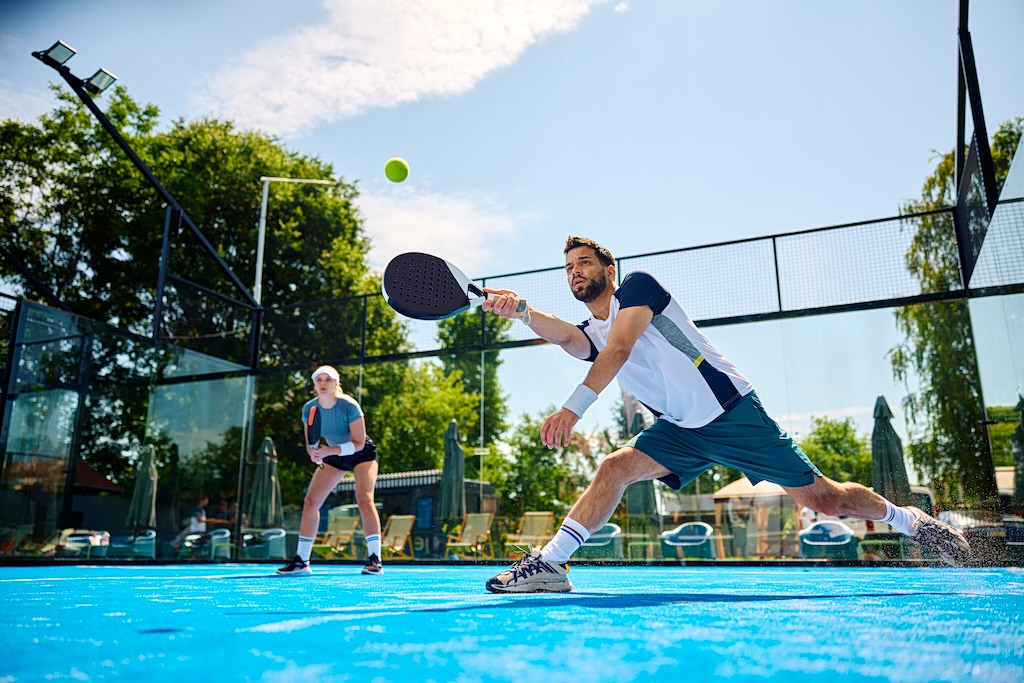
Instead of strings, padel rackets have holes in their dense heads. Padel balls share a color with tennis balls, but are less bouncy. The sport’s rectangular courts are 66-feet long by 33-feet wide, divided by a net and surrounded by four walls made of glass panels and mesh.
Pickleball
The solid, rectangular faces of pickleball paddles make them resemble pizza peels. Plastic pickleballs look similar to Wiffle balls, but with more holes. Courts can be set up on various surfaces, including driveways. They are 44-feet long and 20-feet wide, with 7-foot-long zones known as “the kitchen” near the net.
Tennis
Tennis rackets have large, round heads with firm, crisscrossing strings. Balls are about the size of a mature orange and the bounciest of the bunch. Courts can be constructed on hard and soft surfaces, from clay to grass, with dimensions measuring are 27-feet wide—or 36 feet for doubles—and 78-feet long.
Squash
Firmly strung in a gridded pattern, squash rackets have more of an ovular shape. Roughly the size of golf balls, squash balls are made of rubber, but have relatively little bounce. Four walls enclose the courts, including a 15-foot-tall front wall. Singles courts are 32-feet long, doubles are 45 feet and all have a wooden surface. undefined undefined undefined