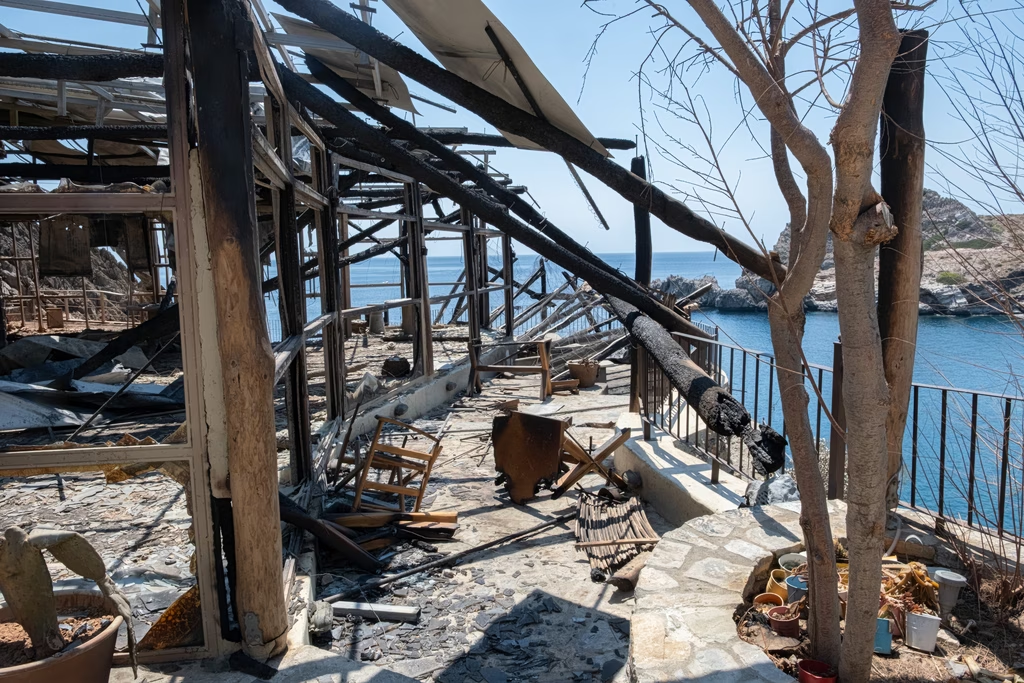
Every major wildfire has two dates, according to meteorologist Theodoros Kolydas. The first is the date seen in the news, when smoke rises, flames spread and communities come under threat. The second, and more important, lies years earlier, when forests are left unmanaged, fuel accumulates, forest roads deteriorate, firebreaks are not maintained and human activity expands into natural areas without proper planning.
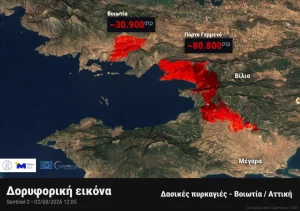
Writing about the recent wildfires in western Attica and the area stretching from southern Boeotia to Porto Germeno, Kolydas said the disasters are not simply isolated incidents but reveal deeper weaknesses in a model that has prioritized firefighting over prevention for decades.
“No matter how effective the Fire Service response is, no agency can easily confront a wildfire when the landscape itself has become a massive fuel reservoir,” he said.
Kolydas stressed that weather conditions, particularly strong winds, play a decisive role in wildfire behavior. Powerful winds can accelerate the spread of flames, carry embers hundreds of meters ahead of the main fire front and create new outbreaks.
However, he argued that winds do not create the underlying problem but expose how vulnerable unmanaged forest ecosystems have become.
Forest Management at the Center of Prevention
According to Kolydas, the key to reducing wildfire risks lies in continuous forest management.
“A healthy forest is not a forest left to chance,” he said, emphasizing the need for year-round measures such as clearing vegetation, reducing excessive plant growth, removing dead trees, maintaining forest roads, ensuring functional water supply points, applying controlled grazing where appropriate and carrying out constant monitoring.
These actions, he noted, cannot be carried out only a few weeks before summer begins but must be treated as a permanent responsibility throughout the year.
Kolydas also highlighted the challenges created by areas where forests and residential zones meet. Settlements located inside or next to pine forests require specialized planning, including safe evacuation routes, fire protection zones and strict vegetation management rules.
He argued that responsibility cannot be placed solely on citizens when, for decades, the state allowed or tolerated this type of development without creating the necessary infrastructure.
Prevention Over Suppression
Kolydas pointed to international experience, saying that countries that systematically invest in forest management significantly reduce the intensity and impact of major wildfires.
By contrast, when prevention declines and funding is directed mainly toward firefighting operations, wildfires become increasingly difficult and destructive to control.
“The real question is not how many aircraft took off when the fire started,” he said. “It is what happened from November to May. How many acres of forest were managed? How many forest roads remained truly operational?”
He added that summer wildfires are not only a test of civil protection systems but also a reflection of the forest policies implemented in previous months.
“If we want to limit future disasters, we must shift the focus from suppression to prevention and from reaction to continuous management of forest wealth,” Kolydas said.
“The battle against wildfires is won or lost long before the first flame appears.”
He concluded by noting that the August meltemi winds — seasonal northerly winds that have shaped Greece’s climate for thousands of years — will continue to occur naturally.
“However, we must change our actions and management policies, giving even greater weight to prevention,” he said. “Less firefighting after the fact, and more preparation beforehand.”