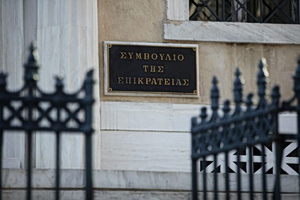
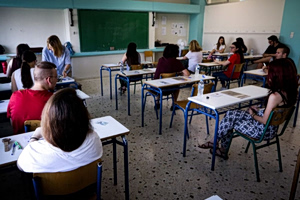
Until last year, Greek public school students exempted from Religious Education faced a familiar routine. They wandered empty school corridors, waited in courtyards or sat at the back of classrooms, using up what amounted to free time while classmates attended the mandatory course. That gap is now closing. Greek schools are introducing a new subject called Ethics, designed to turn that unused time into structured discussion about life, society and human relationships. The change follows several rulings by the Council of State, Greece’s highest administrative court.
A constitutional balancing act
The debate over the place of Religious Education in Greek schools is not new. Nearly two decades ago, there was a push to eliminate the course entirely. The Council of State ruled at the time that because the Greek constitution mandates religious instruction, the course could not be removed from the curriculum.
This year’s change offers, for the first time, an alternative to students who are exempt from religious classes. They now attend Ethics instead.
The new Ethics course is being taught initially by theology and humanities teachers. To prepare them for the material, the Ministry of Education is providing specialized training aimed at giving educators the tools to handle the course’s themes.
From women’s rights to artificial intelligence
Stelios Virvidakis, professor emeritus of philosophy at the National and Kapodistrian University of Athens and supervisor of the team that wrote the course material, described the new subject to TO BHMA as closer to philosophy than religion, though it carries a normative dimension.
“If one had to compare Ethics to an existing course, it would resemble philosophy classes layered with civic education, since it contains normative elements,” Virvidakis said. He added that the goal is to familiarize children with the concepts, theories and values people draw on when grappling with questions about society.
The curriculum ranges widely. It covers social problems such as poverty and hunger around the world, difficult questions such as euthanasia and the recognition of every child’s worth, and contemporary issues including bullying and the challenges posed by artificial intelligence. Long standing philosophical questions, such as the nature of justice, are introduced through accessible formats like fables or anecdotes rather than abstract theory.
Multiple faiths, no dogma
Although the Ethics course is not a substitute for religious education, it does allow for connections with religious traditions where relevant, according to Virvidakis. Textbooks for some grade levels include a unit called Ethics and Religions, which introduces students to a range of faiths with the aim of helping them accept people of different beliefs.
“The book does not oppose any religion, nor does it seek to promote atheism,” Virvidakis said. “It recognizes that our society is multicultural and that all citizens can coexist and contribute to the common good by embracing values that guide everyday life. Under no circumstances is the course meant to become politicized.”
Content adjusted by age
Course material is tailored by age, beginning in third grade and running through the final year of high school, with content calibrated to what students can process at each stage. More sensitive subjects are introduced only in the later years. Abortion, for example, is absent from the elementary school curriculum entirely and enters the material starting in the third year of middle school (Gymnasio), continuing through high school, framed in a way that recognizes women’s rights.
How the course will be graded
Ethics will be assessed the same way Religious Education is. Stavros Karageorgakis, who holds a doctorate in philosophy and one of the authors of the curriculum, told TO BHMA that students will receive a regular grade each term, but the course will not be included in the end of year exams.
Karageorgakis said he personally believes Ethics should eventually be taught to every student, not only those who are exempted from Religious Education, noting that the initiative has already been warmly received by educators. For now, though, he said, extending the course to the full student body would require a decision by the Ministry of Education. At present, Ethics has been introduced specifically as a way to make use of the time available to students who opt out of religious instruction.
Supporters argue the course is about more than filling a scheduling gap left by a long running legal and bureaucratic question. They say it goes to the heart of what modern education is meant to do: build critical thinking, encourage acceptance of different viewpoints and help shape engaged citizens.