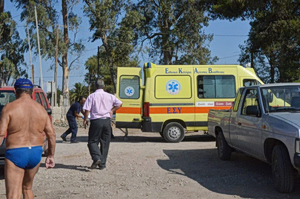
The drowning of a 4-year-old boy in a swimming pool at a beach bar in Paros has raised questions about pool safety and child supervision, while experts warn that drowning can happen quickly and often without obvious signs.
The 69-year-old owner of the beach bar, who was released after being detained, is also registered as a lifeguard. Authorities are investigating whether he held the required license and met the necessary conditions to work in that role, as well as whether he was at the scene when the incident occurred.
Investigators are also examining the circumstances under which the child became separated from his parents, approached the pool and ended up in the water.
Experts warn that drowning can be silent
Nikos Rigas, vice president of the Athens Police Officers’ Association, told MEGA that the parents and the owner of the bar had been detained in connection with the case but were released and will face a regular trial.
He stressed the importance of having a lifeguard, a defibrillator and first-aid equipment at facilities with swimming pools.
Rigas also noted that many lives are lost every year both at sea and in swimming pools, despite pools generally being considered more controlled environments.
Psychologist Vasilena Stavropoulou addressed the psychological burden of such a tragedy, emphasizing the importance of constant supervision of young children near water.
“There are very specific guidelines, even from the World Health Organization, regarding the supervision of children from zero to four years old,” she said. “Supervision near water is mandatory because a child cannot be responsible for themselves.”
Stavropoulou stressed that drowning is relatively quiet and can happen silently.
Forensic pathologist Dimitris Galenteris similarly explained that drownings involving children in swimming pools can occur without noise or obvious warning, while death can occur very quickly, particularly in fresh water.
“Drowning in fresh water is completely different from drowning in salt water,” he said. “Death occurs much more quickly. The pool is a particular environment and, if we are not careful, death can come very quickly.”
Calls for stronger pool safety measures
Panagiotis Paschalakis, president and founder of Safe Water Sports, described the death as a profound tragedy and highlighted the broader scale of drowning incidents in Greece.
“We essentially have 20 people over the past five years who have lost their lives in inland waters, such as swimming pools, lakes and rivers,” he said. “The number at sea is very large, at 370 people a year.”
Paschalakis emphasized that close supervision of young children is critical because drowning can happen extremely quickly.
For older children, he stressed the importance of swimming skills and referred to efforts to cooperate with Greece’s Education Ministry to promote swimming lessons in schools.
Questions over Greece’s pool regulations
Paschalakis also criticized the legal framework governing swimming pools outside hotels, describing it as outdated because it is based on legislation dating back to 1973.
By contrast, regulations for hotel swimming pools were modernized in 2020, making it mandatory for a qualified lifeguard to be present throughout the pool’s operating hours.
Rigas added that when a lifeguard is not present, a specific notice must be displayed and the pool must be fenced off to prevent access.
Stavropoulou stressed that responsibility for supervision ultimately lies with the parent or caregiver, particularly when young children are near water. The distance between the child and the supervising adult, she said, should always remain very small.