 Μake us preferred on Google
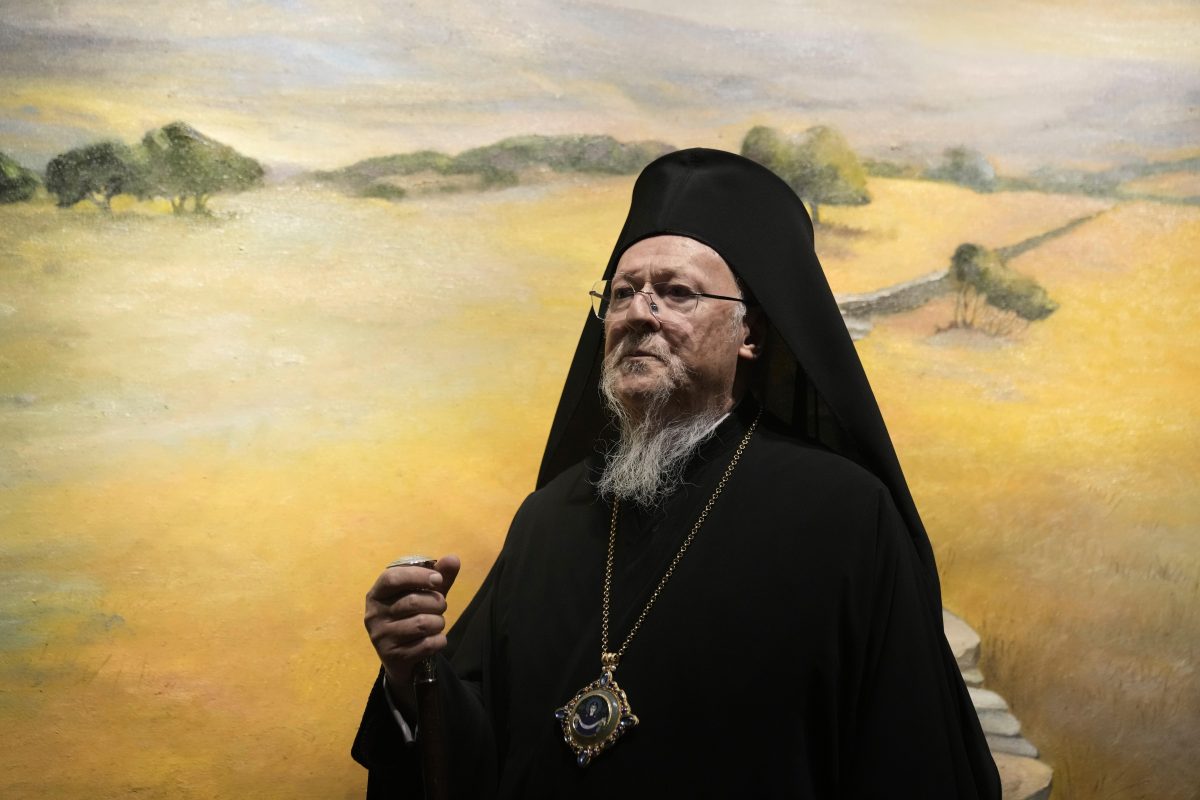
With 35 years as occupant of the first-ranking throne of the Eastern Orthodox Church, Ecumenical Patriarch Bartholomew is the longest serving primate in the 1,700-year history (counting from the First Ecumenical Council of Nicaea in 325) of the Church of Constantinople.
During his tenure, he has opened the patriarchate of Constantinople to the world and has met with countless religious and political leaders globally, including US presidents, always being received with high honors.
He has carried an anti-war message of peaceful reconciliation among peoples, bemoaned socio-economic inequality and, most emphatically, stressed the urgency of environmental protection to avert a global catastrophe. This has earned him among leaders and the international press the moniker of “Green Patriarch”.
Since the start of his ministry in 1991, Bartholomew has been dedicated to advancing through theological dialogue a stronger rapprochement between the Eastern Orthodox and Roman Catholic Churches. That dialogue began in earnest in 1980, but despite good will on both sides, it has not produced any substantial breakthroughs.
At 86, the patriarch appears intent upon pursuing a substantive step in the direction of complete communion with Rome (that despite good will on both sides would still certainly take decades), a step that would, if successful, define his historical legacy.
Bartholomew became intimately acquainted with the Catholic Church during his years in Rome, where in 1966 he completed his doctoral studies at Pontifical Oriental Institute, a historically Jesuit-run institution. His dissertation was on the codification of the Sacred Canons and canonical regulations in the Orthodox Church.
By all appearances, the Ecumenical Patriarch believes that the election of Pope Leo XIV opens new opportunities to step up the process of dialogue, as the pope has said boldly that he sees the “full visible communion” of the two Churches as an important goal, to be achieved through dialogue.
Bartholomew has taken palpable steps to externalise his desire to advance dialogue with greater determination. He attended the Funeral Mass for Pope Francis, with whom he had developed a close rapport, and the Inaugural Mass for Leo.
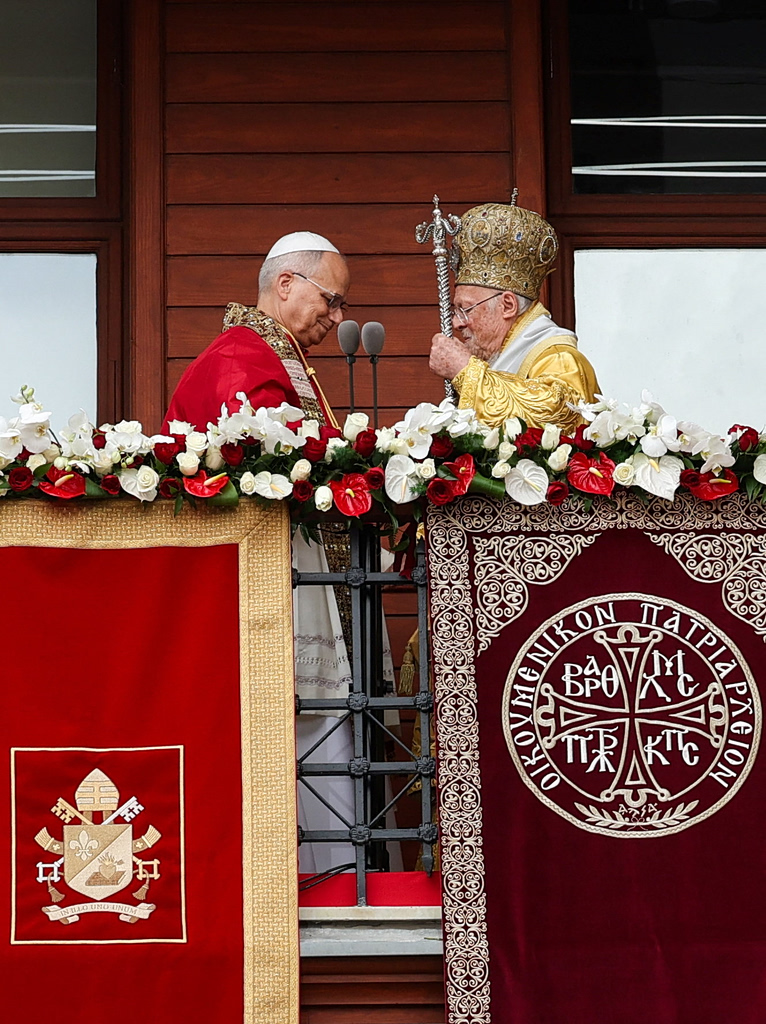
Pope Leo XIV and Ecumenical Patriarch Bartholomew I during an ecumenical blessing at the conclusion of a joint Christian prayer service, at the Patriarchal Church of St. George, during his first apostolic journey, in Istanbul, Turkey, November 30, 2025. REUTERS/Murad Sezer
‘Full visible communion of Churches’
Addressing a delegation of the Ecumenical Patriarchate on 28 June, 2025 at the Vatican, Leo stated: “As I think back with gratitude on the progress made thus far, I assure you of my desire to persevere in the effort to restore full visible communion between our Churches. The attainment of this goal can only come about, with God’s help, through a continued commitment to respectful listening and fraternal dialogue. For this reason, I am open to any suggestions that you may offer in this regard, always in consultation with my brother Bishops of the Catholic Church.”
Pope and Patriarch in Nicaea
The most visible of their common will was Leo’s decision to celebrate with Bartholomew (keeping a commitment made by his predecessor Pope Francis) the 1,700th anniversary of the First Ecumenical Council (when the entire Christian Church was united), held in the city of Nicaea (present-day Iznik, Turkey).
There, together they recited together the Nicene Creed – the Council of Nicaea finalised the first eight clauses and the last four were agreed to at the Second Ecumenical Council of Constantinople (381) – the dogmatic profession of faith that has guided the two Churches through the centuries. Leo has said that the common Creed must be the compass on the road to Christian unity.
Decades of dialogue, moderate progress
The explicit quest for Christian unity in substance emerged in the 20th century. A central dispute between East and West as far back as the Great Schism of 1054 has been the nature and content of papal primacy. The Eastern Orthodox Church has always accepted that the pope is the first-ranking bishop in Christianity, but has rejected the fundamental principle of Catholicism that he is entitled, as a successor of the Apostle Peter, to exercise his authority over the entire, universal Christian Church.
Orthodox discussion of papal primacy
Papal primacy and its content was the core subject at the 27th International Congress of the Society for the Law of the Eastern Churches, held in Budapest and entitled The Bishop of Rome: Future Horizons from Ancient Traditions for Catholics and Orthodox.
There, in a major address delivered on 4 September, Bartholomew articulated the Eastern Orthodox interpretation of papal primacy, which harkens back to the ecclesiastical structure of a united Christendom: “A primacy of loving service, exercised within, and never above, the communion of sister Churches.”
He stated that Rome’s primacy is “inseparably linked to the ancient institution of the Pentarchy of the patriarchs, within which the Pope of Rome was recognized as “first among equals” — primus inter pares — precisely as the “Patriarch of the West.”
For the Orthodox, this is a primacy of honor.
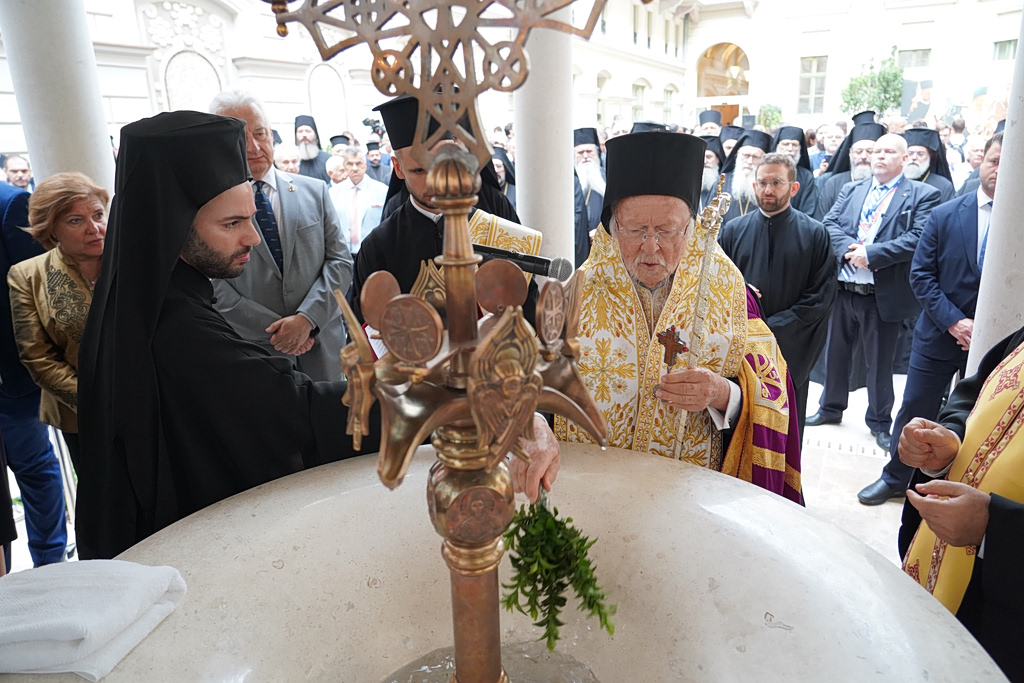
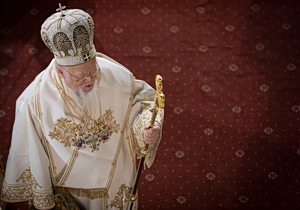
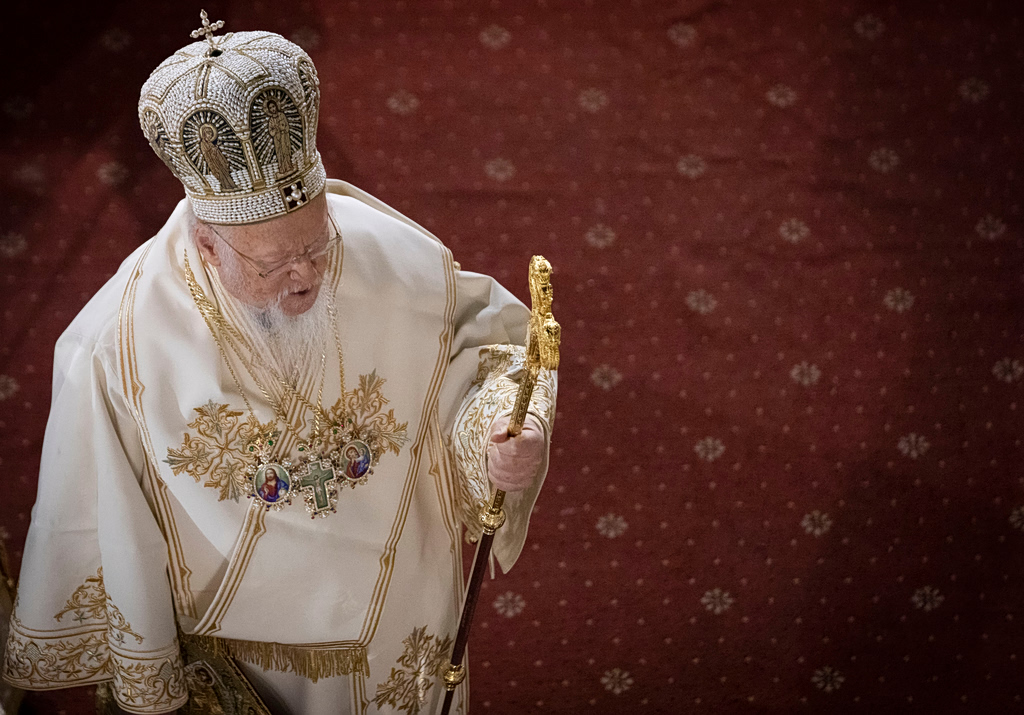
Ecumenical Patriarch Bartholomew officiates at the opening of the Church of The Three Hierarchs in Budapest, where he delivered a major address on the revival of the Pentarchy in the Christian Church, September 5, 2026. Photo credit: Nicholas Papachristou
Proposed visible revival of the ‘Pentarchy’
Bartholomew argued, in this framework, that a formal, explicit revival of the pentarchy – the terms of which Rome and the remaining four Eastern Churches of the pentarchy would have to reconfirm – could contribute significantly to the goal of Christian unity.
The push toward and the terms of that unity, however, are not accepted by most of the autocephalous (self-governing) Orthodox Churches. It is indicative that the issue of the pentarchy was not even on the agenda of the Holy and Great Council of the Orthodox Church in Crete (2016).
Pope as ‘Patriarch of the West’
In a gesture of good will that indirectly harkens back to the pentarchy, Pope Francis in 2024 restored one of the historical titles of the pope (that had been removed by his predecessor, Benedict XVI in 2006) – Patriarch of the West. Although this was welcomed by the Ecumenical Patriarchate, it in no way altered the core of the Vatican’s interpretation of primacy.
Francis described the pope as the one who “leads the Church of Rome [and] who presides in love over all the Churches”.
The notion of the pope “presiding in love” is how Ecumenical Patriarch Athenagoras framed papal primacy when he addressed Pope Paul VI – at the patriarchate in July, 1967 – as “Successor to Peter, the first in honor among us, the one presiding in love”.
The ‘Ratzinger formula’
Bartholomew’s recent emphasis on the pentarchy is very much in line with one of the preeminent theologians of the Catholic Church of the 20th century, Joseph Cardinal Ratzinger, later Pope Benedict XVI.
In what has become known as the “Ratzinger formula”, he wrote in 1976: “Rome must not require more from the East with respect to the doctrine of primacy than had been formulated and was lived in the first millennium.”
At the same time, he called upon the East to recognize the legitimacy and orthodoxy of the Western Church in its historical development, while the West would recognise the Eastern Church in its own tradition.
Theological fault lines
The central difference in the theological traditions is the understanding of the nature of the Holy Trinity. The Orthodox stick to the Nicene-Constantinopolitan Creed’s formulation that the Holy Spirit descends only from the Father, while the Catholics in 1014 incorporated in their Mass the word filioque (first encountered in 8th century Spain), that it descends from the Father and the Son.
Though the dispute might baffle the layman, the issue is theologically important because it concerns the inter-relation of the three persons of the Trinity, and effectively defines who God is eternally. Over the centuries, all Orthodox Churches have viewed this departure from the original Creed as a heretical teaching.
Although over the last decades popes – John Paul II, Benedict XVI, Francis and Leo (at Nicaea) – have at times recited the Creed without the word filioque, the Catholic theological teaching remains unchanged.
The conundrum of papal primacy
The content of papal primacy in the first millennium of Christianity and how it was exercised is not prima facie obvious. The Orthodox have historically viewed it as a primacy of honor, first among equals, without authority to intervene administratively or otherwise in the affairs of other Christian Churches.
The Catholics view it as authority over the entire universal Christian Church.
Another key issue that divides the Churches is the Catholic dogma (formally defined quite late, in 1870) that when the pope speaks ex cathedra (in his official pontifical capacity) he is infallible.
The Orthodox position is that this completely undermines the fundamental ecclesiastical concept of synodality (collective decision-making) and establishes a universal ecclesiastical imperium.
The patriarch’s speech
In his address in Budapest, Bartholomew argued essentially that the heritage of the Church Fathers of both the Orthodox and the Catholics is the natural point of convergence between the two Churches and their future dialogue. In this regard, the administrative structure of the first millennium can be a point of departure in the quest for a unified, universal Christian Church.
This communio patriarcharum (communion of the patriarchs), he noted, and Constantinople’s place in it, constitute the Ecumenical Patriarchate’s canonical inheritance.
Primacy of patriarchs in their jurisdiction
A formal modern revival of the pentarchy would reaffirm the hierarchical structure of the unified Church, with Constantinople (the capital of the Eastern Roman Empire, or “second Rome”) directly following Rome, whose primacy remains undisputed. Third, fourth and fifth in the hierarchy are the “ancient and venerable” Eastern patriarchates of Alexandria, Antioch and Jerusalem.
An important parameter of the ancient structure of the Christian Church that Bartholomew underlined is that each of the Eastern patriarchs enjoyed primacy within their own ecclesiastical jurisdiction, while remaining united with Rome “in the one faith and at the one Eucharistic chalice”.
That effectively means that Rome’s hierarchical primacy is not an administrative one in Orthodox patriarchal jurisdictions.
Pentarchy as a lyre: The music of full communion
Bartholomew waxed lyrical about the institutional importance and interconnectedness of the pentarchy, evoking the five chords of the ancient Greek lyre (mentioned in Homer), as we now know it can produce harmony.
“We await, by the grace and help of God, the restoration of full communion with the Church of Rome within the one Body of the One, Holy, Catholic, and Apostolic Church (articulated in the Creed), so that the Pentarchy may once again become complete and the ‘five-stringed lyre’ of the universal Church may resound anew with the fullness of its ancient harmony.”
Meeting of all four patriarchs of the East?
In this entire context, Bartholomew announced that he has issued an invitation to the patriarchs of Alexandria, Antioch and Jerusalem to meet with him at his seat at the Phanar on November 30, for the celebration of the (thronal) feast of Saint Andrew. Patriarchs of Constantinople are successors to the Apostle Andrew just as popes are successors to the Apostle Peter.
At this writing, none of the patriarchs have publicly accepted the formal invitation. Bartholomew has not yet announced an agenda for such a meeting, which presumably aims above all to symbolise and display Orthodox unity, at the highest level of the hierarchy at least.
The last time patriarchs convened for a synod at the Ecumenical Patriarchate was 15 years ago, in September, 2011. However, Patriarch Ignatios of Antioch did not attend, but instead sent a representative.
The current patriarch, John X, may well follow suit.
In this regard, it should be noted that the Patriarchate of Moscow – which along with the Kremlin has declared war against Bartholomew over his decision to recognise an Autocephalous Church of Ukraine in 2019 – has historically exercised strong influence over the Antioch patriarchate. It has been known to exercise some influence in the patriarchate of Jerusalem as well.
The risk is that if one or more patriarchs are absent, the message conveyed will be one of disunity.
The proposed synod in November would presumably touch on key issues of the last one, including the severe persecution of Christians in the Middle East, inter-confessional dialogue (with Catholics and Protestants) and inter-faith (with Judaism and Islam) dialogue.
Dialogue: An arduous road with meagre results
Athens University School of Law Professor Emeritus of Ecclesiastical Law Ioannis Konidaris, the foremost expert in the field, outlined for TO VIMA International certain central obstacles confronting the Orthodox-Catholic dialogue.
“Dialogue in general—whether inter-Orthodox, inter-confessional, inter-Christian, or interreligious—is seemingly endless. A characteristic example is the dialogue between the Orthodox and Roman Catholic Churches, which effectively began in 1960 and formally in 1980, and has now continued for several decades without tangible or concrete results,” he says.
“This is due among other things, to the fact that these dialogues take place between theologians, clergy, and laypeople who are constrained by rigid doctrinal positions. Consequently, it is entirely different from, for example, a dialogue between politicians, or one between jurists,” Konidaris underlines.
Complexity of many national Orthodox Churches
A key obstacle is the different structures of the two Churches.
Whereas the Catholic Church has a pyramidal structure in which the pope has overwhelming authority over all of Catholicism, Konidaris stresses that the Orthodox Church is structured with many local Churches – patriarchates and many national, self-governing Churches – that do not answer to the first-ranking Ecumenical Patriarchate.
“For definitive decisions to be taken on major theological or ecclesiastical issues, a consensus must first be forged,” the professor points out, adding that this has proved to be difficult. “This is because of the national basis on which these churches were built, mostly in the era of 19th century nationalism.”
This results in a core problem for ecclesiastical law. While the Catholics have codified their Canon Law for the entire Church (1917, revised in its current form1983), the Eastern Orthodox Church has yet to do so.
Eastern Orthodox Canon law is differentiated in the 15 autocephalous (self-governing) Churches, in accordance with the legal order of the states in which they function, Konidaris notes.
He underlines that after nearly half a century of dialogue, the Catholics and the Orthodox have been unable to agree even on celebrating Easter on the same day. Though this is largely a calendar issue (conflict between the Gregorian and Julian) that might have been resolved as such, many Orthodox faithful view it dogmatically as a theological issue.
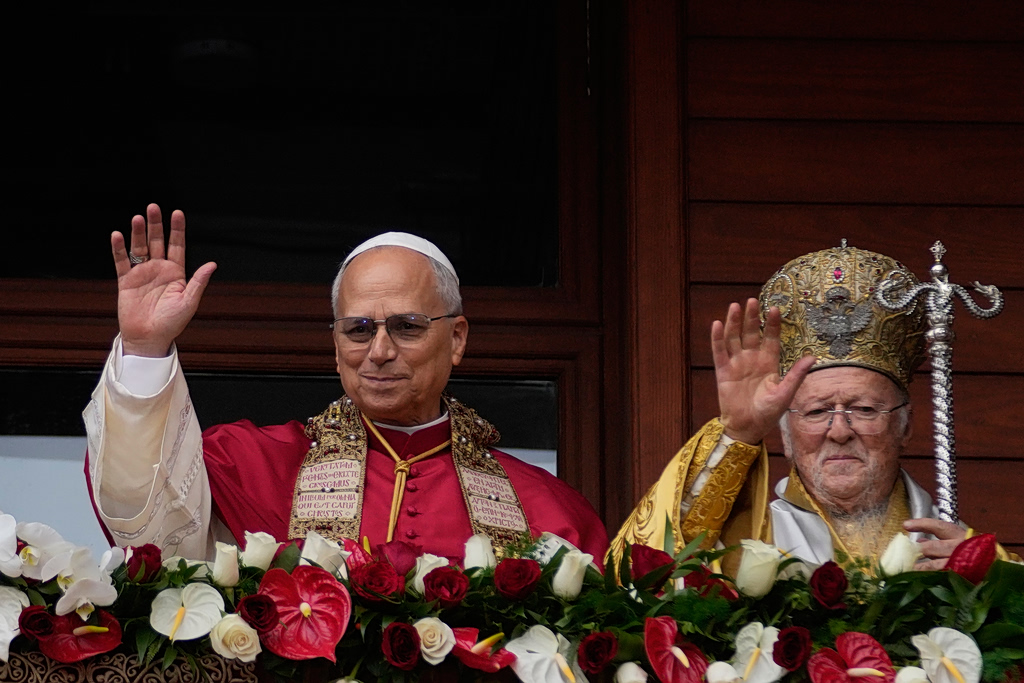
Pope Leo XIV and Ecumenical Patriarch Bartholomew I, the spiritual leader of the world’s Eastern Orthodox Christians, waves to the crowd after delivering a joint Ecumenical blessing at the Patriarchal Church of Saint George, in Istanbul, Turkey, Sunday, Nov. 30, 2025. (AP Photo/Khalil Hamra)
Ecumenism as ‘heresy’
The burdens of a past tumultuous history of Orthodox-Catholic relations still weigh heavily and define the perspective of many of the autonomous Orthodox Churches toward Catholic-Orthodox dialogue.
“There are Orthodox Churches that consider any contact with Roman Catholics to constitute heresy—the heresy of Ecumenism. This creates divisions within the Orthodox Church and is directed primarily against the Ecumenical Patriarchate and its helmsman, who consistently serve the cause of inter-Christian dialogue,” Konidaris says.
Though the pursuit of unity between the Churches was initiated and has been led by the Ecumenical Patriarchate, most Orthodox faithful have historically viewed the Catholic Church with suspicion and animosity for what they view as heretical teachings and historic sins.
Rejection of Ecumenism
That mindset has led to their strong aversion to Ecumenism – Constantinople’s active reaching out to other Christian confessions as well as to the Muslim and Jewish faiths.
This is grounded on major, divisive issues of the past, ranging from the Great Schism of 1054 to the much more important and traumatic Sacking of Constantinople, the centre of Eastern Orthodoxy, with the great crimes committed against fellow Christians during the Fourth Crusade of 1204, by Latin Catholic Crusaders who were ostensibly en route to recapture Jerusalem.
The regret of John Paul II
In a historic statement delivered in Athens before Archbishop Christodoulos on 4 May 2001, Pope John Paul II expressed deep regret for the Fourth Crusade’s Sack of Constantinople.
“I am thinking of the disastrous sack of the imperial city of Constantinople, which was for so long the bastion of Christianity in the East. It is tragic that the assailants, who had set out to secure free access for Christians to the Holy Land, turned against their own brothers in the faith. The fact that they were Latin Christians fills Catholics with deep regret,” he said.
“For the occasions past and present, when sons and daughters of the Catholic Church have sinned by action or omission against their Orthodox brothers and sisters, may the Lord grant us the forgiveness we beg of Him.”