A few days before our meeting, Dimitris Yeros spends hours working on old reels and cassettes. He is digitizing electronic music he composed in the early 1970s, back when he was simultaneously experimenting with painting, video, performance art, and anything else that sparked his curiosity.
Our conversation could easily have turned into a retrospective. His career certainly lends itself to one—from his status as one of the first Greek artists to experiment with performance and video art to his exhibitions abroad, and from the photographic series that have traveled to major museums to his encounters with figures including Gabriel García Márquez and Louise Bourgeois. Though he himself rarely dwells on any of that. Whenever the discussion veers toward such accolades, he deftly redirects it back to painting which, as he admits, has always been the fixed point that anchors his work. He does not seem to place much stock in the labels that frequently accompany artists, nor in the necessity of serving a single medium. To him, photography, video, and painting are not distinct identities; they are simply different ways of approaching the same idea.
Which may be why his final answer also serves as the most candid commentary on his entire career. When asked what it is that keeps drawing him back into the studio every day, he does not speak of prestige or recognition. “The hope I will create my best and greatest work,” is his reply. “In recent years, that hope has kept me going.” That phrase seems to explain better than any biography why, after more than fifty years of creative output, he continues to treat every new work as though it is the most important he’ll ever make.
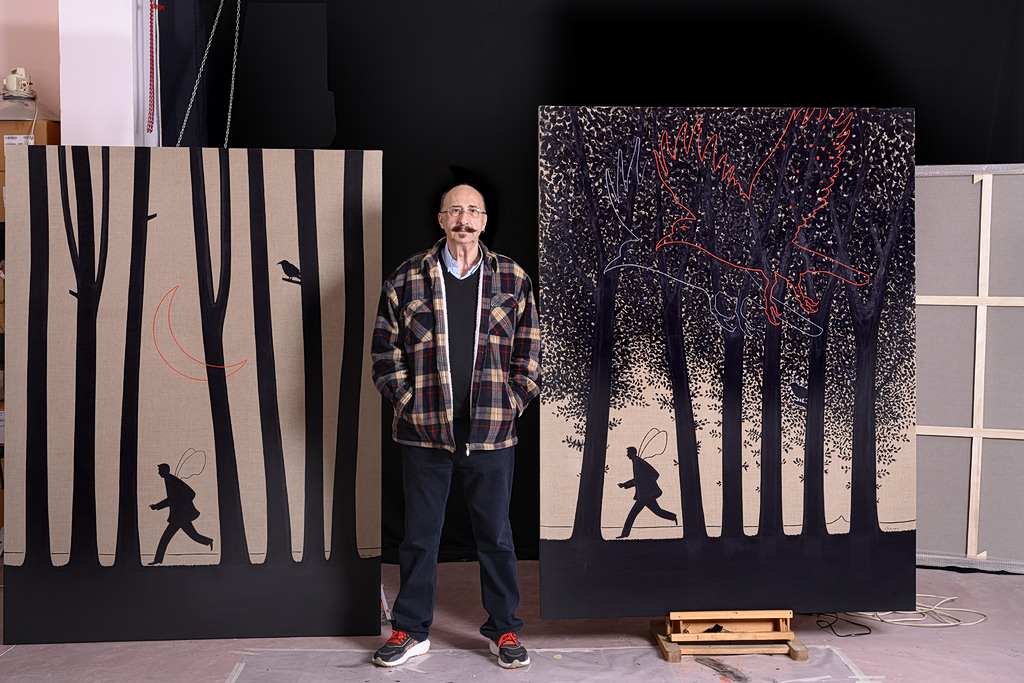
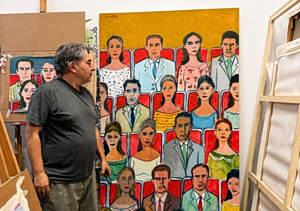
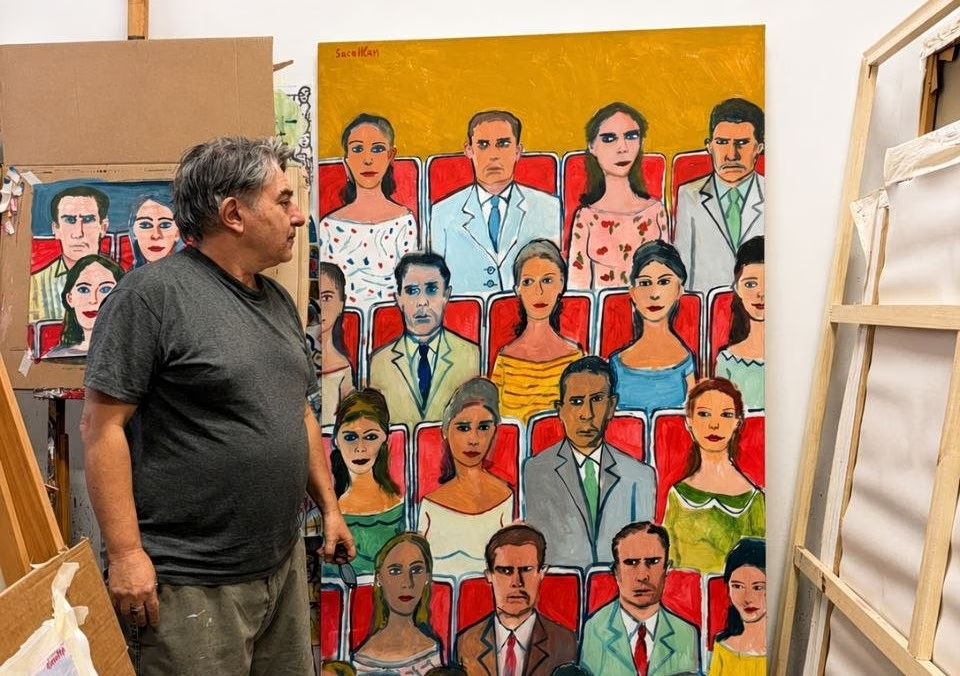
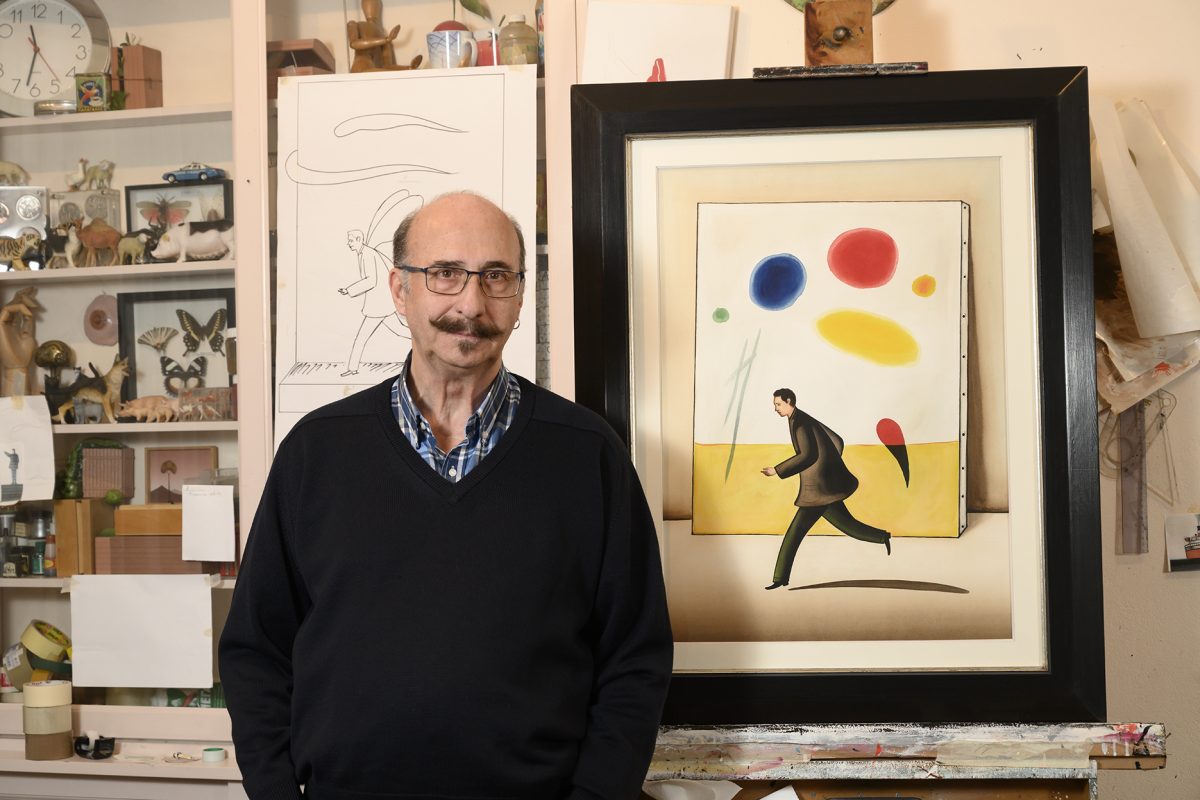
Dimitris Yeros in his atelier. PHOTO BY DIMITRIS YEROS
Your career has embraced painting, printmaking, photography, video, and performance art. Looking back at this journey today, what is the thread you feel connects these different forms of expression?
I am a painter first and foremost, and a photographer after that. But to return to your question, I think you forgot—or perhaps did not know about—the electronic music I have composed, which I had almost forgotten about myself and only recently rediscovered. Lately, I have been spending days on end listening to and digitizing old reels and cassettes containing my compositions, and I think they remain interesting. I wrote them between 1970 and 1980. I was, in fact, an avid member of the Hellenic Association for Contemporary Music, and I attended almost all their events. There were some outstanding musicians there under the leadership of Yiannis G. Papaioannou: Vassiliadis, Logothetis, Aperghis…
Look, I was quite young, I didn’t care about tomorrow, I lived for the moment and did whatever I liked and whatever amused me. I was always on the lookout for new outlets. I would play around, and have the best time doing it. I would lock myself in the studio for days creating things that were for me and nobody else. I wasn’t interested in their impact or reception. I happened to be making a bit of money from the visual arts, and that supported me. I also spent my days and nights at discos and clubs. I enjoyed countless nights of carefree abandon at Quinta, for instance. However, later on, in 1976 when I first went to New York and began working with the Gimpel & Weitzenhoffer gallery, and right after that with the Hubertus Schoeller gallery in Düsseldorf, I found myself with less time on my hands and had to dedicate myself more to painting. Which is how I came to drift away from the other stuff. I mean, there were years when I had three to five one-man shows in different cities. Then, in 1986, the Bochum Museum in Germany staged my first solo exhibition. Recently, I’ve also spent an inordinate amount of time searching for the video art I made between 1977 and 1983, which was scattered near-ruined around my studio. I had to digitize it, because it will be included in a major international exhibition on Video Pioneers which a European Museum will be staging in the near future. I think I’m the only Greek artist in it.
You’ve had five or six solo exhibitions in museums abroad and works of yours are held in several of their collections. But I don’t think I’ve seen your work in a museum in Greece.
That’s because none of my work is actually held by museums here. They might be waiting for me to call round cap in hand—who knows?. You see, Greek museum directors have their own unique style, their own idiosyncrasies. I won’t go into what those idiosyncrasies actually are. But I will share something that Heinz-Norbert Jocks, who has curated exhibitions of mine, said to me when he was in Greece a few days ago as a guest of Dakis Joannou. Having just visited the National Gallery, when we met he asked me if they had works of mine in their collection. When I told him they didn’t, he replied: “It’s to your credit that they don’t…” Just so you understand, the director of the National Gallery, an older woman and supposedly competent, doesn’t know the difference between a woodcut and a wood carving, and there’s published proof of her ignorance in a lengthy book she authored.
Did the time come when you felt that painting was no longer sufficient in itself to express what you wanted to say, so you turned to photography?
No, not at all. Painting is my passion. I cannot live without it. Of course, I don’t paint like a… house painter, every day to a schedule, and when I start painting I isolate myself and work at length. I might not leave my studio for months.
But you don’t stage exhibitions very often…
There was a time when I hadn’t had an exhibition in Athens for twenty years. I don’t do them often, because I wait to accumulate enough material to create a cohesive body of work. I’m not interested in selling everything I create, either. I paint for myself first; it’s only later that I consider which ones I’ll exhibit. And even when I do decide to exhibit a work, it doesn’t necessarily mean it’s for sale. In New York, I collaborated for many years with the John Stevenson Gallery on 23rd Street. He sold my photographs and was crazy about my painting. He only represented two painters: Mark Beard, who has also painted all the Abercrombie & Fitch stores, and myself. In fact, whenever I sent him works to set aside for a future exhibition, he’d sell them—on the excuse that he couldn’t say no to his collectors.
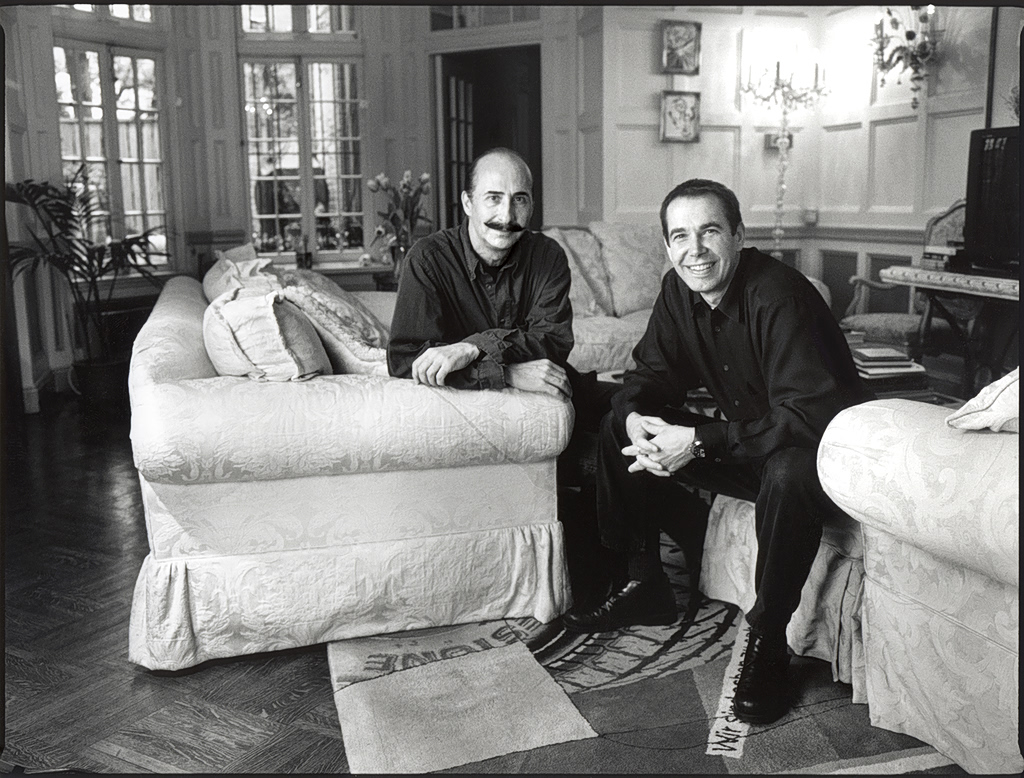
Dimitris Yeros, left, with Jeff Koons. PHOTO BY DIMITRIS YEROS
The male body is central to your photographic oeuvre, yet it never functions as a provocation or a bid for sensationalism. What does its persistent presence seek to achieve?
Talking about the photographic nudes featuring humans with animals, which are my best-known works of this type, I wanted to shed light on the relationship between the natural-innocent nudity of the animal, and the unnatural nudity of the human figure. Peter Weiermair, Louise Bourgeois and Jeff Koons are among those who have praised these photographs, which were published in book form in 2000. Edward Albee was also inspired to write a poem by one of my photographs, Another Narcissus, which we later included in a book. I should say that I started taking these specific photographs in 1988, on film, before the advent of digital cameras and their infinitude of cost-free conveniences. So many conveniences, in fact, covering so many levels, that it verges on the ridiculous… which is to say on the vulgar.
“Queer” is used ever more frequently as a term in public discourse and art history today. Do you feel it is applicable to your work, too, or is it a characterization applied in retrospect?
Not only is it not applicable to my work, it’s an insult to it. Nor could I ever have imagined my work being described in such terms. It is like putting José Domingo on the same billboard as Le.Pa (Lefteris Pantazis)! First of all, let me clarify that I have nothing against Le.Pa., or what’s called queer, or any other movement, term, collective, etc. There is a place for everyone and everything in society as a whole. It’s just that I live in my own society and am very happy here. And that I have so much to do, while also preparing for my… departure, which I hope will happen in the most painless way possible, that I’m not interested in other societies—which, as time goes by, seem increasingly anti-social to me. What’s more, I don’t concern myself with trivialities. I think it’s just a passing fad, unattractive and in poor taste. If someone isn’t much to look at, they pass by unnoticed. If they desperately need to be noticed, they invent things to draw attention to themselves… then complain that people are giving them dirty looks.
Still, I don’t think the term can be applied to any work—it’s entirely inadequate for the task, and certainly doesn’t describe the work of many of the serious artists of my acquaintance. It is also aesthetically displeasing. In my day, fifty plus years ago, I remember them using “queer” in America to describe certain low-class, self-outed fringe types who sought to provoke the public with their behavior then reveled in the backlash. Nowadays, they call them… faggots! Here, they used to call them something else. I remember a certain Werner in Eighties Athens who used to wear a skirt and sashay around Kato Patisia purely so people would jeer at him. The more they jeered, the happier he was!
But tell me this, if you will: why isn’t the term “straight photographer” used in the public discourse? And this: would they ever dare apply the label to Manos Hadjidakis or to Cavafy? Because they’d have cut them to shreds—Hadjidakis, in particular! Not to mention Alexander the Great, Hadrian, or the Borgias. So let’s stop lumping everyone together, shall we?. A few days ago, a great photographer and a friend for thirty-seven years, Duane Michals, died. One or two Greek publications, determined to impose the term on him, described him as a queer photographer. I’m certain he’d be furious if he found out. He was singularly dignified, an extremely erudite gentleman with a fantastic sense of humor, active and creative until the very last. He was married to Frederick Gorrée, probably for practical reasons, whom he never called “my husband”, and who cared for him with great devotion until he died of Alzheimer’s. Duane never referred to his sexual side—not once. And he was annoyed with another friend of mine (I once introduced the two), the great writer Edmund White, who has taken to describing his sexual exploits in recent books. He found them cheap, vulgar, and ridiculous, capable of eliciting nothing more than a “Why do we care?”. Edward Albee, another dear friend, had the same reaction to this “queer”… movement, as did Gore Vidal.
The series “Shades of Love,” inspired by the poetry of Constantine Cavafy, stands as a unique dialogue between image and word. How did this need to converse photographically with Cavafy come about?
One day, a publisher friend asked me if I would like to illustrate some of Cavafy’s poems with paintings. I thought about it and concluded that I could do it better with photographs. Besides, apart from having young models available for Cavafy’s erotic poems, I also had many acquaintances, outstanding men and women of letters and the Arts, whose lives or work had some link to the poems’ protagonists. So, for example, I asked the sculptor Armand Fernandez to pose for the “Sculptor of Tyana”, the painter Tom Wesselmann for “Artificial Flowers”, the award-winning poet Richard Howard, who has his entire bathroom wallpapered with photographs of the famous dead, for the poem “Voices”, Olympia Dukakis for the poem “Supplication,” and so forth.
When you were working on the series, were you guided by specific poems or more by the atmosphere and the world Cavafy constructs through his poetry?
I was guided by the poems, and the verses I could make into images that worked in their own right.
You got the chance to photograph Gabriel García Márquez. And your acquaintance with Louise Bourgeois brought you face to face with one of the most important figures in contemporary art. What’s the main thing you’ve kept from those encounters?
I am often asked about my relationship with Márquez and Bourgeois, because they are leading figures in their fields, and that sells. It was an honor to know them and spend time with them for so many years. And I have to say that both opened their doors to me because they knew and appreciated my work. I met Márquez when I photographed him for the poem Ithaca. When we went out into the garden for the shoot and because he was stiff—strangely, he was very shy—, I reminded him that I was not a paparazzo but his friend and asked him to relax. In reply, he said, “I know very well who you are, Dimitris, I have your ‘x-ray’ and your magical realism on my desk.” for her part, Bourgeois dedicated her first photograph to me with the phrase “Avec Antmiration”. My photographs of Márquez were published many years ago. I also have a book ready with Bourgeois and am looking for a publisher.
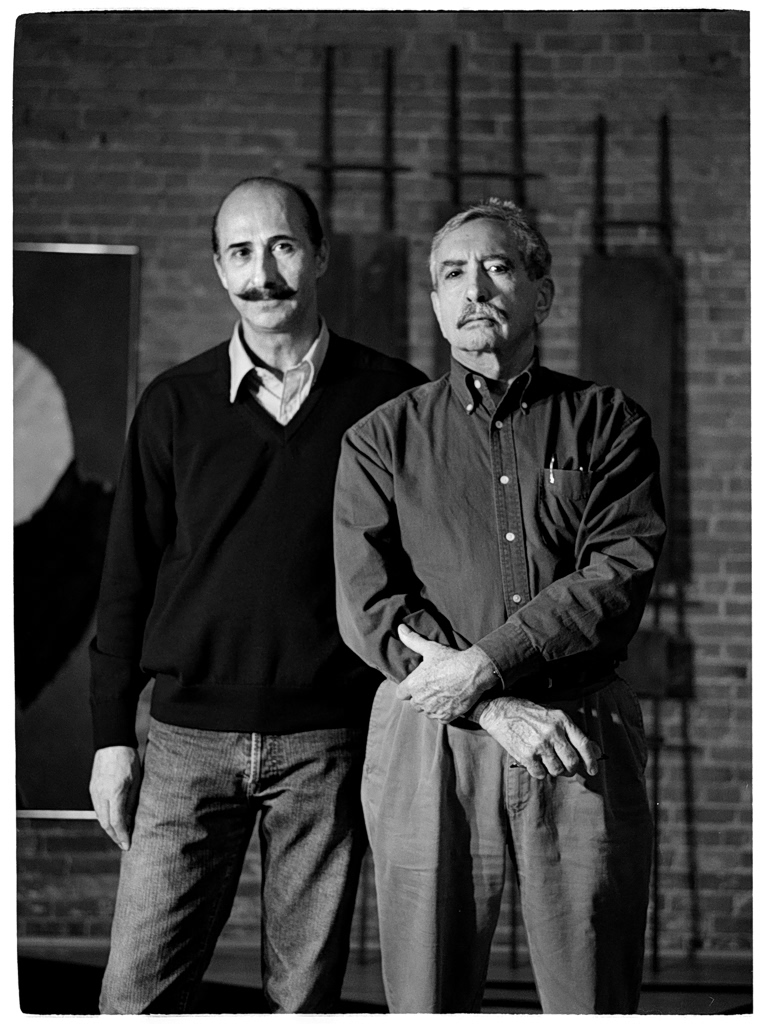
Pulitzer prize winning author Edward Albee, right, with painter Dimitris Yeros. PHOTO BY DIMITRIS YEROS
In your documentary Ovil and Usman, about two homosexual Muslim refugees on Mytilene, the viewer feels they are watching two human stories more than a political commentary. Was this your intention from the start?
Yes it was, but along the way I tried—and, I think, managed—to present through their story the entire migration drama, which I experienced from the first boat that washed up on Lesbos through to the destruction of the Moria camp. It was shown at a few festivals, but most didn’t know which category to put it in: gay or straight. Madness…
How hard is it to win the trust of people who have experienced fear, persecution, and social exclusion, without the camera acting as an obstacle between you?
It wasn’t difficult at all. In fact, a lot of people would come up to me and beg to be photographed and recorded. They had seen me in the camp and I’d become a familiar figure. My house was quite close by, and I’d also bump into residents on their walks. I’d made friends with many and would often help them with information and advice regarding lawyers and doctors. The only wretched individuals I met—and they were truly wretched—were the members of the NGOs. In fact, I wrote the first article condemning them, in a major Sunday newspaper, and its impact has still to die down.
Do you believe it has become more difficult to create an image that sticks in the viewer’s memory?
Really? Don’t you see? Nothing sticks anymore. And people—and younger generations, in particular—have very little in the way of memory left. It’s shrunk to nothing as they concern themselves with increasingly trivial things—chiefly themselves and their five minutes of self-promotion in social media. You can no longer have a conversation with young people under 30. I’m speaking about the majority, of course, though it’s the same uneducated, mindless majority that votes for us and puts governments in power…
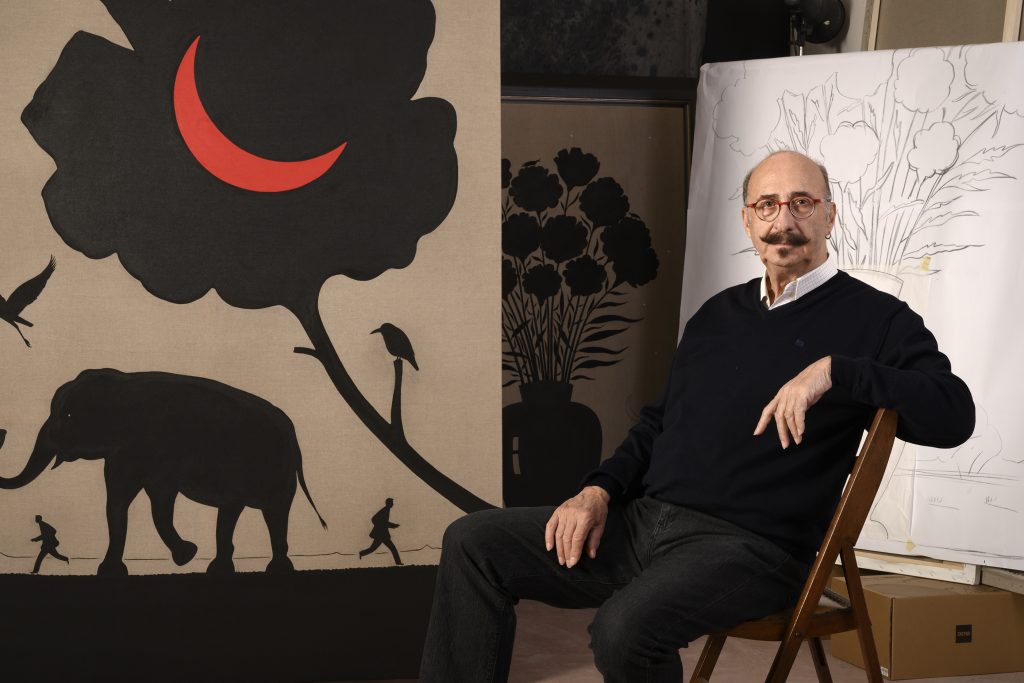
Dimitris Yeros in his atelier. PHOTO BY DIMITRIS YEROS
Is there a specific work or idea that you’ve had in your head for years, but have still to realize?
There are a whole lot of works and a good many ideas in there. In fact, about forty-five years ago, I published my ideas for works which I could never hope to realize, given their scale and cost, in an artsy magazine. Today, with so many showy, vain sponsors around, I see enormous visual art productions being made—most of them, I think, simply for show, and many without the knowledge of their creators.
To bring this interview to a close, could I ask what it is that keeps you coming back into the studio every day to create?
The hope that I will create my best and greatest work. In recent years, that hope that has kept me going. And that’s no small thing…