 Μake us preferred on Google
 At the center of the criticism is the cover of the magazine, which depicts a settler who mockingly records a young Palestinian woman with his mobile phone. The title accompanying the issue even bears the title “L’ Abuso”, which led to the intervention of the Israeli ambassador in Rome, Jonathan Peled, who spoke of “manipulation” and accused the historical publication of distorting reality and reproducing anti-Semitic stereotypes.
TO BHMA spoke with Italian photographer Pietro Masturzo, who took the controversial image, about the conditions under which the report was made, the criticism of anti-Semitism and the prevailing climate in Israel, in the wake of the successive, bloody conflicts in which the country is involved.
View this post on Instagram
What were the circumstances under which the photographs were taken and the report was made?
Together with other colleagues – Palestinian photographers from international agencies and a New York Times delegation – we were at a festive event for the first day of the olive harvest. Local Palestinian authorities and pro-Palestinian activists were also present at the same location. Suddenly, a group of settlers, accompanied by IDF soldiers, invaded the field with the aim of harassing the attendees and interrupting an activity that had been taking place completely peacefully until that time. It was in this context that the photograph was taken, which depicts the harassment of a settler in military uniform towards a Palestinian woman who was participating in the entire event.
Based on the photograph, the Israeli embassy in Italy spoke of the reproduction of stereotypes and anti-Semitism. What is your response to this accusation?
I received a series of similar comments on Instagram, where I posted the cover photo, which focused on the mocking smile of the settler, in contrast to the expression of the Palestinian woman. I expected such reactions, however, especially from the Israeli authorities. Talking about anti-Semitism when criminal practices of specific governments are highlighted, and not of course of Jews or Israeli citizens as a whole, is a familiar demonization tactic. And their irritation is greater, precisely because the L’Espresso report and the photo on the cover had an impact, they brought back the discussion about reality, about the miserable situation that prevails in the West Bank.
View this post on Instagram
What is your impression of the climate that prevails in Israeli society and the Palestinians respectively?
As for the prevailing climate, the majority of society supports the Netanyahu government and its extremes. Of course, there are many opposition activists who demonstrate and try to protect local Palestinian communities, their help in doing my job is invaluable. But the majority of society has internalized a logic of a chosen nation under constant defense, has been exposed to this anti-Palestinian rhetoric since school age, and the trauma of October 7 [ed. 07/10/2023 was the day the deadly Hamas attacks took place] reinforced this perception. What is being said by Netanyahu himself and his most extreme ministers such as Smodric and Ben Gvir that the West Bank should be annexed responds to the general sentiment and at the same time certainly intensifies it.
As for the Palestinians, I have not been to Gaza since 2021, so I have been hearing indirect information that Hamas is more popular than it was before the Israeli invasion, due to its ability to capitalize on the cause of resistance to the occupation. In the West Bank, however, the climate is not in favor of Hamas, I have not seen any flags of the organization, nor people discussing it in a positive way. People are tired of the constant war and the occupation, but there is in no way any current of support for it.
Journalists and photographers who are on the battlefield are literally risking their lives. How do you manage the fear factor?
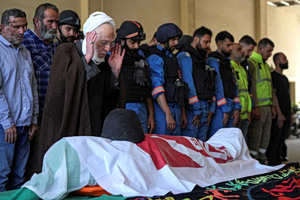
The issue is not the fear that each individual rightly has. Yes, journalists, especially Palestinian journalists, face a great risk, some colleagues have even gone so far as to say, self-mockingly, that wearing a press vest serves more as a target than as a cover.
I have been working in the Palestinian territories, Gaza and the West Bank since 2010, and the situation is constantly worsening. Especially in the West Bank, settler attacks are escalating in quantity and quality, becoming more and more violent, on a daily basis.
But there are also positive developments. We can and are here thanks to a solidarity initiative that we organized with colleagues from the Prospekt photo agency with which I work, with the aim of supporting Palestinian photographers working under great pressure in the field. Our access to the West Bank has become difficult due to costs. We are now organizing a new mission to the West Bank, with the support of the Israeli photojournalist community ActiveStills, who are doing excellent work.
View this post on Instagram