
 Μake us preferred on Google
 Late fees, shelves that must be restocked, rude customers, self-proclaimed experts in Kurosawa’s filmography, blockbuster hits that drive revenue—and damaged tapes returned after careless use. All paid for in cash, no cards accepted.
These scenes come alive in one of the most talked-about video games of 2026, Retro Rewind. Set in a deliberately low-resolution environment—at a time when most developers are racing toward hyper-realistic graphics—the game puts you in the shoes of a 1990s video rental store owner.
Its success, however, is no surprise. In recent years, a clear shift from the digital to the analog world has emerged. Nostalgia, combined with a growing desire to escape an increasingly complex reality, is proving powerful. Even the sound of a DVD sliding into a player now feels oddly comforting. While DVDs are technically digital, they are considered outdated in an era dominated by streaming platforms like Netflix. They are tangible—you can feel their weight, store them in cases, and admire the artwork on their covers.
The power of human connection
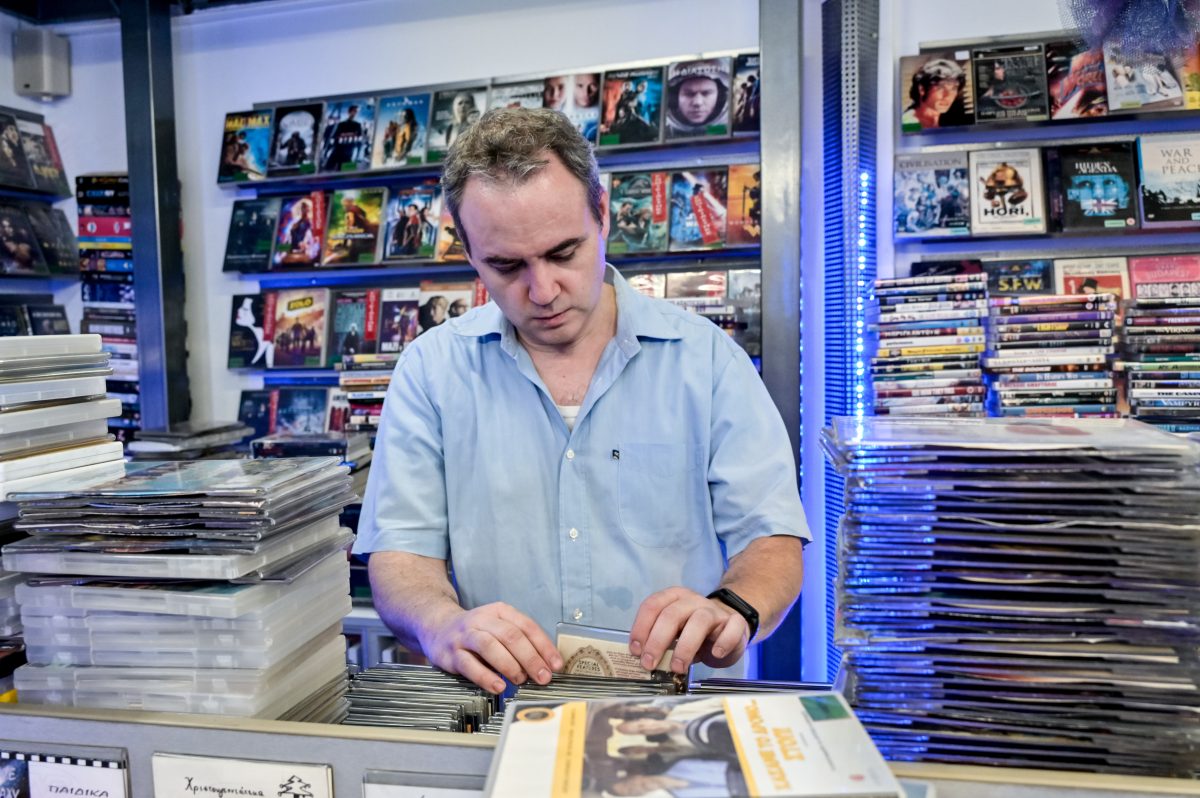
Lefteris Tzortzis, owner of the Movie Galaxy video rental store in Exarcheia—a central Athens neighborhood known for its strong artistic and student community—has been living the Retro Rewind experience in real life since 2006.
He continues to defend what now feels like a rare, authentic ritual: watching a film recommended by an expert. In this case, the expert is the store owner himself, whose knowledge builds a relationship of trust with customers.
“Here, there is human contact and social interaction. People need that. You can’t talk to a platform,” he tells TO BHMA.
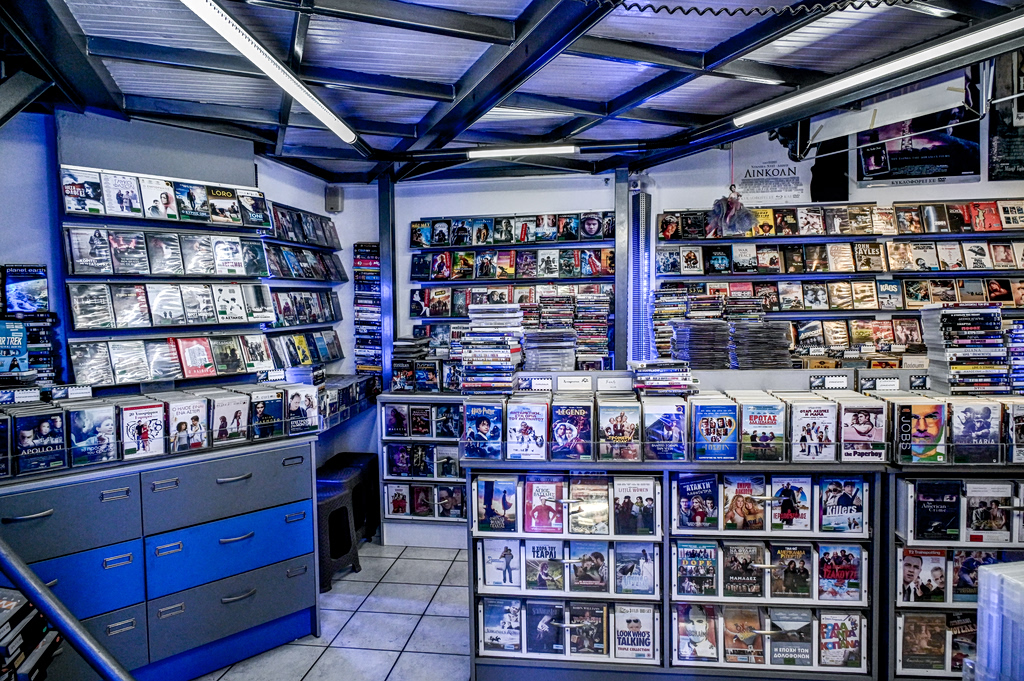
The interior of Movie Galaxy video rental store.
With more than 50,000 titles, Tzortzis has witnessed both the golden age of video rental stores and their decline during Greece’s economic crisis, when shops shut down one after another. Piracy, the rise of streaming platforms, and the COVID-19 pandemic also dealt heavy blows.
Today, his store is one of the few still operating in Greece. “The area helped me—there’s a strong artistic scene and people care about films. There are also many students. I get new registrations all the time. People are tired of all this information. Many tell me they spend an hour browsing platforms and end up watching nothing,” he says.
The comfort of the past
Digital fatigue is becoming increasingly evident, especially among younger people who grew up almost entirely immersed in new technologies. For them, the past holds a particular allure.
Angelos Kyrousis, who spent 17 years working in a record store and now operates online, points to a clear resurgence in vinyl records.
“In Greece, the first strong signs of vinyl’s revival appeared around 2019,” he says. “But it’s a global phenomenon. The new audience is mainly women. Many people, according to studies I’ve seen, buy records without even owning a turntable. They buy them because they’re popular, fashionable, or simply intriguing. There’s a tactile element—they hold them. It excites them more than a digital platform.”
Rising demand, however, has driven up prices. “If this continues, vinyl will become a luxury,” Kyrousis warns. In Greece, the most popular genres remain pop and rock—the “classic catalog,” as he puts it—meaning bands like The Beatles and Led Zeppelin dominate. “The security of the past will always have stronger commercial appeal.”
Inside the darkroom
Our lives are now captured through the lenses of ultra-modern smartphones, often rivaling professional equipment. Yet, these devices lack something older analog cameras still offer—especially to younger generations: anticipation.
Was the shot good or not? To find out, you must step into a photography studio’s darkroom.
Generation Z—those born between 1997 and 2012—feels nostalgic for a past they never lived. They carry film rolls, prefer prints over instant edits, and embrace the slower process.
As Stratos Neslechanidis, owner of a specialized photography store in Omonia (central Athens), explains: “People are fed up with screens. The rise of film is real.”
Since opening his shop in 2003, he has witnessed three distinct phases: the decline of film, the rise of digital, and now the return of analog. “There’s nostalgia for the old. Film is relatively expensive, considering everyone can take photos on their phone. But at the same time, it has a romantic quality. That’s what the new generation is looking for.”
Initially, about five years ago, he and others in the industry thought it was just a passing trend. “There was a serious shortage, and we were all searching for film. Gradually, major companies started investing in this sector, and we realized we had to take it seriously.”
Today, in 2026, his shop is frequented by people aged 18 to 25, trying to bridge past and present through vintage aesthetics. “Many ask me to digitize their film photos so they can upload them to Instagram. It helps—and it’s true,” he says.
In a world dominated by speed and endless choice, the slow, tangible, and imperfect nature of analog life is no longer outdated—it’s becoming desirable again.