 Μake us preferred on Google
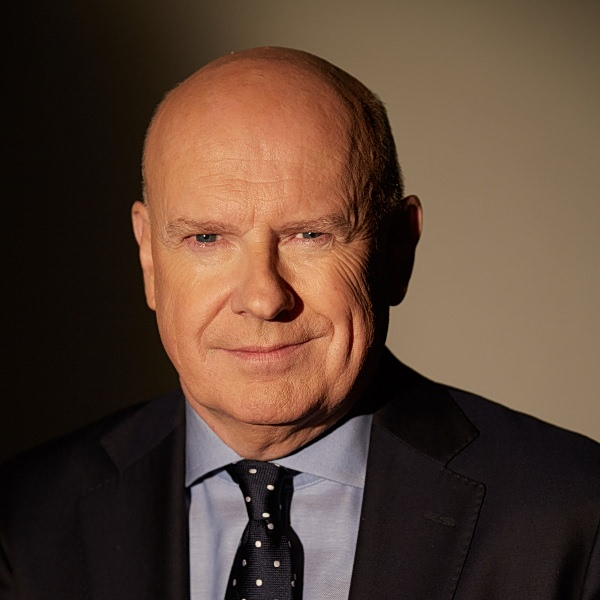
 In this interview, Gerard Baker, Editor at Large of The Wall Street Journal, reflects on the growing instability in global politics. Arguing that NATO is dead in the water, Baker also examines the U.S. strategy toward Iran, suggesting it was poorly planned and executed and seems to be failing. Ultimately, he highlights a growing desire among Americans for stability, normalcy, and a reduction in political turbulence.
You stated in a recent podcast that NATO was already ‘dead in the water.’ Do you think recent developments confirm that assessment?
NATO was dead—poisoned, shot and drowned like Rasputin. That’s what Trump did: he stabbed or poisoned NATO. He’s now proceeding to drown it in the Atlantic Ocean.
Given what’s happening now with Iran and the wider Middle East, do you think there’s a clear logic behind current developments?
I think the logic behind what the United States was trying to do in Iran was perfectly reasonable. I mean, the United States has been under attack from Iran, directly and indirectly, for 47 years.
The Iranian Revolution in ‘79 was literally born in a fit of anti-American rage. Since then, Iran has been not only a rhetorical enemy, but also an actual enemy, of the United States. Many, many Americans have died at the hands of Iranian or Iranian-backed terrorists.
What’s more, we still strongly believe they are developing a nuclear capability. That would be a nightmare, a disaster for the region. Of course, Netanyahu also played a role, as we know. He was important. But Trump doesn’t really do what other people tell him to do—he’s very much his own man. And I think he was helped by many—Netanyahu among them—to believe that this was the right thing to do. I think the problem with what we have now in Iran is that it wasn’t properly planned; they didn’t really know what they were trying to do. I think Trump really believed that a massive bombing campaign that took out the Ayatollah would lead to the collapse of the regime. And I think Netanyahu played a crucial role in persuading him of that.
Unfortunately, the U.S. never really matched the resources to the task. Nor did they think through the consequences of what would happen if they struck Iran—how Iran would respond, and what could be done to stop the closure of the Strait of Hormuz.
So, it was badly conceived, badly planned and now badly executed. I think that’s why the United States is in the mess it’s in right now.
You recently wrote about the idea of ‘normalcy’ and argued that neither Donald Trump nor Joe Biden has been able to deliver it. What do you mean by ‘normalcy,’ and why do you think it has been so difficult to achieve?
This is a very turbulent period in American politics, and it has been that way for the last 20 years or so. I think the 21st century has been more challenging than a lot of people thought it would be. We’ve had a major financial crisis. We’ve had wars that the United States has not really won. Then, you know, we had the COVID crisis. And this period of abnormality in American life has been destabilizing. As a result, I think there’s a hunger among Americans for a period of calm, a period of normality with less turbulence.
In 2020, I think Americans just wanted a period almost boring ordinariness, without this drama/melodrama continually playing out. And so they voted for Joe Biden, who looked like the most boring and ordinary person—someone who’d been around in politics for 50 years, and not for Donald Trump.
What happened then was that, instead of presiding over a period of boring normality, Biden proceeded to interpret his election victory as a vote for a kind of revolution, for a political revolution. So, we got an open-border immigration policy and this radical progressive ideology on things like sexual identity and gender.
We had a massive spending program, a huge expansion in government spending and a huge expansion of the deficit, because Biden interpreted that victory as an opportunity, as a mandate, for revolution. But that wasn’t what the people had voted for.
We had this crazy woke ideological revolution. And to cap it all off, Biden was getting increasingly senile and incapable as his term neared its end. And people were like, “God, that’s not what I voted for. I wanted normality!” Come 2024, then, despite all his own personal eccentricities, Trump represented a kind of normality. But when Trump comes in, he interprets his victory as a mandate to do all the crazy things he’s been doing—whether that be starting foreign wars, alienating our allies by claiming he’s going to invade Greenland, or pursuing his incredibly ruinous lawfare agenda domestically. Needless to say, his approval ratings are now in the basement.
So, while people still want a period of calm normality and ordinary politics, they keep getting these wild periods of extremism. Meaning that, with the midterm elections coming up and the presidential election after that, we can expect a candidate to emerge who says “Look, I’m not going to be a radical progressive with those crazy ideas, and I’m not going to be Donald Trump with his crazy ideas. I’m going to revert to normality, to normalcy”. And I think that candidate will probably win.
Do you see the trends we’ve been discussing in relation to the United States also emerging in Europe? Are we witnessing a broader shift in voter behavior, or is it too early to say? Are the days of populist leaders truly coming to an end, or do they still have the power to disrupt?
I think what Orban represented initially, when he was first elected two decades ago, was a counterpoint to the sort of progressive elites that control European institutions, and in some respects, through this, also control numerous American institutions in the media, academia, and permanent government.
The mindset of these elites seems to be that immigration is fine, that we shouldn’t preserve or defend European (in the sense of traditional Christian, Judeo-Christian, ultra-Christian values). They seem to be obsessed with climate change and think that’s the only thing that matters. I think all that stuff has been ruinous for Europe, and I think Orban and others represented a welcome challenge to that.
Unfortunately, I think Orban became increasingly corrupt and, unfortunately, far too sympathetic towards Vladimir Putin in Russia for my taste. Which is why I’m quite happy to see him defeated.
I think populist parties that oppose the kind of things I’ve talked about are going to continue to do well, partly—once again—because people are fed up with open border and climate policies and the kind of woke ideology that seems so dominant in the mindset of the European elites.
And also because the economies of countries like France and Germany are poor, and the governments that run those economies are going to suffer. So don’t misunderstand my call for a return to normalcy as a wish to return to the great days when Brussels was all powerful in Europe or Barack Obama was president here. I don’t support that idea at all. I think people do need to challenge their leaders, but that they need intelligent, sensible, sane leaders to do it. And those seem a little thin on the ground right now.
Gerard Baker will participate in the Delphi Economic Forum