
 Μake us preferred on Google
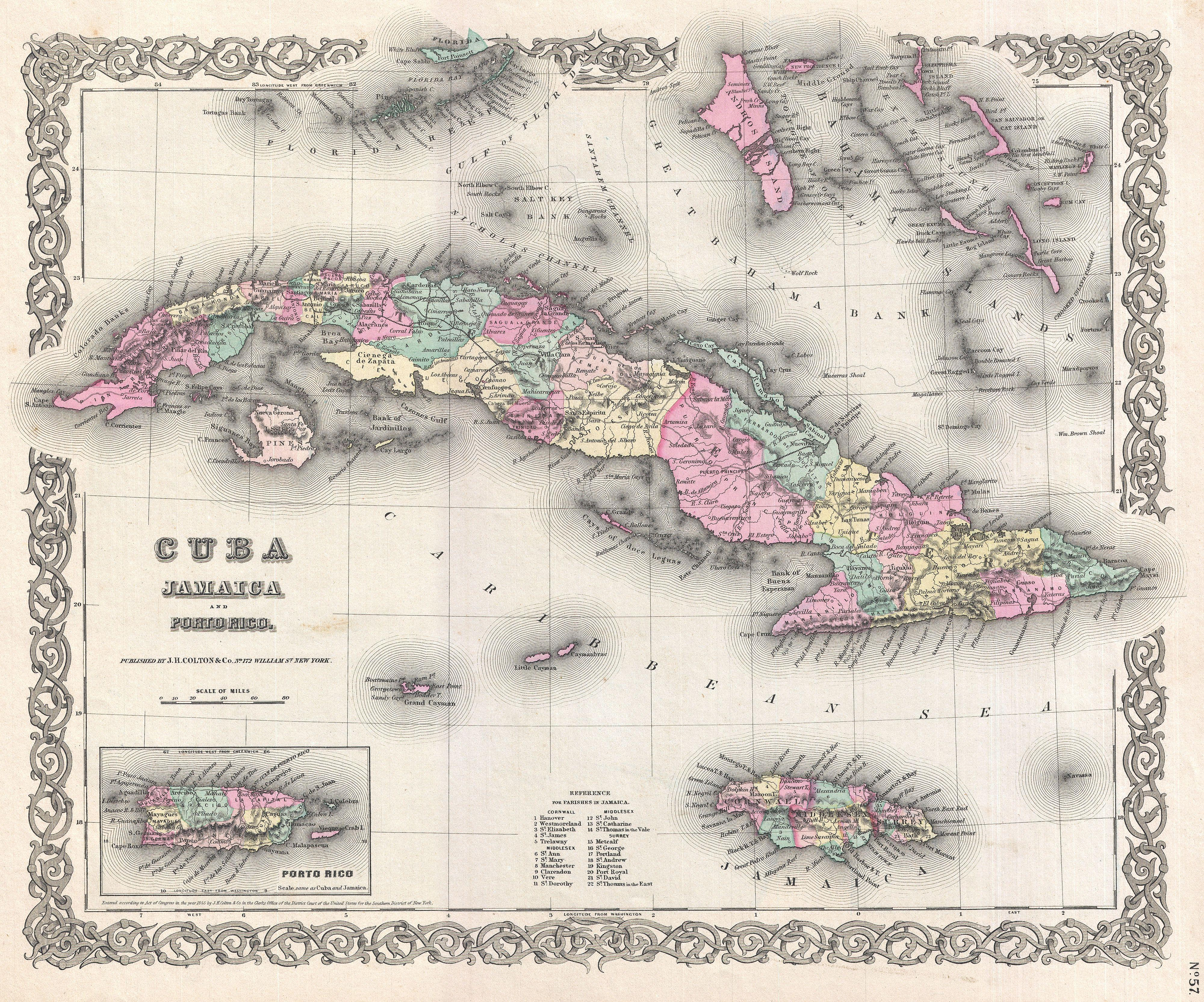
 The year was 1514. Spain had just established its colonial presence in Cuba, incorporating the island into its gradually expanding empire in the Americas.
Cuba was one of the earliest possessions of the burgeoning Spanish Empire, being settled only two decades after they first set foot in the Americas on the island of Hispaniola to the East.
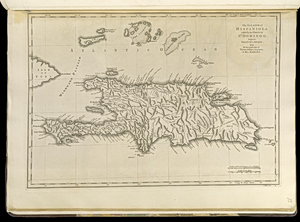
The island of Hispaniola called by the French St. Domingo – subject to France & Spain. Source: Jefferys, Thomas, Sayer, Robert Date: 1768
The island was strategically positioned to take advantage of the Spanish trade from the rest of the colonies, particularly trade of precious metals such as silver from Bolivia and Mexico, and gold from Peru and Mexico. Because of the wealth of the prosperous colony, it was oftentimes the target of piracy, forcing the colonial administration to erect a series of walls in Havana, the capital, some parts of which still stand to this day.
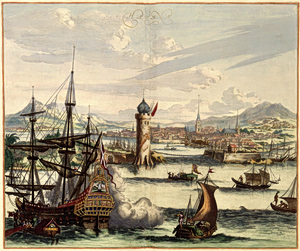
Havana in 1690, according to the Atlas Van der Hagen. British Library
To protect their colony, the Spanish also invested in a formidable fleet to patrol the region.
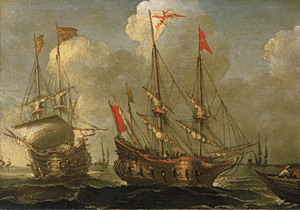
Spanish Ships at Anchor by Sebastrian Castro, c. 17th century. Source: Wikimedia Commons
By the late 18th century, Cuba had shifted to become a plantation economy, relying on a considerable number of black slaves (over 25% of the total population at more than 44,000 according to a 1774 census) brought to Cuba via the transatlantic trade, that would grow exponentially in the next decades.
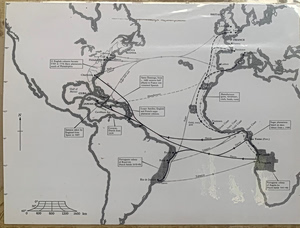
A map illustrating the transatlantic slave trade, showcasing the triangular trade route connecting Europe, Africa, and the Americas. Source: Wikimedia Commons
This overwhelming focus of Cuba on developing a plantation economy would become both a great asset and thorn and would set the tone for much of Cuban history in the next centuries.
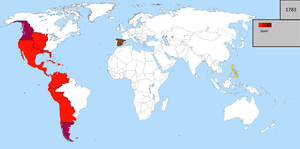
The Spanish Empire at its Greatest Extent in 1783. Source: Wikimedia Commons
Wealth at the Tip of a Blade
By the early 19th century, Cuba was becoming the world’s leading sugar producer, and thus the “golden prize” of Spain’s colonial possessions.
The vast estates of its Creole (persons of mixed European and black descent) planting class were built off of this vast financial boom.
Nonetheless, this state of affairs hung at the tip of a blade, as slave revolts were frequent. One such revolt, allegedly led by carpenter and sculptor José Antonio Aponte in 1812, demonstrated the fragility of the colonial establishment.
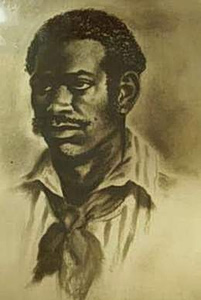
José Antonio Aponte, c. 1808. Source: EcuRed
The rebels set fire to sugar plantations around Havana and in the island’s interior.
While the rebellion was brutally suppressed, many in the Cuban plantation class drew parallels to the feared revolution that had engulfed nearby Haiti, a French colony, in 1791-1804.
The Haitian rebellion had been the cause of the previous vacuum in the world’s sugar market, which Cuba had quickly pivoted to fill. Many were fearful that what could happen to Haiti would also happen to Cuba.
As a result, despite strong internal tensions, Cuba was one of the last colonial strongholds to attempt to break the yoke of Spanish rule, long after Mexico, Venezuela and the rest of the continent.
Many reckoned it better to align with the devil they knew than the chaos of the unknown.
Seeds of Revolution
As the 19th century advanced, the seeds of the French Revolution were beginning to turn to tinder, ever more ready to spark into wildfires. Wars and turmoil in Europe, such as the Glorious Revolution of 1868 in Spain, resulted in the ousting of the Bourbon monarchy.
Due to the weakened state of the central government in Spain, wealthy planter and Cuban nationalist Carlos Manuel de Céspedes, took advantage of this opportunity to press for the island’s independence.
The conflict that ensued became known as the Ten Years War (1868-78). De Céspedes not only declared for Cuban independence, but also advocated for ending slavery, beginning with the emancipation of those in his own estates.
Historians consider de Céspedes to be the first Cuban nationalist.
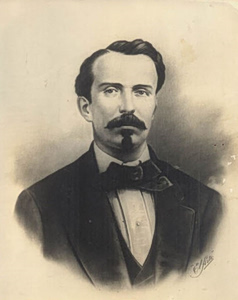
Cuban Father of the Fatherland, Major General of the Liberation Army and Leader of the Great War (1868-1878). Source: Wikimedia Commons
The war ended inconclusively, with an uneasy “truce”, neither side being able to overcome the other.
At the same time, a great wave of Spanish immigrants took place between 1868 and 1894, with 709,000 arriving, resulting in Cuba’s population undergoing a process of Hispanization, mainly in the principal cities.
In the mid 1880’s, due to a drop in sugar prices, the old Creole “sugar aristocracy” slowly began to be bought off by US companies, who began a full-scale economic penetration, involving investments in capital, machinery, and technicians.
Blood and Independence: The War of 1895
In the early 1890’s one of the most complete figures in the Cuban independence movement emerged — José Martí. A man who was simultaneously the movement’s poet, philosopher, organizer, and its martyr.
An exile most of his life, he founded the Cuban Revolutionary Party in 1892, and worked tirelessly to unite the fractious exile community behind a single coordinated push for independence.
He especially warned that Cuba should not trade one colonial oppressor — Spain — for another — the US.
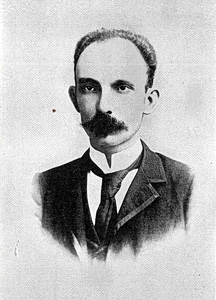
José Martí, the “Apostle of Cuban Independence”, founder of the Cuban Revolutionary Party, 1892. Source: Wikimedia Commons
His death in the first skirmishes of the war, less than three months into the conflict robbed the independence movement of its most sophisticated political thinker at precisely the moment when it was most needed.
Nevertheless, the war continued and savagely so.
Spain was so determined to keep Cuba, that it sent an army of over 220,000 troops across the Atlantic, which was to be the largest army to cross the Atlantic until the Second World War according to the Library of Congress.
Spain’s suppression of the war was exceptionally brutal. General Valeriano Weyler, nicknamed El Carnicero, the Butcher, instituted a massive relocation of Cuba’s rural population.
He placed hundreds of thousands into garrison towns, effectively the first modern concentration camps, resulting in the death of around 100,000 Cubans (nearly 10% of the island’s population, at the time), according to historian John Lawrence Tone.
The rebels, resolute in their fight, continued in the eastern provinces, adopting guerilla tactics. The overall conflict reached a standstill, after 3 years of fighting, with neither the Spanish possessing the ability to decisively defeat the rebels, nor the rebels having the resources to push the Spanish from the island.
Cuba and the United States
The US had hitherto withheld direct involvement in Cuba, despite the statute of the Monroe Doctrine (1823), which essentially declared the entirety of Latin America to be part of its sphere of influence, its “backyard”.
When images of the conflict reached American newspapers, an avalanche of sensationalist reporting ensued, aiming to feed a press hungry for readers, inflaming public opinion.
The sinking of the USS Maine off the coast of Havana, which had come to protect American civilians and property, sparked a wave of public outrage. While by most accounts today, the explosion originated from the ship’s own boiler, many came to believe it was a Spanish mine.
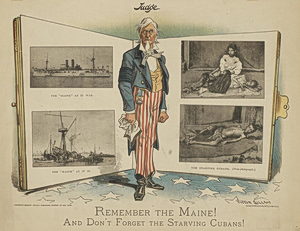
Remember the Maine! And Don’t Forget the Starving Cubans”, 7 May 1898. Source: Originally published in Judge (New York), May 7, 1898, volume 34, page 312
Popular sentiment and perceived Spanish aggression coalesced and led the US into declaring war on Spain in support of Cuban independence on April 25th, 1898. Thus began the Spanish American War.
The US invaded the island with over 16,000 troops and defeated the Spanish forces by July of the same year. The total conflict lasted less than three months.
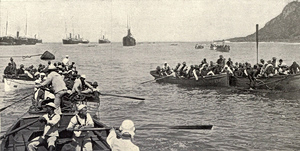
Americans going ashore at Daiquiri, 1898. Source: Harperts Pictorial History of the War with Spain
This victory not only secured Cuba’s independence, but it also struck the nail in the coffin for Spain’s colonial empire in the Western Hemisphere, while securing US predominance in the Caribbean.
Independence in Name Only
In accordance with the terms of peace, the US military ruled Cuba between 1898 and 1902. This was seen as distasteful by most Cubans who, having fought a war of independence, saw themselves having replaced one colonial master with another.
The Platt Amendment of 1901, was perhaps the most telling move of intention by the US. It granted the US the right to intervene in Cuban affairs at will, as well as requiring Cuba to sell or lease land to the US for naval bases. The Guantanamo Bay installation was a product of this arrangement, enduring to this day.
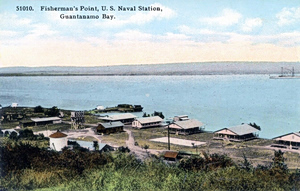
Fisherman’s point, U.S. Naval Station, Guantanamo Bay, Cuba, c. 1909. Source: Harris Brothers, Havana (publisher)
During these years, Cuba was flooded by American capital, creating an economy that was nominally productive, yet also deeply unequal and heavily dependent on the US.
Still largely a sugar exporting country, when sugar prices were high due to global shortages in the period 1914-1920, Havana was gleaming in wealth. Yet, when European production recovered in late 1920, sugar prices collapsed leading to widespread bankruptcies and ever greater foreign (US) control over the island’s economy.
In the mid-1910’s there was a term for the boom itself — Dance of the Millions — before prices collapsed in the 1920’s.
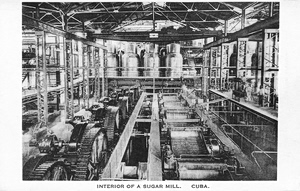
Interior of a Sugar Mill, c. 1920Divided back. Source: American Photo Studios [1920]
- US occupation (1898-1902, and 1906-1909 following a disputed election and Liberal revolt),
- moderate elected democracies (1909-1925),
- military dictatorships (1925-1940),
- democracy again (1940-44),
- flawed democracy (1944-1952) and
- dictatorship (1952-59).
The common thread throughout all of these years was corruption, political instability, rising social inequalities, and the domination of factional forces willing to cater to Washington’s preferences.
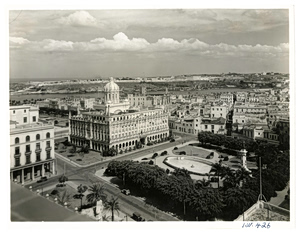
Aerial View of Presidential Palace and Zayas Square in Havana. c. 1920. Source: Wikimedia Commons
Casinos, Corruption and the Road to Revolution
One noteworthy figure in early-to-mid century Cuban politics was Fulgencio Batista, a military officer who was a dominant political figure in the 1930’s – 1950’s.
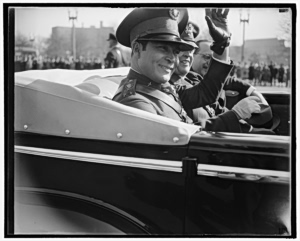
Colonel Fulgencio Batista, on his visit to the United States, c. 1938. Source: Library of Congress
He first came to power through a 1933 coup during which he ruled behind the scenes until 1940, when he was officially elected as president until 1944.
His government, widely considered corrupt and self-enriching, was still perceived as relatively moderate, expanding the educational system and sponsoring public works.
He then departed again only to return in 1952, this time as a brutal dictator who controlled the universities, the press and the congress, embezzling enormous sums from the buoyant economy. The 1954 election was staged to make him the sole candidate, while in 1958, a nominal opponent stood against him.
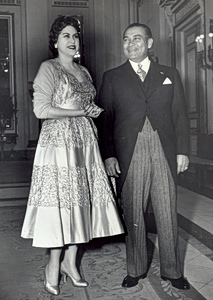
Fulgencio Batista and his Wife Marta Fernández Miranda de Batista, c. 1955
Batista’s approach to increasing revenues included a heavy focus on foreigner-oriented casinos, and sex tourism.
He was particularly known for his close relationship with various figures of the underground, most notably American organized crime financier and gambling tsar Meyer Lansky, whom he appointed to run Havana’s casinos.
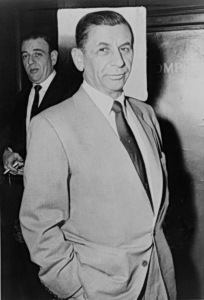
Meyer Lansky, c. 1958. Source: Library of Congress
While on the surface, Cuba was prospering from its hotels, clubs and casinos, financed by mob money, behind the commercial scenery ran rivers of blood with Batista’s Intelligence Service becoming true masters of torture and death.
Meanwhile, the profits from this arrangement, were sent daily to private accounts in the United States.
Washington’s stance was supportive towards Batista throughout, as they viewed an ally dictator to be useful in maintaining stability in the region, particularly due to rising Cold War tensions.
This was to work against him, as his opponents heavily framed him as a puppet of American interests.
Faced with growing opposition, Batista’s regime grew increasingly tyrannical. For many, revolution felt like the only legitimate answer.
“History Will Absolve Me”
It was a young lawyer by the name of Fidel Castro, who would eventually overthrow Batista, but not without a struggle and not without its failures.
Castro, contrary to popular opinion, began as a Cuban nationalist, being heavily inspired by revolutionary works of José Martí, half a century prior.
He began his debut by launching an attack on the Moncada Barracks in Santiago de Cuba on July 26, 1953. The aim was to seize the large weapons cache stored there and using the army’s communications to broadcast a manifesto to the public.
The attack failed to spark a massive national uprising, and dozens were killed in the process. Castro was arrested, tried and sentenced to 15 years in prison.
In his defence speech, his political manifesto claimed “History will absolve me”.
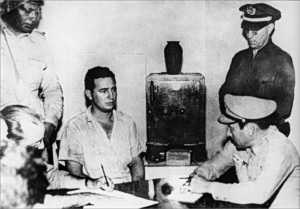
Fidel Castro under arrest after the Moncada attack, c. July 1953
Within 2 years, feeling insecure, Batista granted amnesty, allowing Castro to go to Mexico where he met with Ernesto “Che” Guevara, beginning the organization of a guerrilla force.
It was here that the 26th of July Movement was founded, the name in honour of the failed Moncada attack, in an effort to organize revolutionary guerilla efforts.
In 1956, Castro and 81 rebels landed in Cuba aboard the yacht Granma, yet they were almost immediately ambushed by Batista’s forces, forcing a chaotic retreat where only around 20 survived by fleeing into the Sierra Maestra mountains.
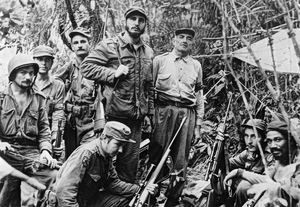
Fidel Castro and his men in the Sierra Maestra, c. December 1956
Throughout the course of the next 2 years, Castro achieved growing support in the countryside, while a campaign of sabotage and strikes was simultaneously waged in the cities.
Following a failed military offensive by Batista against the Sierra Maestra in 1958, Castro and Che Guevara decisively captured Santa Clara in December, effectively cutting off the island in two.
In the early hours of January 1, 1959, Batista fled to the Dominican Republic.
Castro’s forces entered Havana. The revolution was triumphant.
Cuba: A Bargaining Chip Between Superpowers
Fidel Castro moved swiftly, nationalizing American-owned companies including oil refineries operated by Standard Oil and Texaco, sugar mills and utility companies, redistributing land, and restructuring the education and healthcare systems.
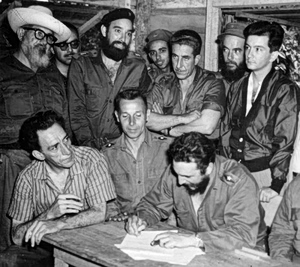
Fidel Castro signs the agrarian reform law, c. 1959. Source: Wikimedia Commons
The US saw this as a direct violation of its interests and a threat to its influence, so under the Eisenhower administration, all imports from Cuba were cut and, what would be the first of many, economic sanctions were imposed.
President Kennedy would expand these into a comprehensive trade embargo in February 1962. In one form or another this exact trade embargo has remained in place to this day, more than 60 years later.
In October 1962, Cuba found itself at the political epicenter of the Cold War clash between the US and the USSR. The US, through aerial surveillance, had discovered Soviet nuclear missiles being installed on the island.
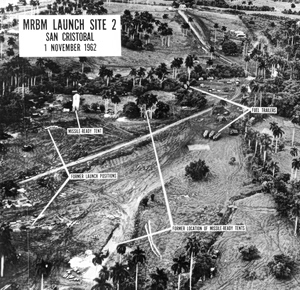
U.S. aerial reconnaissance photograph of a medium range ballistic missile launch site at San Cristobal in Cuba, on 1 November 1962 during the Cuban missile crisis. Source: National Archives (.gov)
The US navy positioned itself to completely blockade the island and would not allow Soviet ships to enter Cuba.
After a series of stand offs over the next thirteen days that brought the entire world on the brink of full-scale nuclear war, the crisis was ultimately resolved when Khrushchev agreed to withdraw the missiles in exchange for a U.S. pledge not to invade Cuba and a quiet removal of American missiles from Turkey.
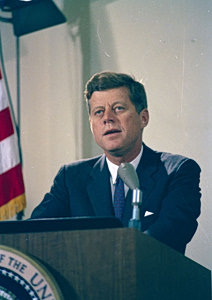
President John F. Kennedy delivers a radio and television address to the nation regarding the dismantling of Soviet missile bases in Cuba. Fish Room, White House, Washington, D.C. 2 November 1962. Source: Robert Knudsen. White House Photographs. John F. Kennedy Presidential Library and Museum, Boston
This deal was struck without consulting Castro, who was furious to discover that both superpowers were prepared to treat Cuba as a bargaining chip rather than a sovereign nation.
Cuba, while safe from a United States invasion, was nevertheless thrust into a relationship of dependence on Soviet subsidies whereas Cuba would import oil at a low price, while exporting sugar at a higher price.
This allowed it to keep the economy functioning, yet leaving it structurally fragile, as more than 20% of the country’s GNP, came from Soviet subsidies.
Despite this fragility, it was a solid arrangement for Cuba, as it allowed the government to maintain the social programs, particularly in healthcare and education, that remained genuine achievements of the revolution.
Part of this alliance however, was that Cuba would also send troops to Soviet-aligned conflicts in Angola and Ethiopia, amongst other countries.
Hunger, Hope and Disappointment
Serious structural problems arose when the USSR collapsed in 1991.
Those subsidies, enjoyed over decades, vanished overnight. This plunged Cuba into what the government called the Período Especial — years of extreme rationing, blackouts, and hunger that drove hundreds of thousands to emigrate, joining a large Cuban diaspora, with most concentrated in Florida, particularly in and around Miami.
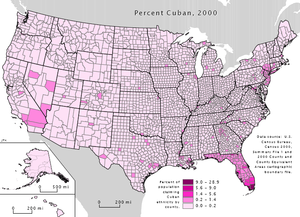
Diagram indicating Cuban American settlement in the United States, based on the census 2000 by the U.S. Census Bureau. Source: Government of the United States
To make matters worse, in the US, the Helms-Burton Act of 1996, also extended sanctions to foreign companies trading with Cuba, effectively creating a significant international deterrent for trading with Cuba.
Cuba survived through desperate improvisation, that involved legalising the dollar, opening to tourism, as well as tolerating small private businesses.
It also acquired a new patron in the form of Hugo Chávez in Venezuela who, coming to power in 1999, offered subsidised oil in exchange for Cuban doctors and teachers.
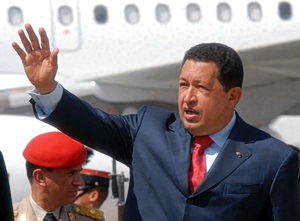
Hugo Chávez. Source: Wikimedia Commons
It was an arrangement that would sustain the island’s energy needs for the next quarter century, continuing with Chávez’s successor Nicolás Maduro, until an American military operation in Caracas on January 3, 2026, brought it to an abrupt end.
The most unexpected diplomatic moment in decades came on December 17, 2014, when Barack Obama and Raúl Castro jointly announced a normalisation of relations.

The culmination of years of talks resulted in this handshake between the President and First Secretary of the Communist Party of Cuba Raúl Castro during the Summit of the Americas in Panama City, Panama.” 11 April, 2015. Source: Official White House Photo by Pete Souza
After more than 50 years, embassies reopened, Cuba was removed from the terrorism list, and commercial flights resumed.
In 2016, Obama became the first sitting U.S. president to visit the island in eighty-eight years. For a brief moment, a different future seemed possible.
It was not to last. The Trump administration began dismantling the opening from 2017, and in his final days in office Trump relisted Cuba as a State Sponsor of Terrorism.
Biden preserved most of the sanctions architecture despite campaign promises otherwise. Cuba’s economy continued to deteriorate.
In July 2021 the largest protests in decades erupted across the island, having been immediately preceded by blackouts, food shortages, and collapsing public services. The government proceeded with mass arrests.
Cuba in 2026
The crisis of 2026 was of a different order entirely. Following the U.S. military operation that toppled Nicolás Maduro in Venezuela, Cuba lost its principal oil supplier in a matter of days.
On January 29, Trump signed an executive order threatening tariffs on any country that exported oil to Cuba, resulting in an immediate suspension of shipments by Mexico, at the time Cuba’s second-largest oil supplier.
The consequences were far-reaching.
Airlines ran out of jet fuel and cancelled routes. Within weeks, hospitals were calling off surgeries, while medical supplies like antibiotics and painkillers were running out.
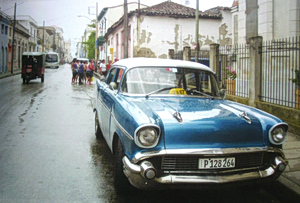
Cuba. Source: “Two hundred days in Latin America” by Victor Pinchuk (author of the photo and book)
A million Cubans had lost reliable access to drinking water, because diesel-powered delivery trucks had no fuel to run.
Meanwhile, blackouts stretched to twenty hours a day. The UN described the situation as “energy starvation.”
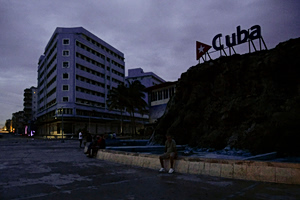
People gather in a plaza as Cuba is hit by an island-wide blackout, in Havana, Cuba, October 18, 2024. REUTERS/Norlys Perez
As of mid-2026, no resolution is in sight.
On May 20, 2026, the U.S. Justice Department indicted former president Raúl Castro for the 1996 shootdown of Brothers to the Rescue aircraft — the most dramatic legal escalation against Cuba’s leadership in history.
No End in Sight for Cuba
Cuba’s history throughout the centuries has been a variation of the same theme: The perpetual trading of one vastly more powerful patron for another, never truly sovereign.
Spain had used Cuba to enrich its treasures. The US used Cuba to project hemispheric dominance and as a recreational resort. The USSR as a Cold War chesspiece, and a thorn to their main rivals’ southern border. Venezuela used it as a partner for its regional political ambitions.
Millions of Cubans have found themselves over the centuries, through no fault of their own, at the centre of someone else’s power struggle.
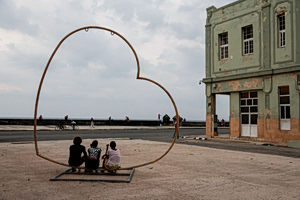
People sit in a heart-shaped public art installation at the seafront Malecon as Cuba’s state-run economy has descended into a full-blown crisis after the administration of U.S. President Donald Trump hardened sanctions and cut off the Caribbean nation’s oil supply, in Havana, Cuba, May 6, 2026. REUTERS/Norlys Perez
The question of what the island deserves, not as a pawn, but as a nation remains, as it has for five centuries, unanswered.