 Μake us preferred on Google
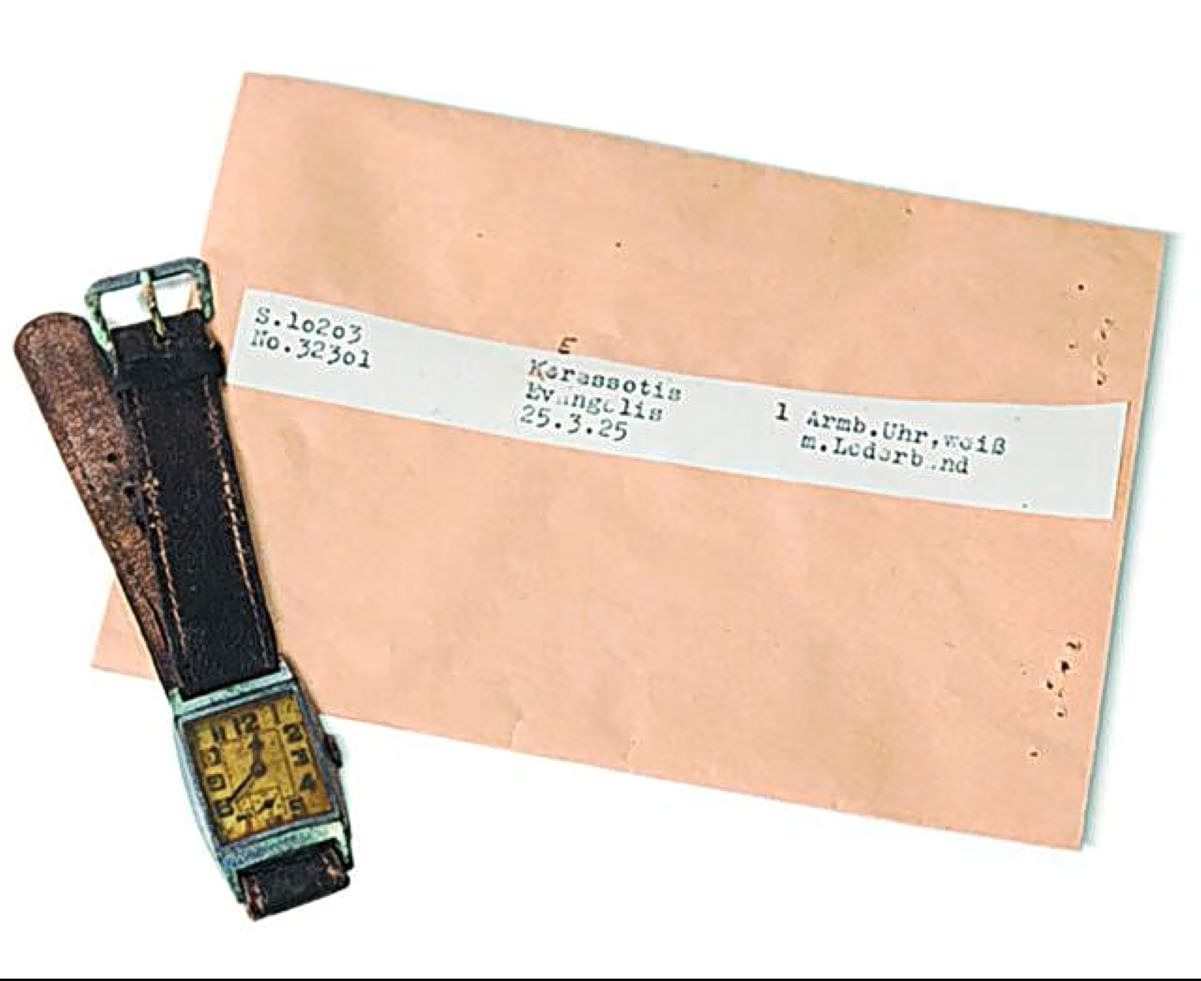
 Two wristwatches, their hands frozen in June 1944—the month their young owners were deported from Athens to the Nazi concentration and forced-labor camp of Neuengamme near Hamburg. For decades, these objects stood as silent witnesses to one of the darkest chapters of European history and to the enduring grief of Greek families torn apart by Nazi persecution. Many never saw their loved ones again, nor had the chance to say goodbye, leaving wounds that remained open across generations.
On June 25, four families of former Greek prisoners will finally receive personal belongings once taken from their relatives, during a special ceremony at Greece’s Ministry of Foreign Affairs. For two of the families, the items belong to men who never returned home. The restitution takes place 81 years after the events, as part of the international #StolenMemory campaign launched in 2016 by the Arolsen Archives, the institution that preserves records from Nazi camps and leads efforts to identify victims of the Holocaust and Nazi persecution.
The Arolsen Archives are overseen by an international commission representing 11 countries, including Greece. In recent years, efforts to locate relatives of nine Greek concentration camp prisoners gained new momentum through a collaboration between the Ministries of Foreign Affairs and Education, which enlisted secondary-school students to conduct historical research. During the 2024–25 school year, students successfully traced the families of three former prisoners, while the following year they identified four more. The June 25 ceremony will honor those four cases.
The Greek initiative has attracted attention for its direct involvement of schools and young people in historical investigation. Beyond recovering family histories, it has demonstrated how collective effort can bridge decades of silence and loss. At its heart lies a simple but powerful lesson: division can lead to catastrophe, while cooperation can achieve what once seemed impossible.
A Survivor’s Watch
One of the watches belonged to Evangelos Kerasiotis, born in Kavala in 1925. His case was investigated by students at the Evening Vocational High School of Evosmos under the supervision of historian and lawyer Angelos Chotzidis. Through painstaking research in municipal, military, and archival records, students located surviving relatives and uncovered details of his wartime ordeal.
Kerasiotis was arrested by the SS in May 1944, at the age of 19, during a period of mass roundups in Nikaia. He was deported to Neuengamme on June 4 and later transferred to the Salzgitter-Drütte labor camp. Following the evacuation of the camps in 1945, he ended up at Bergen-Belsen, where British forces recorded his presence after liberation.
“He was one of the lucky ones who survived,” says Chotzidis.
Kerasiotis returned to Greece in August 1945 and later joined the police force. Yet the physical toll of imprisonment proved devastating. He died in February 1949, just 24 years old, from a rare heart condition linked to the hardships he endured in the camps.
The family learned of the watch’s existence only through the students’ research. Among the documents uncovered was a condolence letter sent to Kerasiotis’ parents, informing them that their other son had arrived too late to attend Evangelos’ funeral.
For Sofia Kerasoti, his niece, the watch represents far more than a recovered possession. Her 27-year-old son will become its custodian.
“I grew up hearing stories about ‘Uncle Vaggelakis’ almost as if he were a legend,” she says. “Now, after all these years, holding his watch means connecting with a part of my family history I never knew firsthand. It’s an extraordinary feeling.”
The Brother Who Never Came Back
Another watch will be returned to the family of Georgios Sagmatopoulos, whose fate remained unknown for decades. Students from the 7th Gymnasium of Nea Ionia, led by music teacher and deputy principal Konstantinos Karaberopoulos, traced his descendants and reconstructed his story.
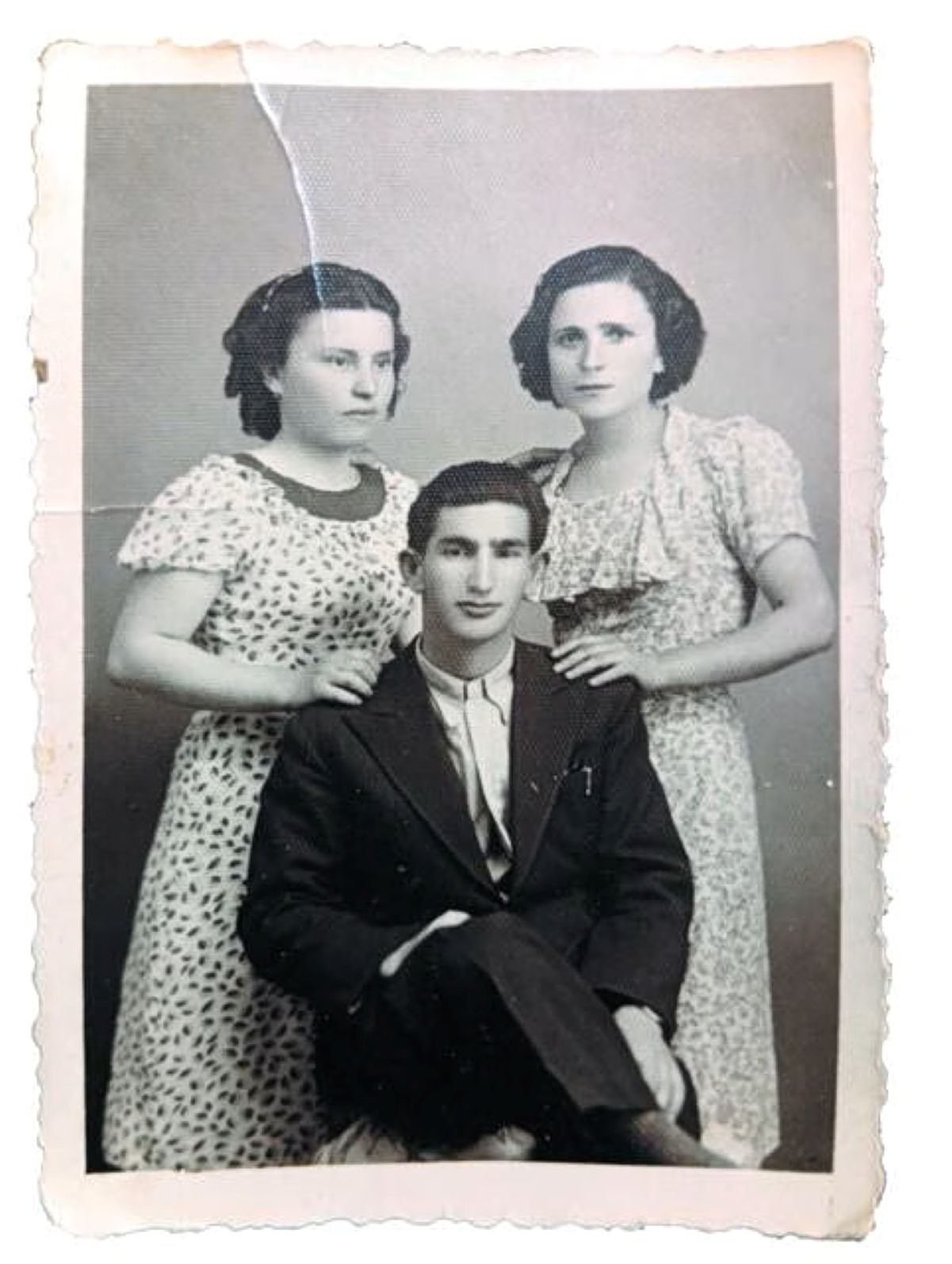
Georgios Sagmatopoulos. On the left, his cousin Rodi; on the right, his sister Panagiota Galani-Sagmatopoulou.
For Panagiota Galani, the recipient of the watch, the loss has always been part of the family’s collective memory.
“In my grandmother’s house there was a large photograph of her brother,” she recalls. “Whenever she spoke about him, she would cry. It was a family trauma.”
Sagmatopoulos arrived at Neuengamme on June 6, 1944, at the age of 24, after being transferred from Athens. The son of Pontic Greek refugees who had come to Greece during the 1923 population exchange, he had reportedly been arrested during a roundup in Nikaia. From Neuengamme he was sent to the Bremen-Farge satellite camp. After that, his trail disappears.
Official records later certified that he died in April 1945.
For Galani, receiving the watch carries profound emotional significance. She plans to visit her grandmother’s grave immediately after the ceremony.
“I feel blessed to be the one receiving it,” she says. “Without the dedication of the students and all those who helped, none of this would have happened.”
Karaberopoulos believes the ceremony is especially meaningful for families whose relatives never returned.
“The goal is to heal a wound of the soul,” he says. “A personal object once confiscated by the Nazis is finally being restored to the family it was taken from.”
Young Detectives of Memory
For the students involved, the project became much more than an academic exercise. Eleni Boutraki, now a pharmacy student at Aristotle University of Thessaloniki, participated in the program for two consecutive years.
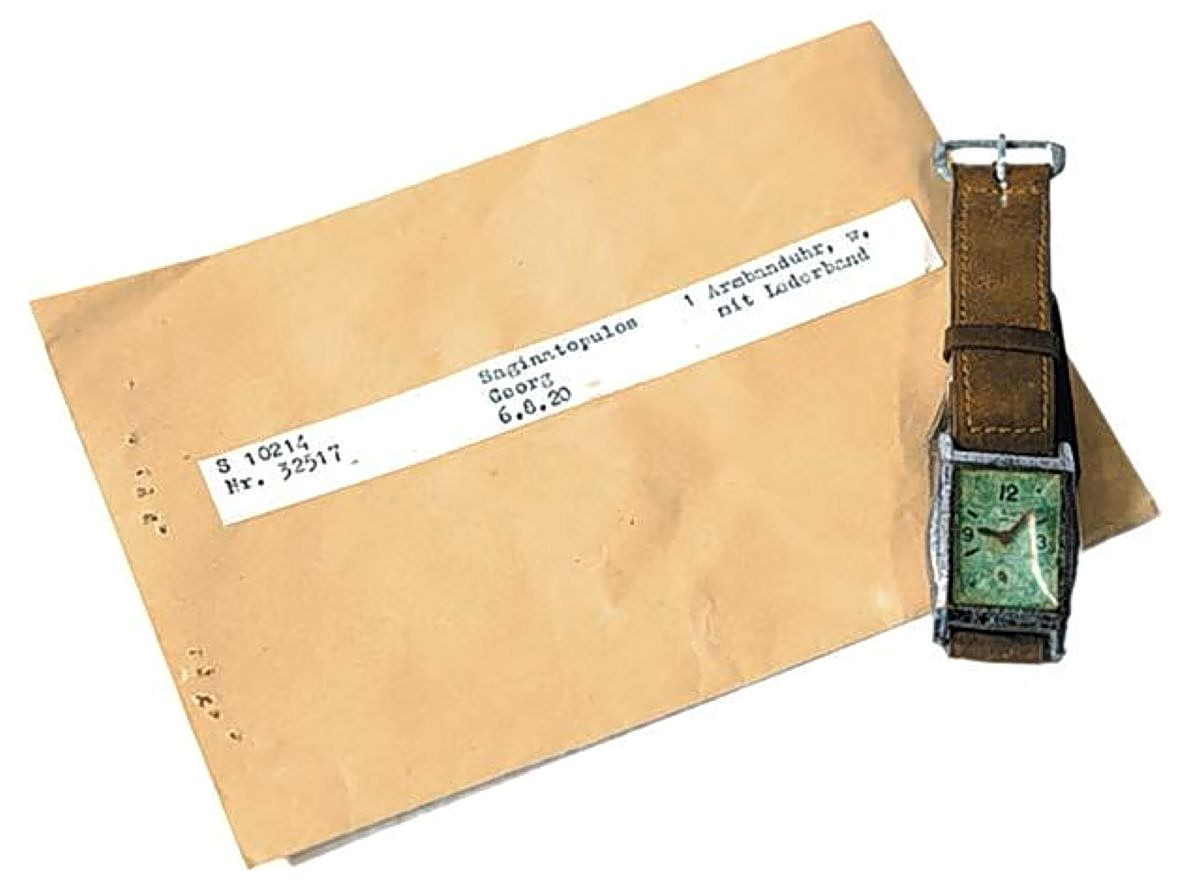
The watch of Georgios Sagmatopoulos.
“It wasn’t simply an educational experience,” she says. “It was a journey into parts of history we knew nothing about. As we conducted our research, we became connected to families who were searching for answers just as intensely as we were. We wanted to learn what happened to their relatives, to honor their memory, and, in some way, to help bring them peace.”
She argues that initiatives like #StolenMemory offer a powerful model for education by encouraging students to engage directly with the past rather than encounter it only through textbooks.
Memory Anchored in Objects
According to Moritz Wein, Director of the Arolsen Archives, the institution still holds more than 2,000 personal belongings taken from concentration camp prisoners.
He said the items serve as powerful links to the victims and their families, noting that Greek students played a key role in tracing the relatives of all ten Greek former prisoners represented in the collection.
He also stressed that the project connected young people directly with the history of Nazi persecution.