 Μake us preferred on Google
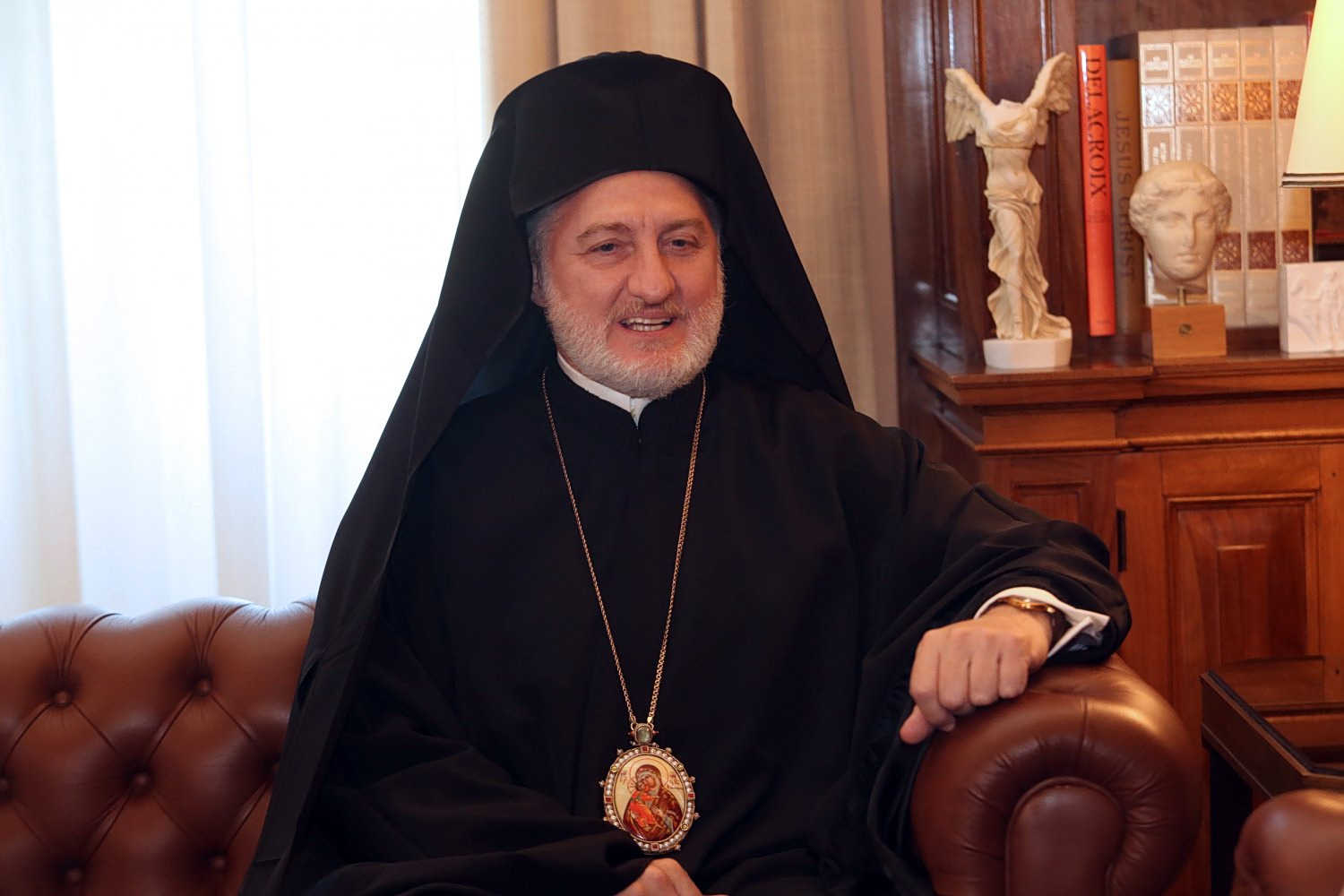
 Twenty five years after the September 11, 2001, terrorist attacks, St. Nicholas Greek Orthodox Church and National Shrine held a memorial service on the sacred ground steps from the World Trade Center Memorial in New York City. Presiding over the ceremony, Archbishop Elpidophoros framed the shrine itself as a rebuke to intolerance, declaring that “mutual respect, dialogue and understanding are the only way forward” and vowing that hatred would “never again” be allowed to harm the site.
The gathering brought together prayer, personal testimony and reflections on the resilience of St. Nicholas, the only house of worship destroyed in the attacks. The original chapel, a small parish that had stood near the Twin Towers, was flattened when the towers collapsed. It has since been rebuilt on the same site as a National Shrine, a status that marks it as a place of remembrance for the entire country, not just its parish community.
The service drew a wide mix of civic, religious and diplomatic figures. New York City Mayor Zohran Mamdani attended, along with Archbishop Ronald Hicks, the Roman Catholic Archbishop of New York. Also present were Consul General of Greece in New York Iphigenia Kanara, Consul General of Cyprus in New York Kyriakos Pogiatzis, and Consul General of Romania in New York Mihaela Simon Florea. Interfaith leaders, public officials, first responders, survivors, family members of victims, chaplains and clergy filled the shrine beneath its dome for the ceremony.
A message against division
Archbishop Elpidophoros presided over the service. In his remarks, he urged those gathered to reject intolerance and to see the shrine as a symbol of coexistence. “Never again shall intolerance and hatred bring harm to this hallowed ground, nor to our city,” he said. “The Saint Nicholas National Shrine stands to declare that mutual respect, dialogue and understanding are the only way forward.”
He also spoke to the shrine’s purpose as a living memorial, noting that its rebuilding gave a permanent home to the memory of those who died. “We could not bring back those who unjustly perished,” Archbishop Elpidophoros said, “but we could enshrine their nobility, their heroism, their courage and ultimately their humanity in a sacred space open to all.”
He pointed out that an entire generation of Americans has now grown up since the attacks, a fact he said makes the work of remembrance more urgent, not less. “Our collective responsibility of being a living memory will only grow as the years go on,” he said.
View this post on Instagram
Mamdani: a city’s resilience made tangible
Mayor Mamdani used his remarks to recall the acts of ordinary kindness that defined the days after the attacks. “We remember the generosity strangers showed to strangers, those who never made it home so that others could, the kindness so many summoned from deep within,” he said. “That memory can feel distant sometimes, but not here, not at St. Nicholas.”
He also framed the shrine’s reconstruction as a parallel to the city’s own recovery. “No other church was destroyed on September 11. No other congregation found themselves so deep within a maelstrom and so deprived of the place of gathering and solace needed to endure it. And yet, this community, like this city, is resilient,” Mamdani said.
The mayor recalled how first responders treated the ruined chapel with care during the recovery effort, returning religious items found in the wreckage. “I am moved by how many first responders treated this site with solemn reverence, carefully excavating and returning Bibles and candlesticks and treasured items,” he said. “Within that resilience lived a deep desire to honor what we had lost by treating one another with dignity, with love, by making faith real.”
A closing blessing
The service closed beneath the shrine’s dome with a final blessing from Archbishop Elpidophoros, delivered in both English and Greek: “May their Memory be Eternal. Αἰωνία ἡ Μνήμη Αὐτῶν,” a traditional Orthodox liturgical phrase used to honor the dead.
Organizers described the shrine’s ongoing mission as a place of healing and reflection, where the memory of those lost on September 11 is preserved for future generations.