The city is better known for steel mills and football than for diplomacy. But on Feb. 27, Pittsburgh will briefly become a focal point of transatlantic energy politics, as American and European officials gather to mark the 10th anniversary of the first shipment of U.S. liquefied natural gas to Europe. Greece’s energy minister, Stavros Papastavrou, has been invited to attend.
The commemoration is largely symbolic. Yet it comes at a moment when relations between Washington and Brussels, strained in recent years by trade disputes, industrial policy and political polarization, remain fragile. The image of European and American officials celebrating a shared energy partnership can no longer be taken for granted.
Still, the anniversary underscores a central reality: over the past decade, U.S. natural gas exports have become a cornerstone of Europe’s effort to reduce its dependence on Russian energy and to diversify its supplies.
That strategic consensus remains one of the few areas of continuity in Washington’s polarized political environment. Support for liquefied natural gas exports continues to cut across party lines, reflecting a shared view of LNG as both an economic asset and a geopolitical instrument.
That message was reinforced last week during a Senate hearing that featured testimony by Jeffrey Pyatt, the former U.S. undersecretary of state for energy resources and a former American ambassador to Greece. Mr. Pyatt praised the rapid growth of the American LNG industry, which has turned the United States into one of the world’s leading exporters in less than 15 years.
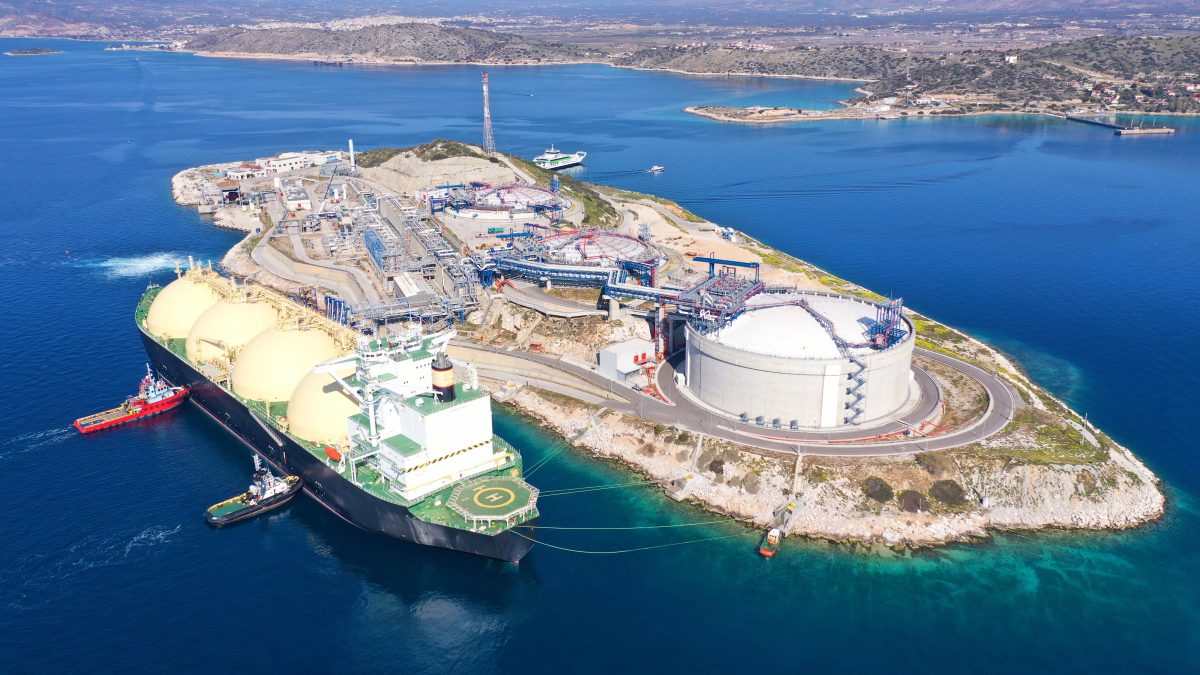
He devoted particular attention to the so-called Vertical Corridor, a network of pipelines, terminals and interconnectors designed to carry gas from Greece’s LNG facilities and ports through the Balkans and into Central and Eastern Europe, linking U.S. supply to inland European markets. He described the project as one of the most underestimated achievements of transatlantic energy diplomacy.
At the same time, Mr. Pyatt acknowledged that the corridor remains vulnerable. Long term political backing, he said, is essential to lowering investment risks for companies considering participation.
He pointed to sustained support from senior officials across administrations, including Chris Wright, the current U.S. secretary of energy, and Jarrod Agen, executive director of the White House’s National Energy Dominance Council.
As further evidence of that bipartisan backing, he cited a provision in the 2019 National Defense Authorization Act that opened the door to financing by the U.S. International Development Finance Corporation in Europe.
When Politics Runs Ahead of Markets
The next major test for the corridor will come at a summit in Washington later this month, scheduled for Feb. 24. The meeting is being organized at a time when the project remains strategically important but commercially uncertain.
Formal invitations have not yet been issued, but American officials are already preparing the ground. Their aim is to send a clear political signal that the United States remains committed, even as market fundamentals remain fragile.
Despite years of diplomatic backing, the corridor continues to face structural challenges. Capacity auctions have not guaranteed stable volumes. Transit fees, layered across multiple countries, steadily erode its price competitiveness. Without more predictable demand and streamlined regulation, investors remain cautious.
For that reason, Washington is broadening the scope of the summit beyond government ministers. Organizers are seeking to bring energy companies, pipeline operators, regulators and European officials into the same room, recognizing that commercial viability will ultimately depend on their decisions.
The effort reflects an attempt to close a long-standing coordination gap by forcing political, regulatory and market actors to confront unresolved problems simultaneously.
In recent months, that gap between political commitment and commercial reality has begun to narrow, at least partially. A Greek joint venture involving DEPA Commercial has signed a long-term agreement to import U.S. liquefied natural gas through Greek infrastructure, the first of its kind in southeastern Europe.
Officials in Washington describe it as strategically important primarily because it sets a long-term precedent for U.S. exports through Greece.
The anticipated presence of the Development Finance Corporation and senior officials from the European Commission is also deliberate. American policymakers are weighing whether to expand the D.F.C.’s role, while monitoring potential opportunities in Greek ports and energy infrastructure should privatization efforts resume, possibly with U.S. financial backing.
European participation is also under discussion, including the use of subsidies and financial instruments to offset costs, an idea being pushed primarily by private sector operators concerned about long-term profitability. Those talks remain preliminary.
But officials in Washington see Greece, as both a transit hub and a European Union member, as a potential bridge between U.S. strategic priorities and Brussels’ regulatory and funding mechanisms.
For now, the American bet is political: to bind the principal stakeholders to a common framework before market pressures deliver a more decisive verdict.
Whether that alignment can translate into lasting commercial success remains an open question.