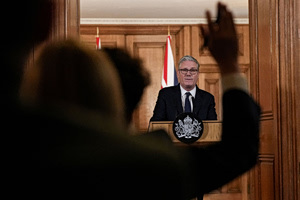
France’s constitutional court rejected on Friday the bill that would have banned social media use for minors under 15, a significant setback for Emmanuel Macron, who asked his government to revise the measure in line with the court’s ruling.
France’s Constitutional Council ruled in its decision that the bill placed a disproportionate limit on minors’ right to expression and communication, and also failed to include adequate privacy safeguards.
As Politico notes, Macron had made the ban a priority for his second and final term, hoping to put it into effect in September, when the European Commission is expected to present a proposal for EU wide measures to protect young people.
The bill, approved in July, would have made France the first European country to follow Australia’s example, which banned access for minors under 16 to platforms like Facebook, Instagram, and TikTok last September. So far, however, that measure doesn’t appear to be working.
The equivalent ban being pushed by the Greek government is scheduled to take effect in 2027, while several other countries, including Denmark, Italy, Sweden, Austria, and Portugal, are pursuing similar restrictions.
The Ruling
The Constitutional Council found that Article 1 of the bill failed to draw clear distinctions between the risks posed by individual platforms, or account for how vulnerable different children are.
In addition, the ban would have applied to platforms with no evidence that they threaten minors’ health and safety, the court said.
“By banning minors under fifteen from accessing certain online services, the law effectively requires every individual, even adults, to prove their age before gaining access,” the Council said in its ruling.
“However, because it failed to set out the conditions and limits under which this proof must be provided, the legislature did not establish the necessary legal safeguards to ensure compliance with these requirements,” it added.
According to Reuters, Macron asked Prime Minister Sébastien Lecornu to redraft the bill so that it complies with the court’s ruling.
The Élysée Palace said Macron is determined to have the ban in place before spring 2027, when France holds its next presidential election.
Reservations
While governments broadly agree that social media is harmful to children, many experts have voiced doubts about whether bans are the best solution.
A report submitted to the European Commission by a group of experts on youth behavior raised doubts that age restrictions alone are the answer. The experts pointed to enforcement failures in Australia and suggested looking for solutions covering all the online spaces where young people spend their time, which increasingly include AI chatbots as well.
In addition, several experts who took part in consultations with the European Commission on the proposed measures sent a letter to Commission President Ursula von der Leyen, warning against blanket measures.
According to the letter, blanket bans are not compatible with protecting children’s fundamental rights, since they restrict access to information, which could push children toward riskier, unregulated corners of the internet.
In the United States, blanket bans would likely be found unconstitutional as a violation of children’s free speech rights. Instead, efforts to protect children from the effects of social media are moving toward holding the platforms themselves legally liable.