 Μake us preferred on Google
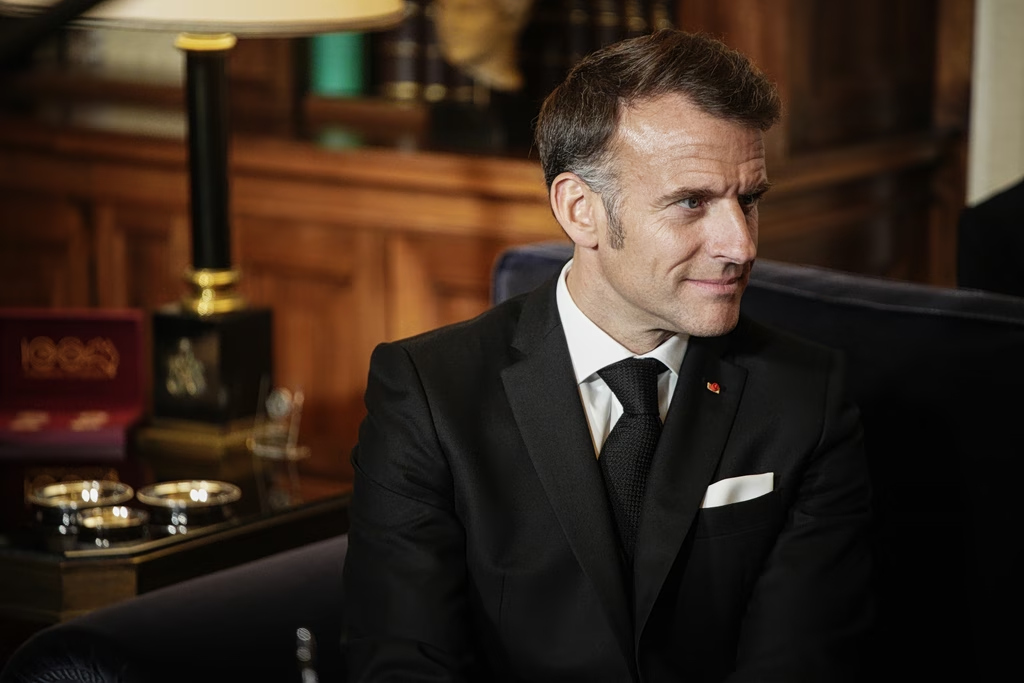
 Emmanuel Macron came to power promising to transcend the traditional Left-Right divide, replacing the old centrist doctrine of “neither Left nor Right” with his own formula of “both Left and Right.”
Nine years later, that project has ended in decline, undone largely by Macron’s own choice to dissolve the National Assembly and call snap elections in 2024 rather than share power with a prime minister from the Left, as his predecessors, from Mitterrand to Chirac, had done when faced with similar circumstances.
This proves to be a fatal overestimation of his own popularity and an unwillingness to share his authority, which cost him his governing majority and alienated key former allies, including former prime ministers Édouard Philippe and Gabriel Attal, both now positioning themselves for the 2027 presidential race.
The three-way fracture
The 2024 snap elections produced an unprecedented, deeply fragmented National Assembly split between a far-left bloc, a centrist/liberal bloc, and a far-right bloc, none commanding a majority. Jordan Bardella’s National Rally topped the first round with a striking 33%, but lost ground in the second round after democratic parties coordinated withdrawals to block the far right’s path to power, a tactic that itself set records, as did voter turnout.
The instability that followed, left France in a considerably weaker position than the one Macron inherited from François Hollande. Macron delayed appointing a new government for months (citing the Paris Olympics), then repeatedly installed prime ministers who couldn’t survive a fractured Assembly, including Michel Barnier, whose government fell in the first no-confidence vote since 1962, followed by François Bayrou and finally Sébastien Lecornu.
To keep Lecornu’s government alive, Macron’s own signature pension reform was effectively gutted, a move of clear irony given it was central to his presidency.
Collapsing public trust
The piece cites CEVIPOF’s “Baromètre de Confiance Politique” (February 2026), showing trust in French politics eroding sharply between 2025 and 2026: 78% of respondents say they have no trust in politics at all, 81% feel negatively toward it, 76% see political figures as corrupt, and trust specifically collapsed for the National Assembly (77% distrust), the Senate (71%), the government (81%), and the presidency itself (75%). Trust in media, political parties, and unions is similarly low, and a majority believe French democracy isn’t functioning well and that politicians ignore public opinion entirely.
Bardella’s rise and Le Pen’s gambit
Into this vacuum stepped Jordan Bardella, groomed by Marine Le Pen as her successor and potential stand-in for the 2027 presidential race, given her legal jeopardy over EU fund misuse.
Bardella is more than Le Pen’s protégé. He is a polished, charismatic figure of Italian immigrant descent from Paris’s working-class suburbs, whose calm demeanor and growing comfort among France’s economic elite (including a widely noted romance with a Bourbon princess) has pushed his personal popularity above Le Pen’s.
Polling reportedly shows National Rally performing better with Bardella as presidential candidate than with Le Pen running a third time. Yet the party’s traditionalist, populist base reportedly watches with unease as Bardella cultivates ties with the establishment and takes pains to distance himself from Trump-style politics, a split that aims to test the movement’s cohesion, especially as Le Pen pursues an appeal that could let her run alongside Bardella as a kind of tandem ticket.
Mélenchon’s ideological pivot
On the far left, Jean-Luc Mélenchon is undergoing his own transformation, moving his France Insoumise movement away from classical Marxist class analysis toward an identity-focused framing that pits a multicultural “New France” against an “Old France” resistant to demographic change, essentially recasting French politics around a fascist/anti-fascist axis.
It is difficult to tell whether this will revive the old “republican front” reflex that once reliably united democratic parties against the far right. Scholars such as Michaël Foessel and Étienne Olion, argue in their 2026 book that French democracy has entered an “era of paralysis” in which the far right can now approach power almost anonymously, unchecked by the old consensus over what democratic politics is supposed to look like.