
 Μake us preferred on Google
 The chancellor eventually landed at the exhibition by helicopter, thus avoiding an unbelievable ordeal. Because early in the morning, pro-Palestinian activists from the organization “Peacefully Against Genocide” had literally glued themselves to the asphalt on the road leading to the exhibition grounds, forcing exhibitors, workers, visitors, and journalists to walk several kilometers on foot and arrive late. But the unexpected events did not end there. Shortly before the tour of Friedrich Merz and the other officials around the exhibition stands, heavy rain broke out, making movement in the outdoor areas of the International Aerospace Exhibition (ILA) difficult, one of the largest exhibitions of its kind worldwide, which closed its doors on Sunday.
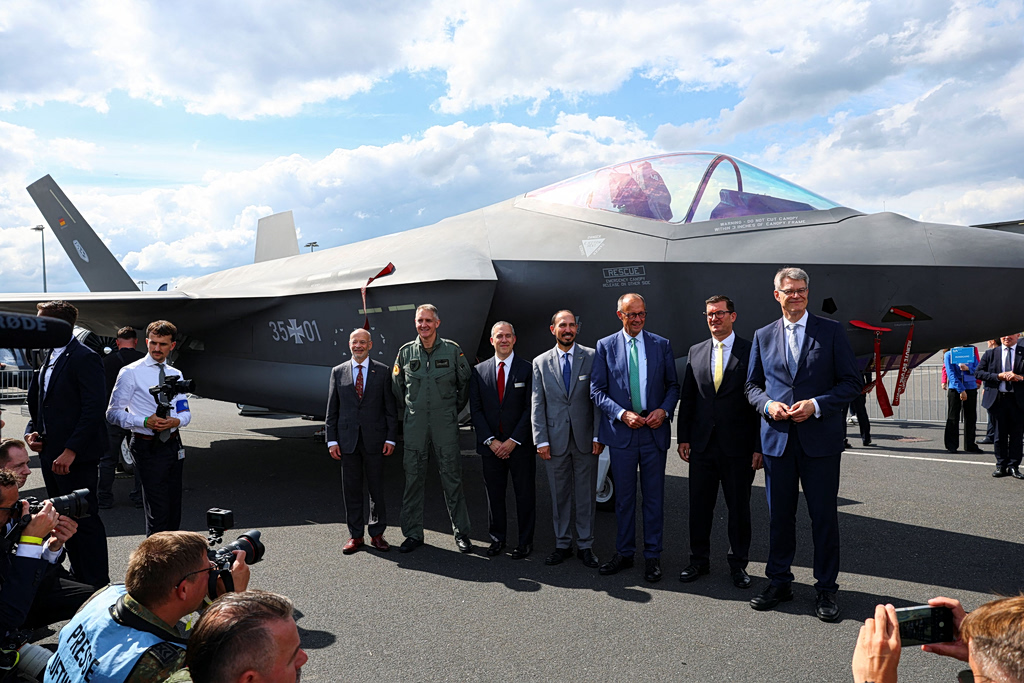
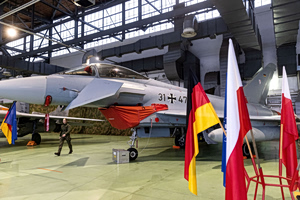
German Chancellor Friedrich Merz poses in front of mockup presentation of Lockheed Martin F-35 multirole strike fighter jet as he tours the International Aerospace Exhibition ILA on the opening day at Schoenefeld Airport in Berlin, Germany, June 10, 2026. REUTERS/Fabrizio Bensch
A walk through the exhibition stands and the outdoor areas is enough for someone to understand that the aerospace industry, especially the military sector, has taken the messages of the times seriously and is feverishly preparing for the undesirable scenario of a military conflict in Europe.
In the shadow of the failure of FCAS
Two days before the Exhibition began last Wednesday, the burial of an emblematic German-French project, FCAS (Future Combat Air System), a symbol of European defense capability, cast a heavy shadow over it. Especially for two countries that want to play the role of driving forces in the defense sector and send a strong message of military capability to the other side of the Atlantic.
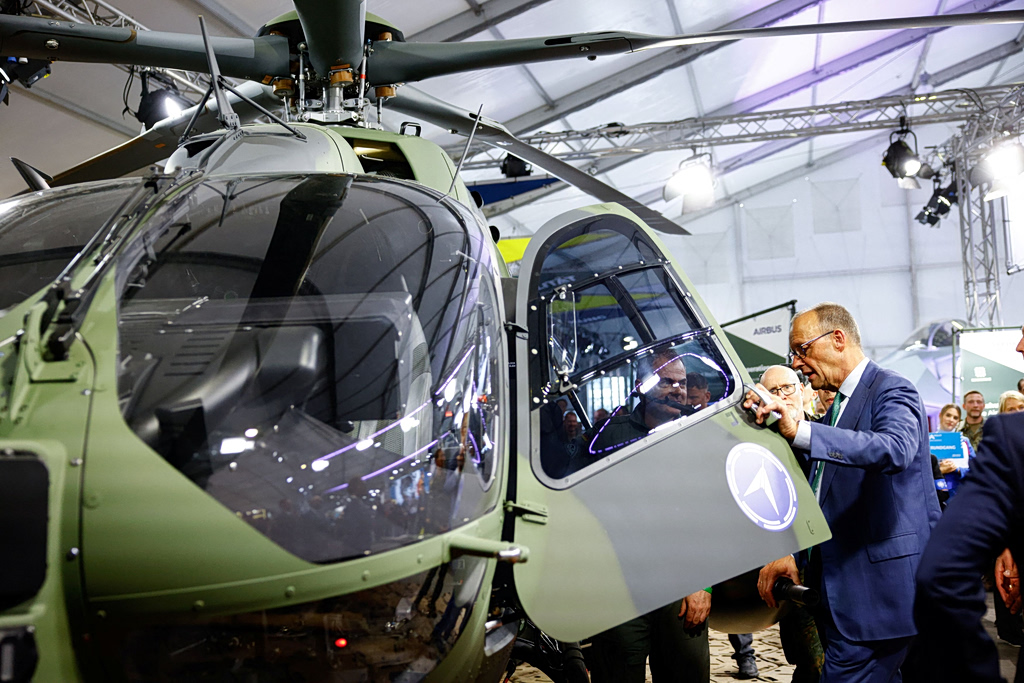
German Chancellor Friedrich Merz tours the International Aerospace Exhibition ILA on the opening day at Schoenefeld Airport in Berlin, Germany, June 10, 2026. REUTERS/Axel Schmidt
After years of preparation, Germany and France suddenly announced that the companies that were to build this state-of-the-art 6th-generation fighter aircraft – with unmanned drones, satellites, and digital battle networks integrated into a single system – had failed to reach an agreement. Conflicts of interest, particularly between the French Dassault and the European Airbus, with major facilities in Germany, regarding intellectual property, development know-how, and management of the fighter aircraft program, were insurmountable, while the cost was enormous, with delivery of the first fighter aircraft scheduled for 2040.
Of course, the chancellor, while inaugurating the exhibition, tried to present the failure as an opportunity.
“We will preserve the true core of FCAS as a European system of systems,” he said, “and within this lies a great opportunity for a central Franco-German defense industrial project of the future, which we want to develop together. Exactly how this will be worked out by the defense ministers of the two countries ahead of the next Franco-German government meeting in Germany in July.”
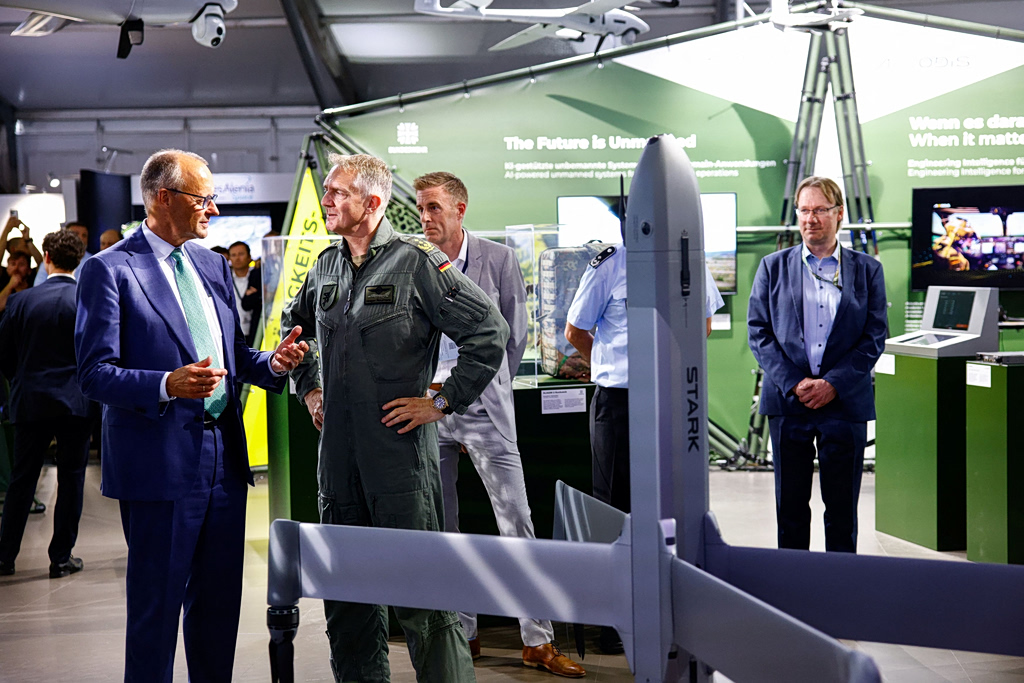
German Chancellor Friedrich Merz speaks with Chief of the German Air Force Lieutenant General Holger Neumann during a tour of the International Aerospace Exhibition ILA on the opening day at Schoenefeld Airport in Berlin, Germany, June 10, 2026. REUTERS/Axel Schmidt
Eight German companies are at the starting point for the joint development of the new latest-generation fighter aircraft in cooperation with European partners.
Drones and Ukraine
This development is reshaping the landscape of the defense industry, creating new business opportunities, and strengthening Germany’s ambitions to lead in the field of European defense. It has the resources. By 2030, defense investments will reach 3.7% of GDP.
It is not considered accidental that, a few hours before Merz visited the Exhibition, the German cabinet, under his chairmanship, approved the new German Aviation Strategy (Luftfahrtstrategie), linking it with military aerospace, innovation, and national security.
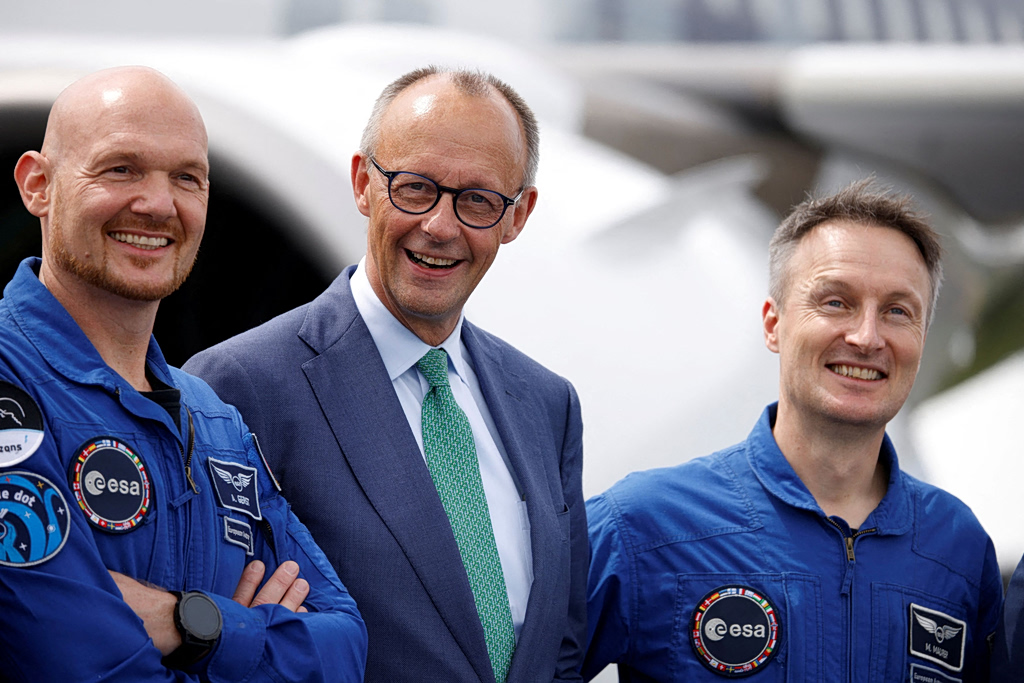
German Chancellor Friedrich Merz reacts next to European Space Agency (ESA) German astronauts Alexander Gerst and Matthias Maurer, during the International Aerospace Exhibition ILA on the opening day at Schoenefeld Airport in Berlin, Germany, June 10, 2026. REUTERS/Axel Schmidt REFILE – CORRECTING NAME FROM “ALEXANDER GERSTER” TO “ALEXANDER GERST”.
Berlin’s leadership ambitions were also displayed visually in the sky above the outdoor exhibition area. Four parachutists jumped from a helicopter in formations. The first had the German flag hanging from him – a rare move in a country that, because of its historical past, continues to have a difficult relationship with national symbols.
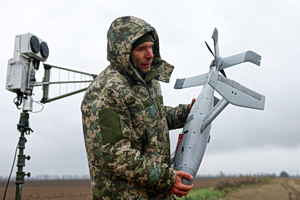
As the only Greek media outlet that accompanied the chancellor during his tour of the Exhibition stands, To Vima recorded how deeply the war in Ukraine has influenced the business decisions of defense giants.
Airbus, for example, displayed the Eurofighter Teaming, an unmanned collaborative fighter aircraft, known as a “Collaborative Combat Aircraft” (CCA), intended for use alongside fighter aircraft that the Bundeswehr will receive in 2029.
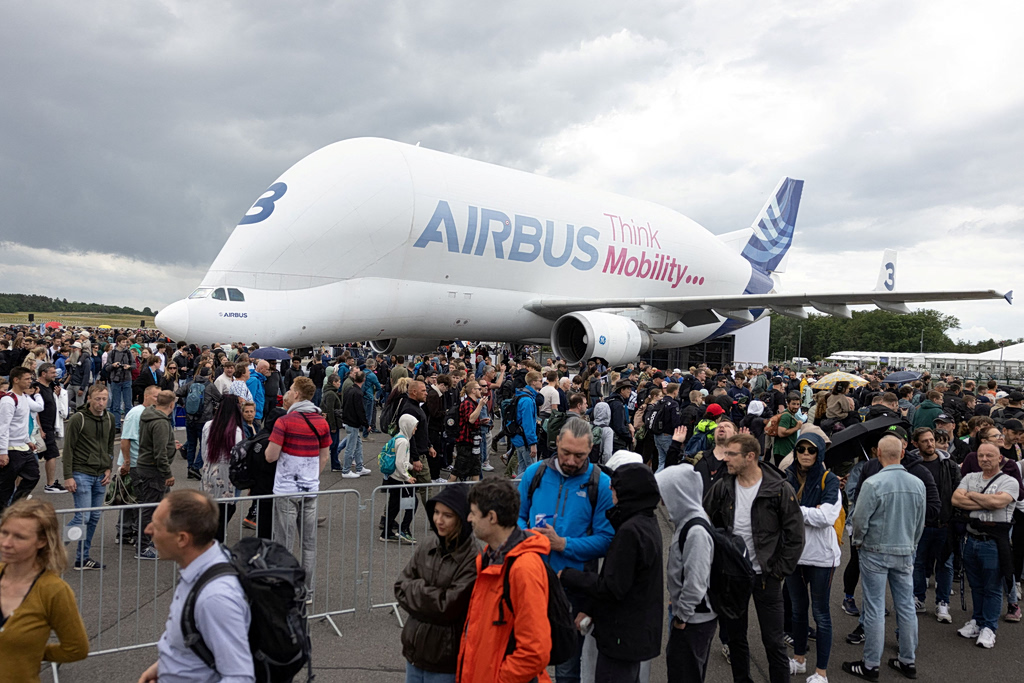
Visitors stand close to an Airbus Beluga ST aircraft at the International Aerospace Exhibition ILA at Schoenefeld Airport in Berlin, Germany, June 13, 2026. REUTERS/Axel Schmidt
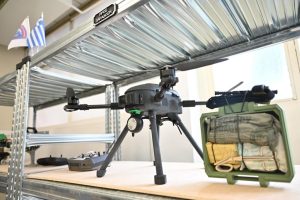
Or the UO-50 Flexrotor, a reconnaissance and surveillance drone that can take off and land vertically like helicopters.
The interest of the public – and of the chancellor – was attracted by the mobile air-defense system IRIS-T SLS MK 4, produced by the German company Diehl Defense, one of the most advanced European short-range anti-aircraft defense systems.
The Ukrainians have purchased many such systems.
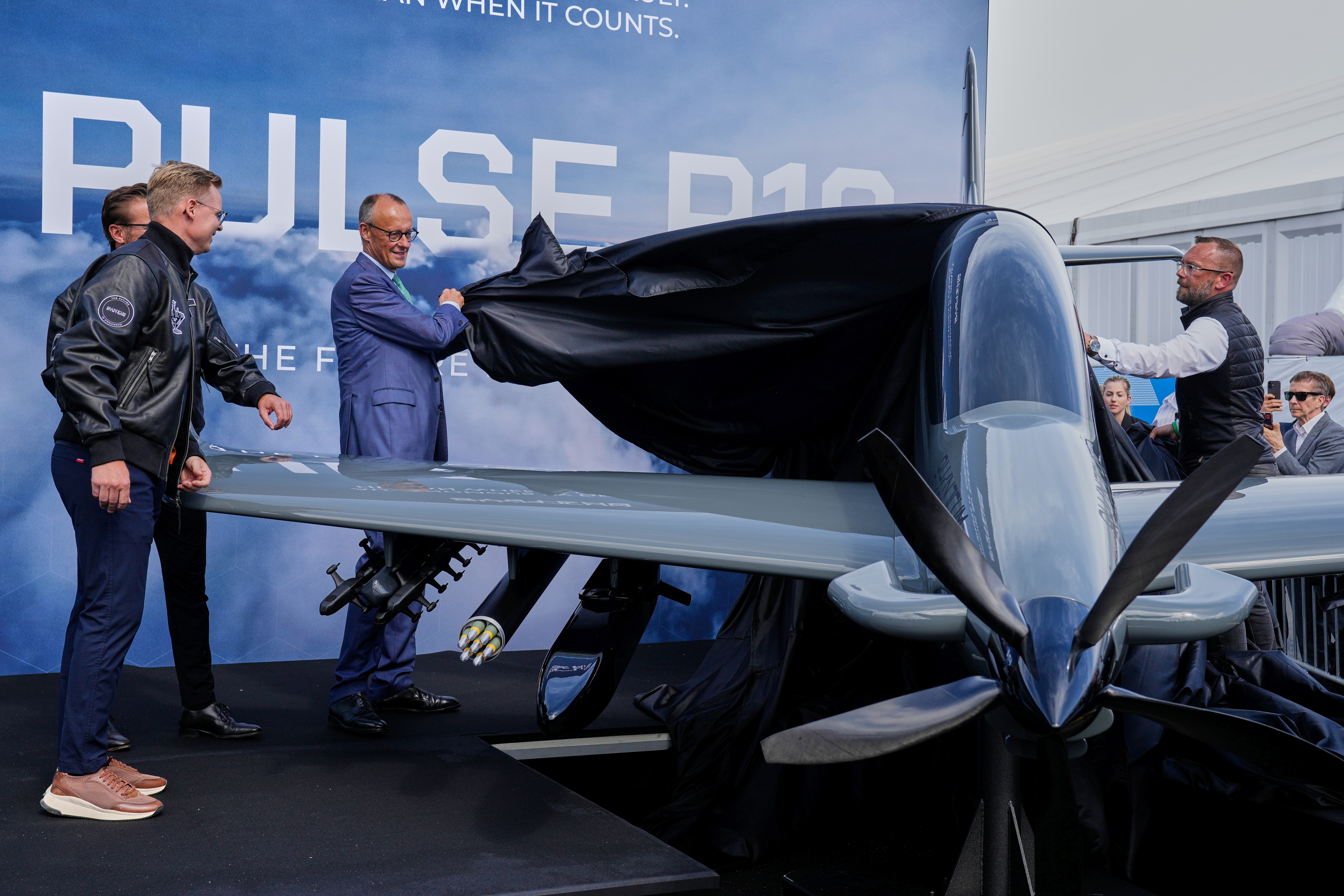
The chancellor visited the Bavarian start-up Quantum-Systems and unveiled the PULSE P19, the first German combat drone, which will most likely be introduced in 2027.
The company has created facilities and training centers in Ukraine.
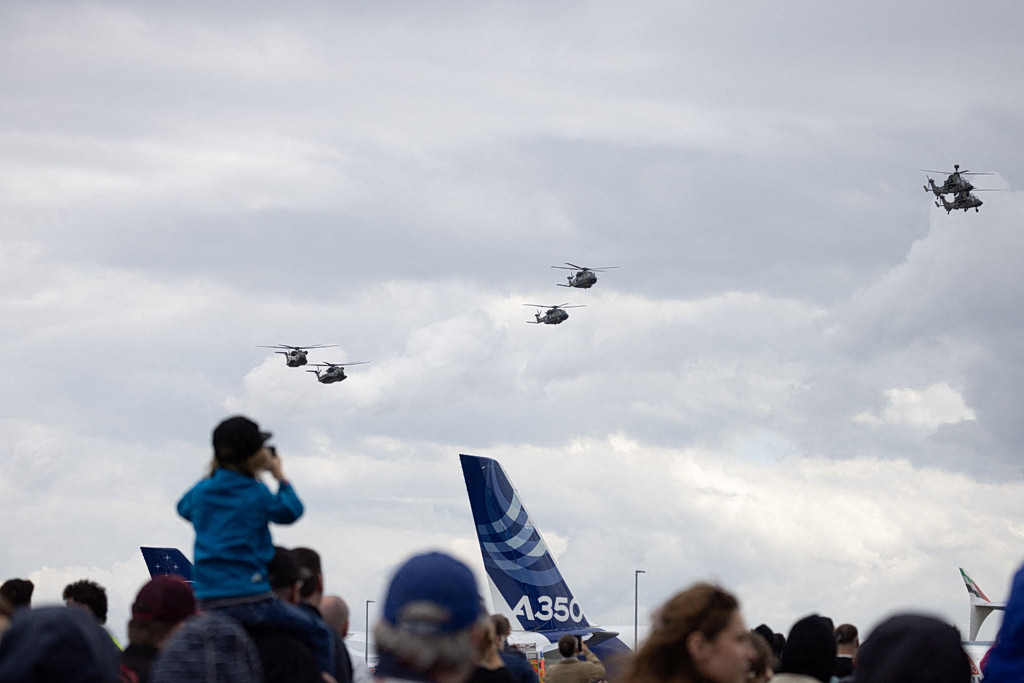
People watch a flying display by German Army helicopters at the International Aerospace Exhibition ILA at Schoenefeld Airport in Berlin, Germany, June 13, 2026. REUTERS/Axel Schmidt
“A sad situation for an airport”
Compared with previous years, this year’s ILA makes the shift in emphasis noticeable: from one of Europe’s largest commercial exhibitions of civilian aircraft to a defense or military exhibition, depending on one’s perspective.
For the first time, there is a heavily guarded “Defense Park,” and the German Armed Forces are the largest single exhibitor.
At ILA, the company Emirates is once again exhibiting the largest civilian aircraft in the world: a four-engine, double-decker A380 with 850 seats, the latest word in luxury, with private first-class suites, a spa shower on the upper deck, and a lounge with a bar.
It flew especially from Dubai for the exhibition.
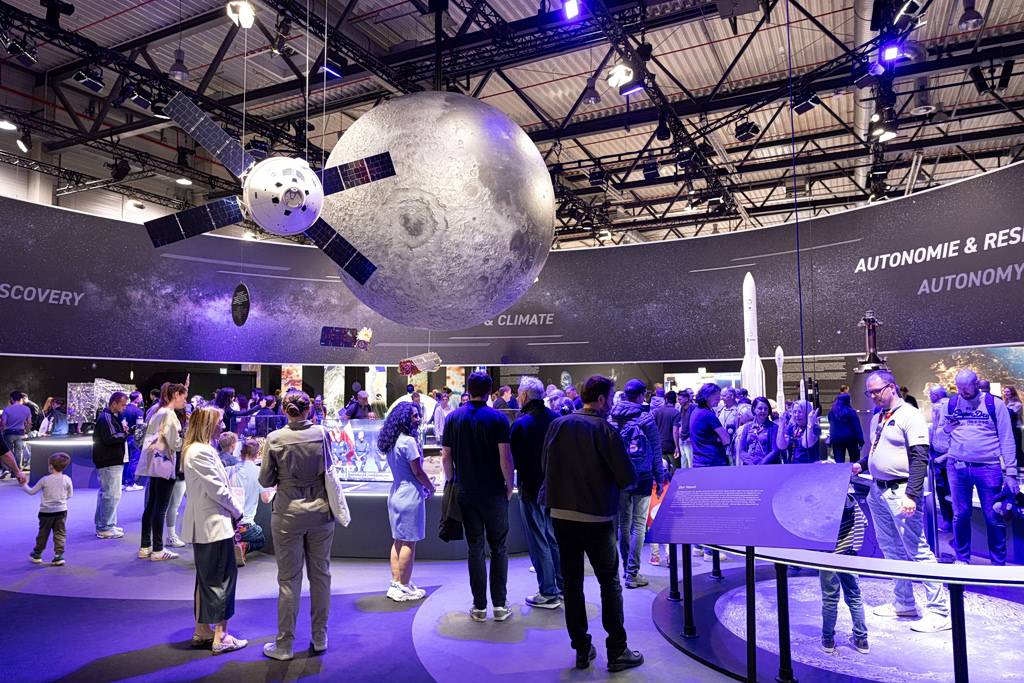
People visit the ESA (European Space Agency) space exploration exhibition at the International Aerospace Exhibition ILA at Schönefeld Airport in Berlin, Germany, June 13, 2026. REUTERS/Axel Schmidt
It is so large that it stands out from all the exhibits in the outdoor area.
A “supersized reminder” from Emirates CEO Sir Tim Clark that his company wants to fly passengers to Berlin and not merely send the aircraft as an exhibition piece.
Emirates serves four German airports, but not Berlin, “a sad situation for an airport of a European capital, a disgrace for Germany as a business center,” as he said.
The 76-year-old British manager suspects the “hand” of competing airlines, which he does not want to name.
He nevertheless warmly welcomed the chancellor for a quick tour of the flagship aircraft of his company’s fleet, before Merz departed by road for the chancellery.
Meanwhile, the police had managed to remove the demonstrators who had glued themselves to the asphalt.