 Μake us preferred on Google
 The European Central Bank raised interest rates for the first time in almost three years, leading the charge among central banks in the developed world in tackling inflation driven by the war in Iran.
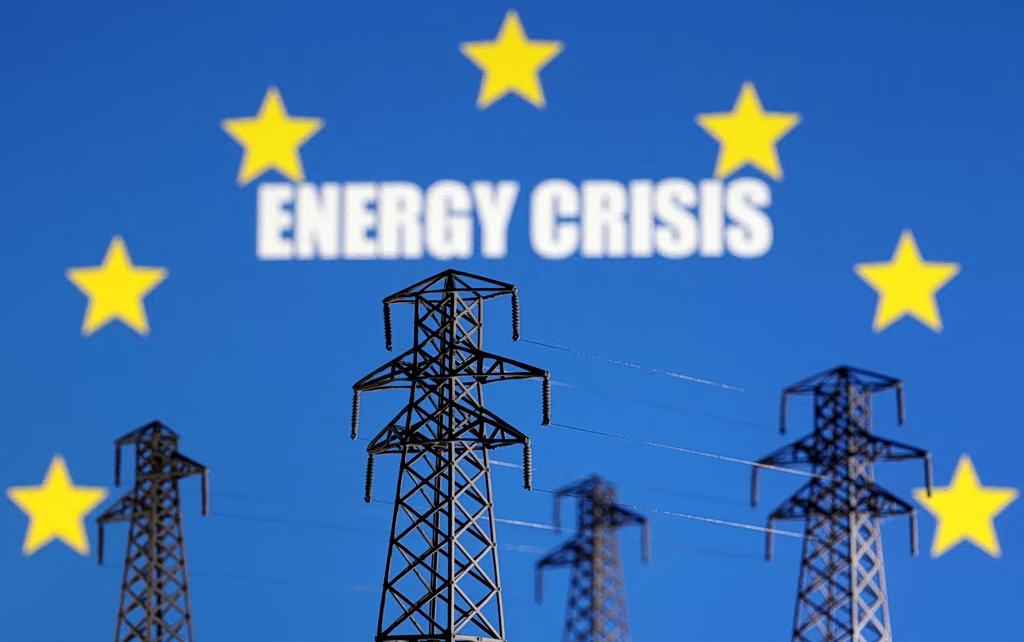
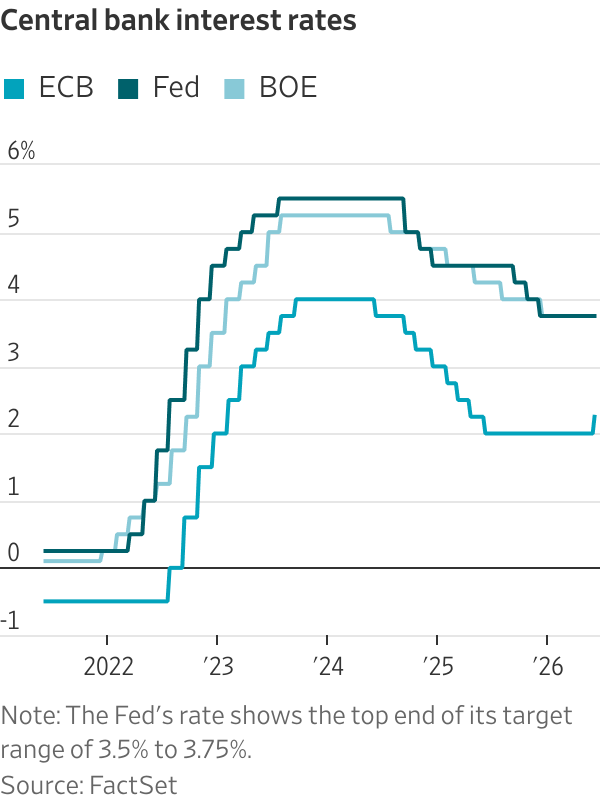
The ECB lifted its key rate to 2.25% from 2%, a move that was widely expected by markets, but which underscores the challenges facing major economies from the jump in energy prices caused by the prolonged closure of the Strait of Hormuz. Investors are betting the central bank will lift rates at least once more this year.
The decision makes the ECB the first major central bank to tighten monetary policy in response to the jump in energy prices, which has driven inflation above 3% in the eurozone . The Federal Reserve is expected to hold rates steady next week in its first meeting under Chairman Kevin Warsh , who is caught between President Trump’s desire for low rates and rising inflation pressures . The Bank of England is also expected to leave rates unchanged next week.
The Iran war has dramatically altered the paths for central banks around the world. Before the conflict, investors expected many, including the Fed, to keep lowering rates this year. Economists largely expected the ECB would keep rates steady in 2026.
The resurgence of inflation has quashed hopes for more policy loosening and left policymakers grappling with how to navigate opposing risks to the economy. Waiting to raise rates could allow higher energy prices to spread to other parts of the economy, while moving too quickly to tighten policy could deepen a slowdown in growth. The uncertainty over the timeline for ending the conflict has also made it more difficult to forecast where the economy is headed.
Europe’s economy has been hit harder by the fallout of the war in the Middle East than the U.S., which is benefiting from both the AI investment boom and surging energy exports.
Still, the ECB has moved faster to lift rates largely because it has more room to do so. Policy rates are nearly 1.5 percentage points lower in the eurozone than in the U.S. Coming into the conflict, the ECB’s interest rate was at the level economists believe is neutral for the economy—neither constraining nor stimulating growth.
“Of all the major central banks, the ECB was among the best positioned to start a hiking cycle. And that’s because policy [rates] had already gone to neutral,” said Laura Cooper, global investment strategist at the asset manager Nuveen.
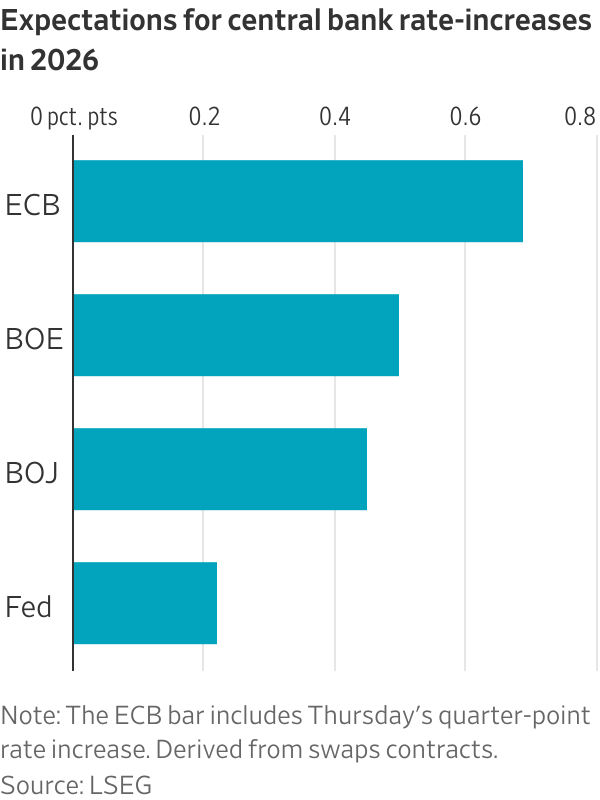
While the ECB has led the response among its peers, policymakers in developing nations such as Indonesia have also increased rates to contain inflation and help stem pressure on their currencies. Central banks in Australia and Norway raised rates in May, while the Bank of Japan is expected to next week.
Economists view the ECB’s rate increase as “insurance” against the risk that higher commodity prices push up wages and the price for other goods, rather than the start of an aggressive tightening campaign.
“They just want to reassure households and firms that essentially you won’t get a repeat of 2022 in terms of inflation,” said Tomasz Wieladek, chief European macro strategist at T. Rowe Price.
Global policymakers were criticized for reacting too slowly to contain price rises in 2022, allowing inflation to become entrenched and requiring a sharp increase in rates.
Economists see a smaller risk of a broad-based surge this time around. While inflation has shot above the central bank’s 2% target, the economy is on weaker footing compared with 2022. Back then, activity was being supported by outsize demand from the pandemic reopening and government stimulus. The natural-gas price rise driven by Russia’s invasion of Ukraine was also larger in scale.
The eurozone is already at risk of stagnating. The economy shrank 0.2% in the first quarter of the year, though the data was heavily skewed by a sharp pullback in the Irish economy, which is often volatile due to its role as a hub for U.S. multinationals. Recent survey data has shown business activity is slowing as higher fuel prices dent demand for goods and services.
Wieladek expects that in the coming months the ECB’s focus will shift from inflation to weakening growth. He thinks the central bank could raise rates again in September then hit pause.
“It’s going to be incredibly challenging to keep hiking in the environment when economic growth is close to zero,” said Wieladek. “By the time it comes to September it will become obvious that the economy slowed down significantly.”
Write to Chelsey Dulaney at chelsey.dulaney@wsj.com