 Μake us preferred on Google
 An aging fleet of water-bombing planes, which have been grounded frequently for maintenance in recent days, has fueled a debate in France over whether the government was ready for some of the worst wildfires in decades.
Opposition lawmakers have blamed French President Emmanuel Macron for failing to replace the country’s 12 Canadair planes, which are decades old and serve as the vanguard of its aerial firefighting response.
Last Saturday, as wildfires tore through pine forests in southwestern France, Canadair pilot Grégory Prats said only five of the planes were available to fight the fires. “It’s just outrageous,” he said in an interview with franceinfo. “We are facing fires of enormous intensity.”
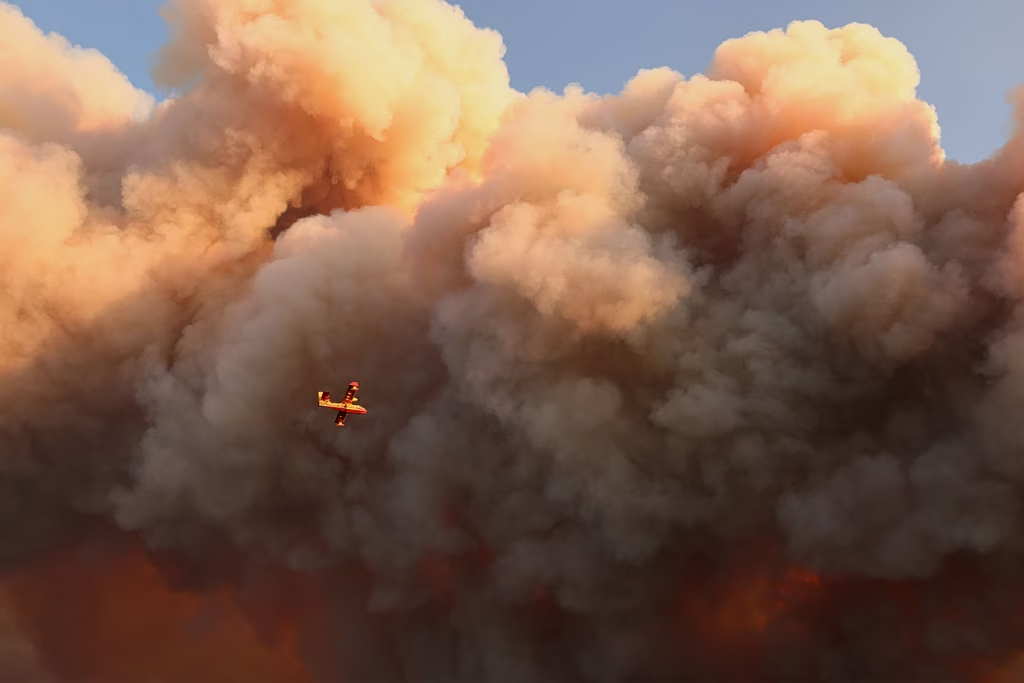
Wildfires have ripped across parts of France and Spain. Firefighters in France have been battling an inferno in the region around the city of Bordeaux that has burned more than 100,000 acres, marking the area’s largest blaze since a deadly fire in 1949.
After wildfires ravaged southwestern France in 2022, Macron pledged to refresh the country’s entire Canadair fleet and buy four more planes by 2027, aiming to have 16 new aircraft by the end of his presidential term.
Four years later, the government has ordered only four. The first two aren’t expected to arrive until 2028, with two more scheduled for delivery four to five years afterward. Its existing fleet includes planes that are 19 to 32 years old.
The delay is partly because of a bottleneck at De Havilland Canada, the manufacturer of the plane. But France exacerbated the problem by cutting the funding intended to pay for two of the planes in 2024, in an effort to save money and reduce the government’s burgeoning deficit. France put in a fresh order for two of the planes in June, but they have been pushed down the waiting list.
“We have lost a crazy amount of time,” said far-left lawmaker Damien Maudet , who co-wrote a parliamentary report last year urging the government to quickly renew its Canadair fleet.
The French government has defended its firefighting effort, saying the Canadair planes are just one of the tools it has at its disposal. Its firefighting fleet also includes Dash 8 water-bombing planes, which can drop more than 2,600 gallons of water or fire retardant. Unlike the Canadairs, which quickly scoop water from rivers or lakes, the Dash 8 has to be refilled on the ground.
The French government has requested help from the European Union—which dispatched a fleet of seven aircraft and four helicopters from Sweden, Portugal and Germany, among other countries—and is hoping to get more help within the next few days. But France isn’t the only country vying for these limited aerial resources.
“We have deployed all the resources we could,” Macron said on Monday. “Right now, we need to be united and take action,” he added.
French Interior Minister Laurent Nuñez said on Monday that it was normal for the planes to require maintenance. “Every day, you effectively have aircraft undergoing maintenance that we offset with rentals,” Nuñez said, adding that on Monday seven Canadair planes were operational.
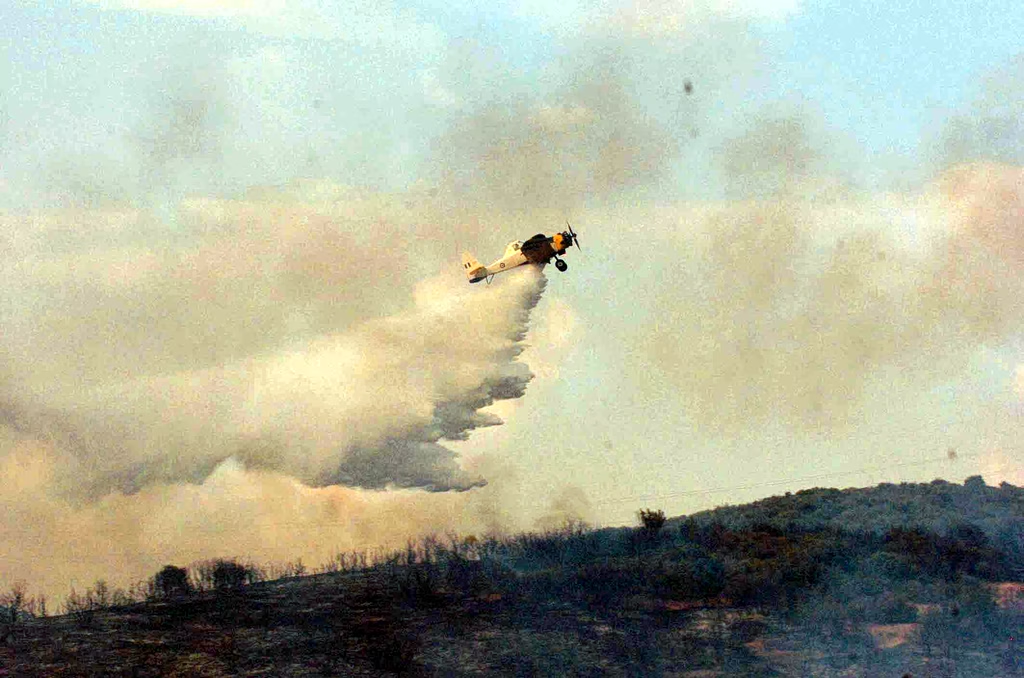
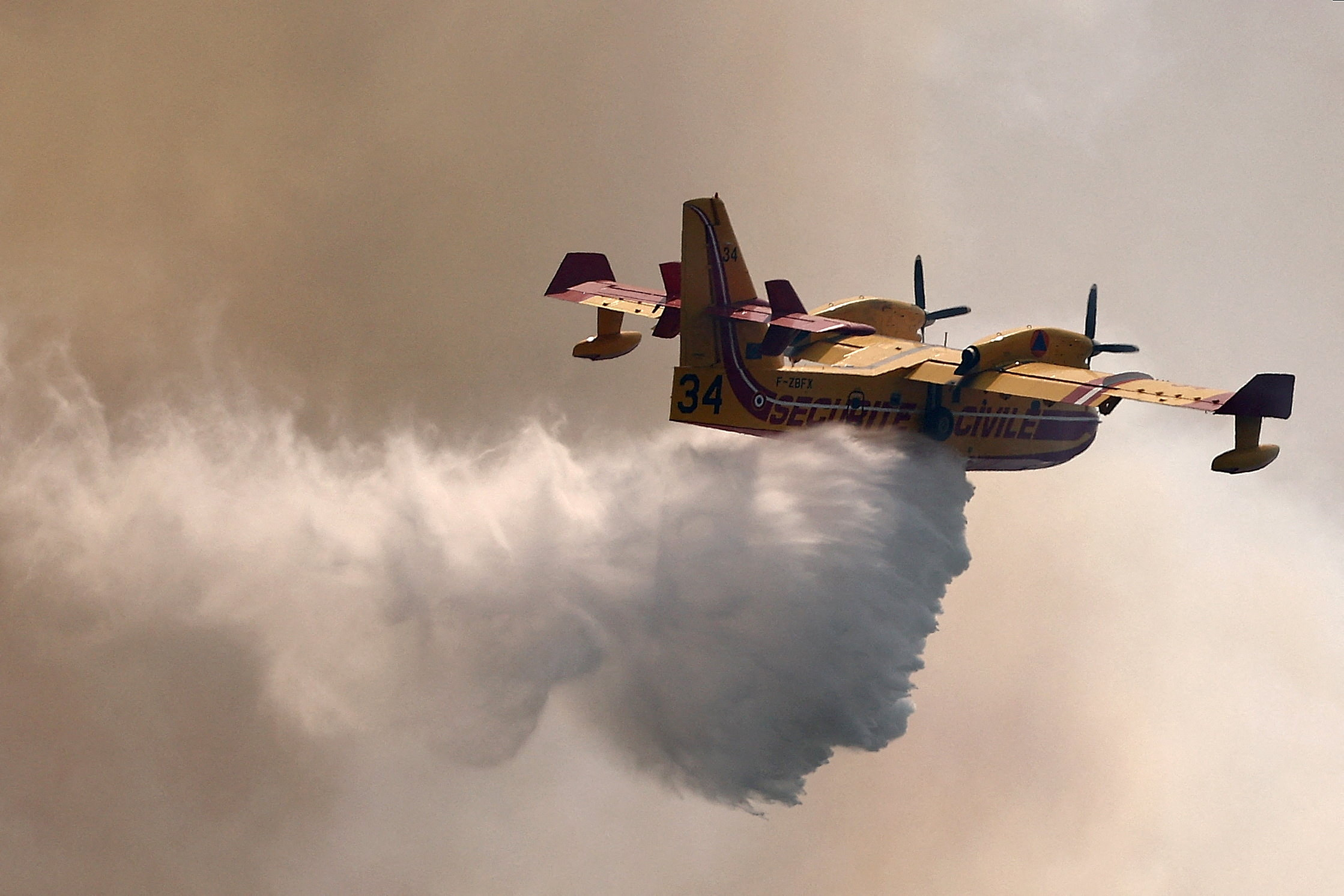
The Canadair planes are specially designed for the particular challenge of fighting wildfires. They strike open bodies of water at high speeds to fill their tanks in seconds, and pull up into unstable, superheated thermal air columns directly above raging fires—then head back to refill and restart the process. As these planes age, they can corrode and require increasingly complex, time-consuming maintenance to keep them flight-ready.
De Havilland’s new Canadair 515, which is scheduled to roll off production lines in 2028, is a bid to revive the so-called Super Scooper amphibious aircraft that takes 12 seconds to refill its more-than-1,500-gallon water tank. Production of an earlier model was halted in 2015 after previous owner Bombardier ran through its order book, delivering some 225 aircraft. About 160 of those are still in service.
The aircraft isn’t the only one of its kind, but its capacity, rapid refilling rate and relatively small size have made it the cornerstone of European firefighting fleets. Countries often complement them with smaller scoopers, helicopters and fixed-wing aircraft that carry higher loads but have to be refilled on land.
The new model, which adds several upgrades such as cockpit air conditioning, currently has 38 orders, 24 of which are from EU countries, according to Neil Sweeney , who heads government relations and corporate affairs for De Havilland. In total, the company expects to build between 250 and 350 at a rate of about 10 a year.
“As summers get longer and hotter, as climate changes in the Northern Hemisphere, we’re seeing fires in places they weren’t before,” Sweeney said. “Demand right now is steady. This year may change that.”
The lack of firefighting capacity has left France trying to find alternative aircraft to help contain the blazes. That includes the first deployment of an A400M military-transport aircraft to help with the emergency response. The Airbus planes cost about $170 million apiece and carry four turboprop engines.
The plane maker, which has evacuated two of its sites near Bordeaux because of the wildfires, has provided French forces with prototype firefighting upgrades that were tested last year. The equipment enables the A400M to carry more than 5,000 gallons of water, all of which can be released in a single gravity-drop maneuver and refilled in about 10 minutes back on the ground.
“The A400M is not an aircraft designed specifically for firefighting, but these aircraft are available,” Airbus Chief Executive Guillaume Faury said on Wednesday, adding that the company had accelerated the A400M modifications to support the active firefighting efforts. “We don’t have a dedicated Canadair-like firefighting aircraft, but we have worked to bring firefighting capabilities to the aircraft we have.”
France isn’t the only country struggling with its aerial firefighting. In Spain, fires near Madrid have destroyed more than 190,000 acres, according to the country’s minister for ecological transition.
Spanish Prime Minister Pedro Sánchez in May presented what he described as Spain’s largest-ever deployment of firefighting equipment ahead of this year’s wildfire season. The response still fell short.
Spain’s firefighting fleet includes 15 water-scooping planes, reconnaissance aircraft and helicopters. Those resources were focused in the fight against the fires that for days spread uncontrollably near Madrid, forcing about 100,000 people to evacuate or stay at home.
Spanish firefighters have made progress over the past two days, stabilizing the blaze and allowing tens of thousands of people to return home.
Write to Noemie Bisserbe at noemie.bisserbe@wsj.com , Benjamin Katz at ben.katz@wsj.com and Margherita Stancati at margherita.stancati@wsj.com