 Μake us preferred on Google
 BEIJING—At the end of President Trump’s state visit to China on Friday, with Air Force One lifting off through the haze at Beijing’s airport, both sides hailed a reset in relations—though each has a starkly different idea of what that means.
For Trump, it is about opening China’s market to American business and reciprocal trade, reviving a U.S. policy he scrapped in his first presidency, when he had adopted a more hawkish attitude toward Beijing.
Chinese leader Xi Jinping, meanwhile, wants “strategic stability”—a predictable relationship in which Washington doesn’t impede Beijing’s economic and geopolitical rise.
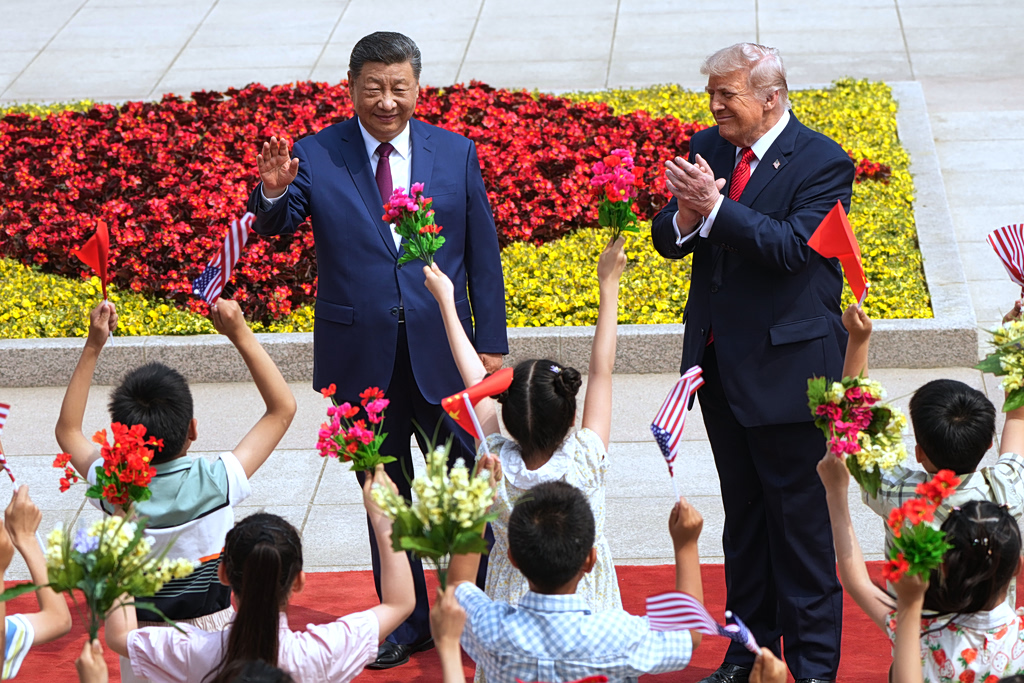
President Donald Trump and China’s President Xi Jinping greet children during a welcome ceremony at the Great Hall of the People, Thursday, May 14, 2026, in Beijing. (AP Photo/Mark Schiefelbein)
The shared desire for stable relations is a change after years of mutual antagonism.
“‘Strategic stability’ from strategic rivalry is a major shift,” said Henry Wang, founder and president of the Beijing-based Center for China and Globalization. “We are moving to a new normal. This summit was an inflection point after a tough relationship that began with the start of Trump.”
Under the surface, however, there remains an intense rivalry that holds the potential to disrupt the world stage, despite the bonhomie of the two-day visit.
China is boldly pressing its claims on Taiwan, a self-governing island that the U.S. is committed to supplying with arms for its self-defense. China’s military is becoming increasingly aggressive in the Western Pacific, rattling U.S. allies and posing a serious military and geopolitical challenge to Washington. And China’s support of Iran—an issue Trump raised during his visit—could undermine U.S. efforts to force the regime to give up its nuclear program and halt its aggression in the Middle East.
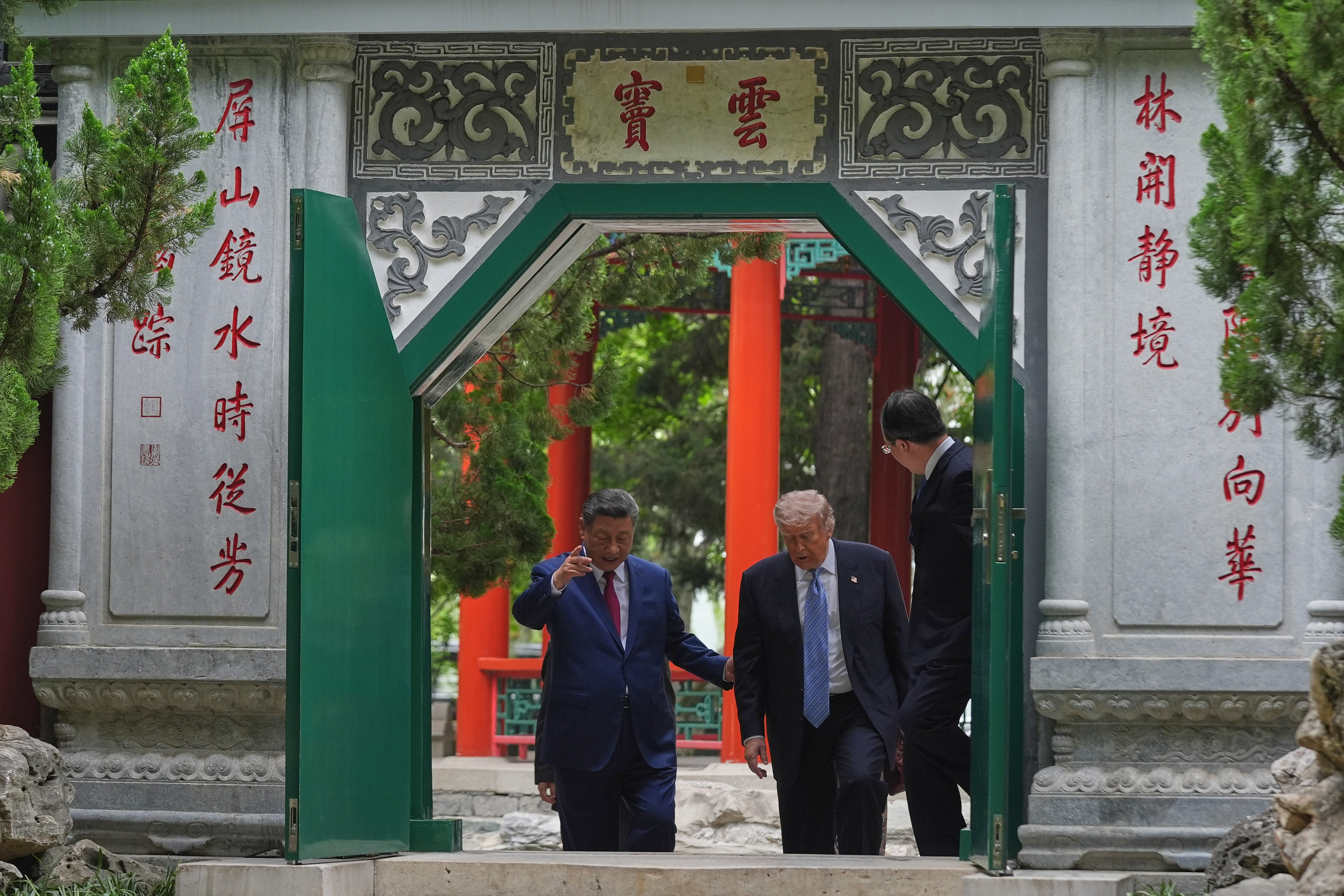
Such disagreements didn’t cool Trump’s show of admiration for a man he repeatedly called his friend. Trump marveled at his reception, from a grand welcome ceremony to a Day Two stroll through the Chinese leadership compound in Beijing.
Throughout the visit, Xi sought to present China as a global power that is quickly closing the gap with the U.S. despite what it sees as efforts by multiple U.S. administrations to contain its rise.
Trump said he was “very impressed.”
“The relationship is a very strong one,” the president said Friday at the leadership compound in the heart of Beijing.
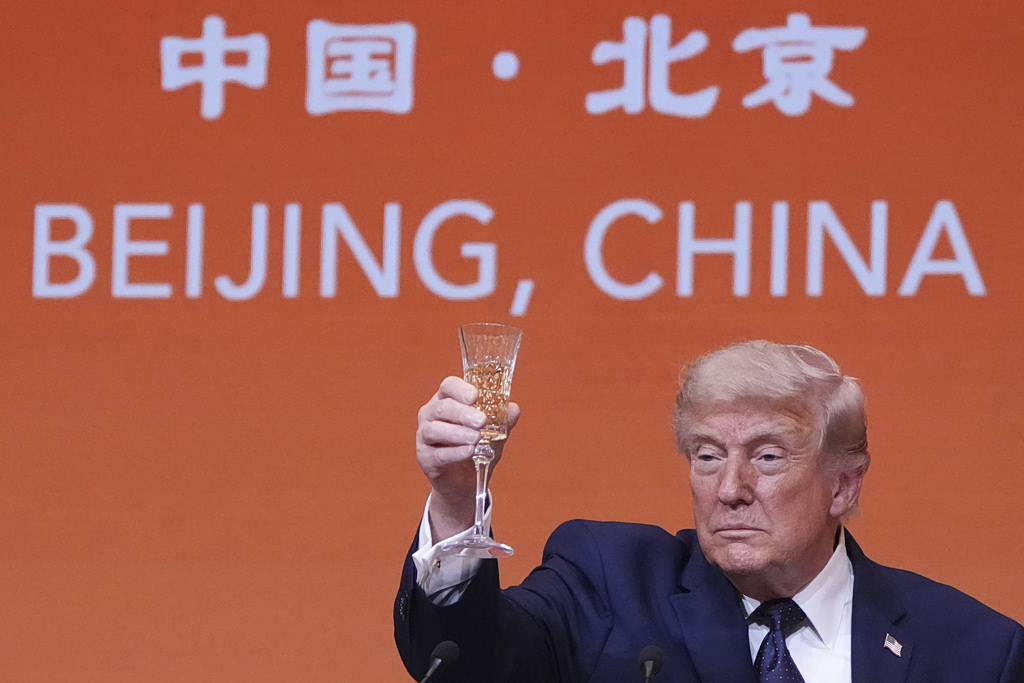
President Donald Trump proposes a toast during a state dinner with China’s President Xi Jinping at the Great Hall of the People on Thursday May 14, 2026, in Beijing. (AP Photo/Mark Schiefelbein)
Trump left Beijing without offering concrete details of any trade agreements. Later, Trump told reporters on Air Force One that American farmers would be happy with China’s purchases of American soybeans. Trump added that he and Xi discussed lifting sanctions on Chinese companies that buy Iranian oil.
His one detailed announcement during the visit, that China would buy 200 Boeing aircraft—fewer than the expected 500—led the company’s stock to fall nearly 4%.
The broad takeaway in Beijing was that Trump and Xi both sought an end to a 10-year era in which the U.S. sought to blunt economic and security threats from China.
Trump, for instance, in a Fox News interview in Beijing played down concerns about China’s espionage and theft of American intellectual property, and floated the idea of the U.S. allowing more Chinese students—where his administration once threatened to expel them.
Xi wants more predictability out of Trump, in particular on trade. U.S. tariffs have hit a key pillar of its growth when some in China were already questioning Xi’s handling of the economy.
But for Xi, Taiwan is the most important issue—and one that could ultimately make or break the relationship with the U.S. Xi said Thursday that any mishandling of tensions over the island, a self-governing democracy Beijing wants to control, could spark an “extremely dangerous situation”—a nod to the potential for a great-power war.
“He does not want to see a fight for independence because that would be a very strong confrontation,” Trump told reporters on the flight back to the U.S., though he minimized the risk of such a conflict.
Trump said he wouldn’t tell the Chinese leader whether the U.S. would defend Taiwan, later adding: “The last thing we need right now is a war.”
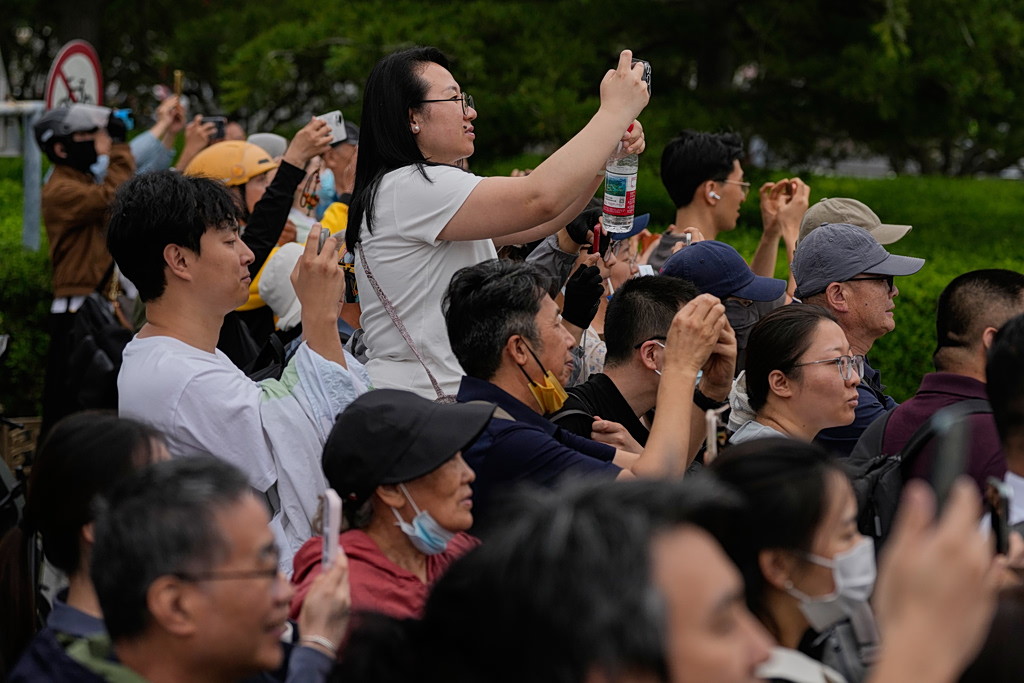
Onlookers try to catch a glimpse of U.S. President Donald Trump’s motorcade moving past Changan street as he heads to Zhongnanhai leadership compound to meet with Chinese President Xi Jinping, in Beijing, Friday, May 15, 2026. (AP Photo/Andy Wong)
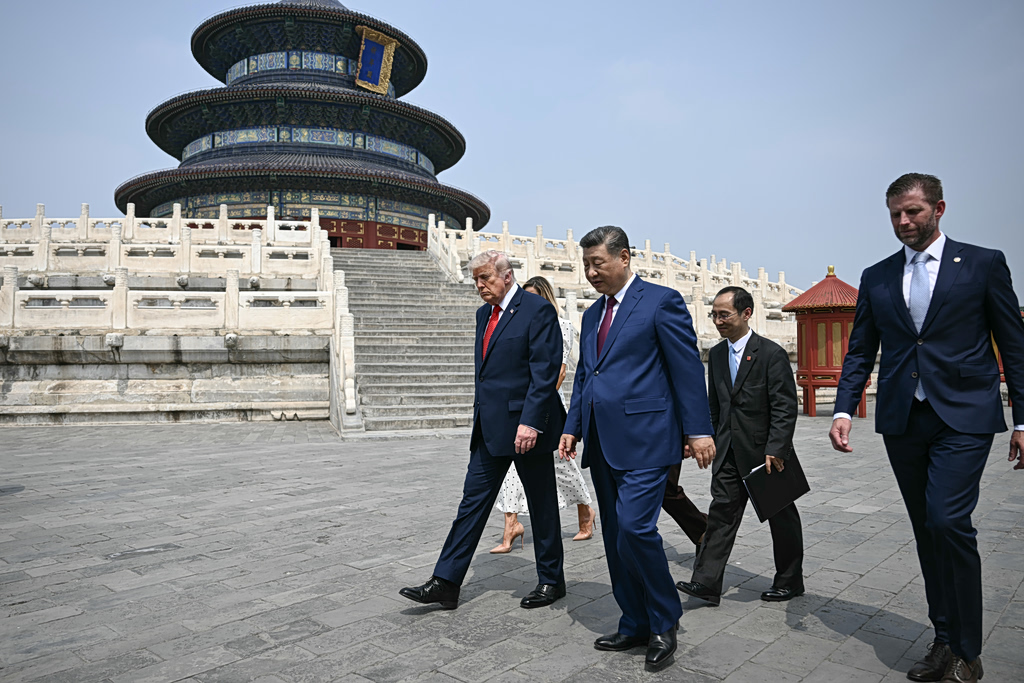
China wants concessions from the U.S. on Taiwan, including small but crucial rhetorical shifts such as moving from not supporting Taiwanese independence to publicly opposing it, while also limiting weapon sales to the democratic self-governed island. Xi also hailed ties with the U.S., in effect arguing that China’s rise didn’t pose a threat to the U.S. “Achieving the great rejuvenation of the Chinese nation and making America great again can go hand in hand,” Xi said at a state dinner for Trump on Thursday. The turnaround was months in the making. Last year, the U.S. imposed tariffs on China—some rising higher than 100%—prompting Beijing to restrict exports of rare-earth materials. Trump and Xi in October brokered a trade truce in South Korea that slashed the tariffs. But after China restricted the exports of the rare earths that are crucial for some U.S. manufacturing, many in Beijing have sensed a shift in how Trump approaches the relationship. “China couldn’t punch back a decade ago. But now if the U.S. plays hardball, China can play hardball, too,” said Wang. In recent months, Trump told aides not to derail plans for the Xi summit and labeled the U.S.-China partnership as the “G-2,” suggesting that the superpowers effectively dominated the world stage. China, reading the signs, saw the summit as a chance to assert itself. “They are trying to lock in a truce, albeit one favorable to them,” Rush Doshi, who worked on China in former President Joe Biden’s National Security Council, said of China. “They want to lock it in beyond Trump, or use the Trump detente as the baseline for the future.” It will take more than momentary camaraderie for Washington and Beijing to change course. Trump, despite his friendly tone toward China, still leads an administration that is tough on Beijing. In recent weeks, the U.S. placed sanctions on Chinese entities suspected of aiding Iran’s targeting of U.S. bases in the Middle East and accused Beijing of stealing artificial-intelligence technology from American companies. The Justice Department continues to charge people, including U.S. politicians, who are alleged to have illegally aided China. China’s President Xi Jinping, center, U.S. President Donald Trump, left, and Eric Trump, right, visit the Temple of Heaven in Beijing Thursday, May 14, 2026. (Brendan Smialowski/Pool Photo via AP) And the war in Iran and U.S. commitments to Taiwan could derail any intended progress, having already clouded a summit centered on economics and trade. Trump came to Beijing looking for China to pressure Iran, which largely relies on China for its economic survival, to give in to U.S. demands and agree to an end to the conflict. During the summit, Trump suggested he and Xi saw eye-to-eye on Iran, noting Beijing agreed that ship traffic through the Strait of Hormuz should be free and Tehran should never get a nuclear weapon. But China’s Foreign Ministry issued a mid-summit statement with the blunt message that the war should never have been started in the first place. Both men are scheduled for another summit on Sept. 24 in the White House, and may also speak to one another on the sidelines of two international gatherings this year. This sequence of meetings could come at the expense of Taiwan, as Taipei awaits a multibillion-dollar arms package from the U.S. that Trump could postpone to avoid angering Xi before future meetings, analysts say. Meanwhile, Trump may be satisfied with the side deal he brokered with Xi during the Beijing visit. While touring the Zhongnanhai garden, Trump admired large rose blooms calling them “the most beautiful roses anyone has ever seen.” Xi directed his staff to send seeds to the U.S. for the White House Rose Garden.