As negotiations with Iran broke down Tuesday before they had even begun, President Trump asked aides whether the U.S. should resume attacks on the country, according to U.S. officials.
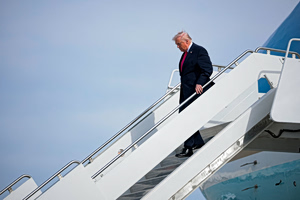
Just hours earlier, White House officials had been optimistic that Vice President JD Vance , set to depart for Islamabad Tuesday, would be able to strike a deal with Iran and get something in writing, unlike his trip to Pakistan two weeks prior, a U.S. official said. Air Force Two sat idle most of the day at Joint Base Andrews in suburban Washington awaiting Vance.
Pakistani mediators said Iran’s top leaders had told them earlier that their negotiating team would also travel to Islamabad on Tuesday. Then, with the clock ticking toward Trump’s cease-fire deadline, Iran reversed course.
In a series of frenzied meetings throughout the day at the White House, Trump weighed his options with Vance, top security officials as well as his son-in-law Jared Kushner and Steve Witkoff, who were also supposed to depart Tuesday for Islamabad for negotiations.
By early afternoon, Vance’s trip was paused. By evening, it was delayed indefinitely.
During the meetings, aides told Trump that Iran’s government wasn’t a unified entity, with hardline factions in Tehran unwilling to bend to the president’s demands. Questions were raised at the White House about whether Iran was really even in a position to negotiate and stick to any commitments.
Even as Trump asked about resuming the bombing campaign, officials said he seemed wary about restarting hostilities and prolonging a conflict that is deeply unpopular with the American public.
Trump and his team split the difference: Maintain pressure on Iran indefinitely until they make a concrete offer to the U.S. After that, the president could gauge whether negotiations could proceed or if he would have to order a new wave of strikes on the Islamic Republic.
Trump said in a social-media post Tuesday that he would maintain the blockade and extend the cease-fire, which was set to expire Wednesday, as long as talks continue. Vance could still leave later in the week, but Trump is privately discussing canceling the trip altogether, a U.S. official said.
The high-stakes game of chicken complicated the effort to negotiate an end to a conflict that has left thousands dead and sent shudders through the global economy.
Delaying tactics aren’t uncommon in negotiations where every detail can be a source of leverage. But mediators said Tehran’s last-minute curveball this time reflected its anger at the week-old American blockade of its ports and an effort by the government’s hard-liners to extract the highest possible price to end the war.
The U.S. military raised the pressure on Iran Tuesday by boarding a sanctioned crude-oil tanker in the Indian Ocean, part of an effort to crack down on ships in the so-called shadow fleet that help Iran evade sanctions.
Tehran went into the first round of talks earlier in April confident that its grip on the Strait of Hormuz and the ability of its drones and missiles to inflict economic pain on the Gulf and global economy had given it leverage in the talks. The largely effective U.S. blockade, which took effect 24 hours after the first round ended without a deal, has chipped away at Tehran’s advantage.
“I think it levels the scales of pressure between the U.S. and Iran,” Michael Singh , a former senior director for Middle East affairs at the National Security Council who is now at the Washington Institute think tank, said of the blockade. “Previously Iran was exporting oil and no one else was, which meant time and pressure were working against Washington.”
Iran’s new leaders, while desperately in need of sanctions relief to rebuild the country after more than 20,000 U.S. and Israeli airstrikes, are aiming to show they can withstand the economic pain and outlast the U.S. in the war.
Many Iranian officials saw the decision to end fighting so quickly in last June’s 12-day war as a strategic mistake . That view became more entrenched as the U.S. tightened the economic screws after the war, deepening a crisis that led to protests that shook the regime in January.
Iran dragged things out going into the first round of talks as well, saying it wouldn’t join without a cease-fire in Lebanon. The talks went ahead anyway without a truce on that front, but the White House did ultimately deliver one days later.
This time, Iran’s hard-line leadership, which has publicly proclaimed that it won’t negotiate under pressure, couldn’t easily green light the talks while the U.S. is actively bottling up its ports, the mediators said.
“Blockading Iranian ports is an act of war and thus a violation of the cease-fire,” Iranian Foreign Minister Abbas Araghchi said on social media. “Striking a commercial vessel and taking its crew hostage is an even greater violation.”
In Islamabad, the city was ready and waiting for a meeting that is now uncertain. The airport road was heavily manned with armed guards in pickup trucks, and soldiers sat around town on plastic chairs. Authorities requisitioned three luxury hotels, but shops remained open, unlike during the first round of talks. The owner of a convenience store at a fuel station said he lost 20% of his weekly business, or more than $20,000, during that shutdown but wouldn’t mind shutting again to support an important role for the country.
While Trump has said he is ready to get back to fighting, he has repeatedly backed away from threats to hit Iran’s power plants and other key infrastructure. Earlier, he appeared to add an extra day to the cease-fire, which had initially been expected to end Tuesday.
The pressure from markets has eased with the cease-fire in place. The S&P 500 stock index has been higher than it was before the war, and the rise in oil prices has been blunted. Iran’s daily drone and missile attacks on Gulf oil producers have ended as well.
The official Telegram account of Iranian Supreme Leader Mojtaba Khamenei published threats late Tuesday to attack U.S. and Israeli forces, but so far the cease-fire has held.
Despite high levels of mistrust on both sides and big gaps in their bottom lines, mediators and other people familiar with the talks say the two foes have been engaging with ideas that could point to possible compromises around core issues like Iran’s nuclear program.
The two sides are getting closer to a framework that would include a basic understanding on curbing Iran’s uranium enrichment, what to do with enriched uranium stockpiles and reopening the strait, people familiar with the matter said.
Iran often deploys long waits to “keep people guessing until the next minute,” said Mohamed Amersi , an Iran expert and member of the Global Advisory Council of the Wilson Center, a Washington think tank.
The blockade cuts into Iran’s ability to use the Strait of Hormuz as a bargaining chip and could over time put pressure on the regime to ease its negotiating position
Some analysts believe that a fully enforced blockade could strip Iran of almost $300 million in daily export revenue and disrupt the imports needed to keep its economy going. Others say it will take longer to bite, while Iran’s own closure of the Strait of Hormuz squeezes global oil supplies.
“This is a leverage seeking exercise, pure and simple,” said Behnam Ben Taleblu , at The Foundation for Defense of Democracies, a Washington think tank which has opposed Iran’s regime. “In the short-term, it signals U.S. commitment, which is important, as this is as much a war of wills as it is one of energy and security.”
U.S. forces have directed 28 vessels to turn around or return to port since the blockade of Iranian ports began on April 13, said U.S. Central Command, which oversees the U.S. military in the Middle East.
Singh warned that the blockade could prove a double-edged sword for Washington, at a time when the blockade of the Strait of Hormuz is hurting the world economy and driving up U.S. energy prices ahead of November’s midterm elections.
“The blockade is a bet that Iran will break before the rest of the world will, but it’s a risky bet,” he said. “The Iranian regime is fighting for its survival and has demonstrated an ability to withstand the strangulation of its oil exports.”
Write to Summer Said at summer.said@wsj.com , Laurence Norman at laurence.norman@wsj.com , Alexander Ward at alex.ward@wsj.com and Natalie Andrews at natalie.andrews@wsj.com