BEIJING—Chinese leader Xi Jinping warned President Trump that any mishandling of Taiwan could lead to “an extremely dangerous situation,” directly raising a point of tension that has loomed over what the U.S. president said at the start could be “the best summit ever.”
Xi’s statement, while in line with China’s longstanding position, threatened to dim the mood of a visit both countries hoped would stabilize ties . The meetings that began Thursday morning at the Great Hall of the People in Beijing were billed as a gathering of superpowers to quell economic and trade disputes .
Those topics were indeed raised, including discussions of trade ties, U.S. access to the Chinese market, Beijing’s investment in U.S. industries and its purchases of American agricultural products.
Xi, however, aims to weaken the U.S. commitment to Taiwan, a self-governing democracy that Beijing seeks to bring under its control.
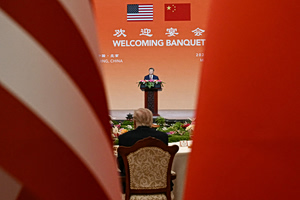
“Handled well, relations between the two countries can maintain overall stability,” the Chinese leader said. “If handled poorly, the two countries will collide or even clash, putting the entire U.S.-China relationship in an extremely dangerous situation.”
Trump didn’t publicly respond to Xi’s statement.
“Great. Great place. Incredible. China’s beautiful,” Trump said following the morning discussions, when asked how the talks had gone. He didn’t answer questions about Taiwan.
Trump entered the meeting with a pressing issue on his hands—the war in Iran. Tehran relies on China for its economic survival , and Trump wants Xi’s help in brokering an end to the war .
The two leaders did discuss Iran, according to a White House official, who said China agreed that the Strait of Hormuz should remain a free waterway and agreed that Iran shouldn’t have a nuclear weapon.
But there was no indication on the first day of the summit that China is prepared to do more. Beijing’s official statement said only that the two sides “exchanged views” on the situation in the Middle East. China’s Foreign Ministry didn’t immediately respond to a request for comment.
Xi also expressed some interest in increasing Chinese purchases of U.S. oil, according to the White House version of events.
China made a point to raise Taiwan even after the U.S. had signaled for days that it had no plans to make substantive changes to its longstanding policy of not supporting Taiwan independence while stopping short of formally opposing it. The White House made no mention of Taiwan.
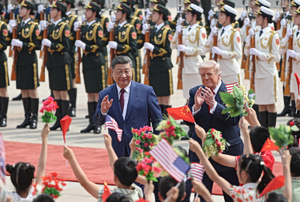
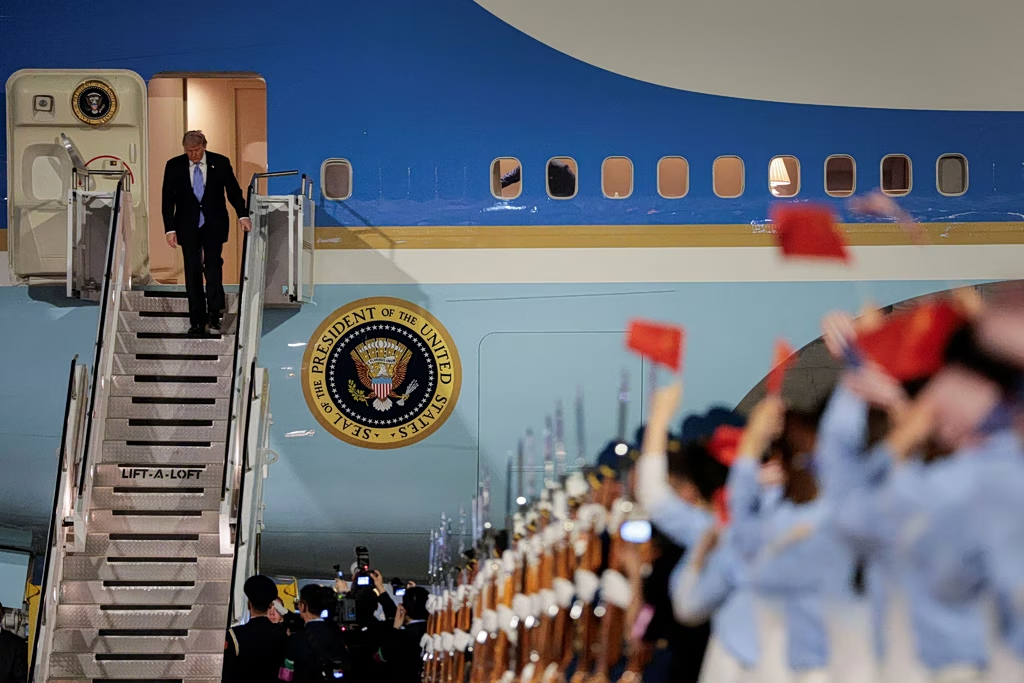
Thursday, the only full day of meetings and events, began with much pomp before the circumstance. A smiling Xi greeted Trump with a handshake, not the “big, fat hug” Trump earlier said he was expecting. A red-carpet arrival ceremony overlooking Tiananmen Square featured a military honor guard and flag-waving schoolchildren.
Cannons exploded over the square as the military played The Star-Spangled Banner and Trump saluted. One Chinese official leaned over to a reporter afterward and asked whether Trump liked the ceremony.
Business executives including X’s Elon Musk and Nvidia’s Jensen Huang , along with the president’s son Eric Trump and his wife Lara, accompanied the U.S. government delegation. The smog lifted shortly before Trump’s arrival, intensifying the unseasonably warm weather.
The meeting of leaders and their delegations lasted over two hours in the hall.
Information about the meeting, including Xi’s remarks about Taiwan and a comment about stabilizing relations for the duration of Trump’s presidency dripped out slowly during the day, mostly from China’s state media and Foreign Ministry. Western-based journalists traveling with the president received a brief account of the meeting hours after it concluded.
Slightly more detail came from U.S. business leaders. Musk, Huang and Tim Cook , the Apple chief executive, were spotted leaving the front entrance of the Great Hall of the People, and reporters asked how the summit had gone as they went down the steps.
“Wonderful,” said Musk. Asked what had been achieved, Musk said: “Many good things.” Huang said “Meetings went well,” and added that the two leaders are “incredible.” Cook simply made a peace sign.
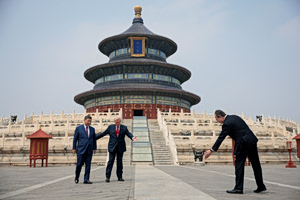
Following the morning meeting, Trump and Xi proceeded to a tour of Beijing’s 15th-century Temple of Heaven.
Both leaders then met again Thursday evening for a state dinner with dignitaries and business leaders.
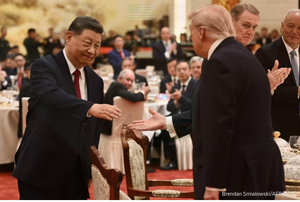
In an opening toast, Xi said the U.S. and China “should be partners rather than rivals.” Trump followed by lauding his visit and inviting Xi to visit the White House on Sept. 24. It was unclear if the Chinese leader had accepted the offer.
Both men then sat at a grand, round table flanked by translators, officials and members of Trump’s family in the ornate Great Hall. On Friday, the two leaders will attend a tea ceremony and working lunch before Trump returns to Washington, D.C.
Senior U.S. officials such as Secretary of State Marco Rubio, Defense Secretary Pete Hegseth, Treasury Secretary Scott Bessent and deputy chief of staff Stephen Miller attended the proceedings.
Ahead of the summit, both countries expected to announce agreements on Chinese purchases of U.S. agricultural and aerospace products. Analysts said they expected few breakthroughs in the trade relationship, unsettled last year by U.S. tariffs on China and Beijing’s retaliatory restrictions on rare-earth exports.
Trump and Xi hope a trade truce announced after a meeting in South Korea late last year can be extended in Beijing. But there had been a longstanding fear that Taiwan and the war in Iran could derail the talks.
Despite the planning and choreography there were snafus. A U.S. Secret Service agent was briefly denied entry to the temple compound with his weapon. Chinese officials at one point tried to prevent some U.S. officials from joining the presidential motorcade, causing a spirited confrontation.