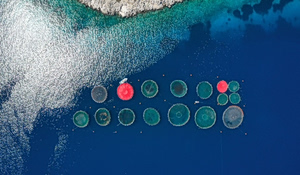
European waters experienced their hottest summer on record this year, as marine heat waves transformed ecosystems and threatened fisheries and the coastal communities that depend on them.
According to a Reuters analysis cited in the report, European waters recorded their warmest summer months since satellite sensors began providing reliable data in 1982. Temperature records were broken from the English Channel to the Mediterranean.
On Aug. 5, water temperatures reached 33.02 C off Mallorca, the highest ever recorded by the Spanish port authority’s buoy network.
The warming is changing marine ecosystems at a rapid pace, with species that have supported coastal communities for generations disappearing from traditional fishing grounds while new, warmer-water species move into areas that have become more suitable for them.
Marine heat waves are becoming more frequent
Scientists warn that marine heat waves are becoming more frequent, intense and widespread as global atmospheric temperatures rise.
Oceans absorb most of the planet’s excess heat and retain it for longer periods than land or the atmosphere. Scientists define a marine heat wave as a period of at least five days during which water temperatures remain significantly above the historical norm for a particular area.
Jean-Pierre Gattuso, a senior researcher at France’s National Centre for Scientific Research, said the speed of change was particularly striking.
“What is surprising is the speed at which this is happening,” he said. “Records are being broken almost daily in many places.”
The average temperature of European seas reached 21.6 C between June and August, a record for the 45 years of available data.
The Bay of Biscay, which lies between France and Spain along the Atlantic coast, provides a stark example. Its traditionally cool waters averaged 21.4 C during the June-August period, more than 2.4 degrees above the 1991-2020 average.
Measurements by the US National Oceanic and Atmospheric Administration showed a peak of 23.2 C (74 F) on Aug. 13, the highest recorded during the satellite era.
In the 1980s, the Bay of Biscay experienced relatively few marine heat-wave days each year. By the end of August this year, however, it had recorded 186 such days, meaning the waters had been affected by heat-wave conditions for more than three out of every four days.
Kelp forests and shellfish under pressure
José Manuel Rico Ordás, a professor of marine ecology at the University of Oviedo in northern Spain, said that people seeking cold waters now have to travel to the westernmost part of Galicia, in northwestern Spain.
Galicia benefits from strong winds that push warm surface waters away from the coast during the summer, allowing colder deep water to rise to the surface in a process known as upwelling.
Ordás has spent summers in the Bay of Biscay since childhood and now studies how the marine environment there has changed.
When he was a child, extensive underwater kelp forests provided food, shelter and breeding grounds for dozens of species that support the region’s small-scale fishing industry. Ordás now estimates that about 95% of the large brown kelp stands have disappeared, which he attributes primarily to climate change.
Kelp requires cold water, generally below 20 C, to survive. Overgrazing by fish, particularly Sarpa salpa, which thrives in warmer waters, has also contributed to the decline.
“We no longer find lobsters, crayfish, sea urchins and many other species associated with healthy kelp forests,” Ordás said.
Fishermen turn to kelp restoration
Fishermen are working with scientists and environmental organizations to restore the kelp forests in an effort to protect local fisheries. Young plants grown in laboratories are being planted on the seabed.
Manuel Ángel Reiriz González, president of a local fishermen’s association in Galicia, recently took members of one such initiative out on his boat. The group carried a box filled with small stones carrying seeds or young kelp plants and released them into the turbulent waters.
González said climate change threatens a way of life that has supported his community for generations. His family has harvested sea urchins and shellfish, particularly clams, for more than a century.
Repeated marine heat waves have already affected shellfish stocks, he said.
The area has also seen the arrival of species from warmer southern waters, including the Portuguese man o’ war (Physalia physalis) and triggerfish, which feed on local fish and crustaceans.
“We had some very bad years for shellfish production, but we worked to replenish the stocks and the species gradually adapted,” González said.
He hopes seabed restoration efforts can produce similar results for kelp forests. Their disappearance could reduce populations of sea urchins and other species on which fishermen depend.
“If we get there, we will cease to exist as an industry,” he said.
Octopus boom reshapes southern England
The arrival of non-native species is also affecting fisheries elsewhere in Europe. More than 1,000 non-native species are found in the Mediterranean, according to a report by the Cyprus Academy of Sciences, Letters and Arts.
The changes are also having effects beyond fishing.
In August, a huge swarm of jellyfish forced the shutdown of reactors at France’s Gravelines nuclear power plant after blocking its cooling system. It was the second such incident at the facility in two years.
Along England’s southern coast, fishermen have reported a dramatic increase in catches of common octopus.
About 2,600 metric tons were caught last year, while this year’s total has already exceeded 3,000 tons. Before 2025, annual catches were below 30 tons.
Octopus larvae are carried into British waters by ocean currents from breeding grounds near the Channel Islands, Brittany and areas farther south.
Previously, many of the octopuses did not survive the cold waters. But since 2022, the English Channel has experienced marine heat-wave conditions for an average of about six months a year, accumulating more than 900 days of such conditions, according to Reuters analysis.
Some fishermen benefit from warmer waters
For Ian Perkis, who runs a fish-trading business in South Devon, the surge in octopus populations has proved highly profitable.
There is an established market for the species in southern Europe, he said, and there are no fishing quotas for octopus.
“There was a week when we handled 200 tons,” Perkis said.
But the octopus boom has created winners and losers. Octopuses feed on local lobsters, crabs and scallops, threatening shellfish fisheries.
The surge in octopus numbers is estimated to have caused losses of about £10 million for the shellfish industry, compared with roughly £12 million in revenue from octopus fishing, between January and September 2025.
The benefits are not distributed equally, and some shellfish fishermen have already been forced to leave the industry.
The uncertainty extends beyond the immediate economic impact. Fishermen are questioning whether the octopuses will still be there next year. If they consume the available crabs and lobsters and then disappear themselves, they ask, what will happen to the fisheries that remain?