 Μake us preferred on Google
 A remarkable ancient inscription discovered in modern-day Kandahar, Afghanistan, offers compelling evidence of the far-reaching influence of Greek culture in Central Asia during the Hellenistic era.
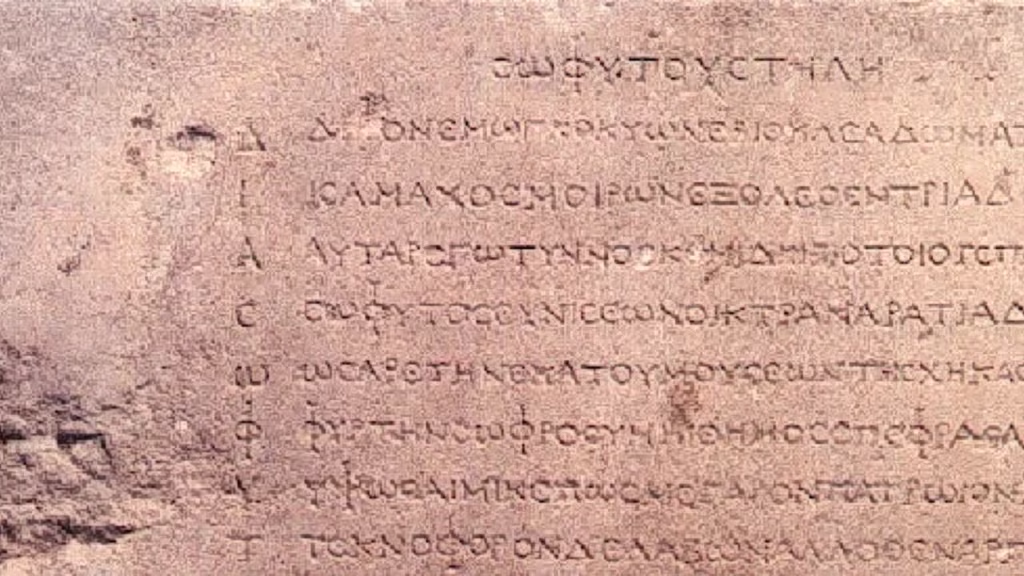
Known as the Inscription of Sophytos, it dates to the 2nd century BC and is attributed to a man named Sophytos, son of Naratos. The text was carved on a square limestone slab, likely once embedded in a wall of the ancient city believed to be Alexandria in Arachosia—a settlement founded during the campaigns of Alexander the Great.
Archaeologists associate the inscription with Old Kandahar, identified as the site of this Hellenistic city. Its significance lies not only in its provenance but in its refined use of the Greek language and its sophisticated literary structure. Composed in verse, the text forms an acrostic: the initial letters of each line spell out a hidden message along the margin.
That message reads: “By Sophytos, son of Naratos.”
The inscription stands as a striking testament to the depth of Greek education in a region thousands of kilometers from Greece. Scholars note that the text contains only a single minor prosodic error, underscoring the author’s remarkable command of the language.
At its heart, the inscription recounts a deeply personal story of loss and renewal. Sophytos describes how his family lost its wealth during his youth, plunging him into poverty. Determined to restore his fortunes, he left his homeland and embarked on a career as a merchant. After years of trade across distant cities, he returned prosperous, reclaiming both his status and his family’s honor.
Upon his return, he renovated his ancestral home, restored his family’s reputation, constructed a new family tomb, and erected this commemorative stele during his lifetime. The poem concludes with a hope that his descendants will preserve the house he rebuilt.
Some historians link the family’s earlier downfall to the upheavals caused by the expansion of the Greco-Bactrian kingdom into Arachosia in the 2nd century BC. The name Sophytos also appears on coins issued by a regional ruler of Arachosia in the 4th–3rd centuries BC, raising the possibility that the inscription’s author belonged to a local ruling lineage.
More broadly, the inscription reflects the multicultural fabric of the region at the time. Greek and Aramaic were widely used following the famous bilingual rock inscription of Ashoka the Great in Kandahar in the 3rd century BC. These linguistic traces suggest that inhabitants of Hellenistic Alexandria in Arachosia—even those of Indian origin—had adopted elements of Greek language and culture.
Some French scholars have proposed a later dating for the inscription, citing the use of the letter “C” in place of the traditional Greek sigma, a feature associated with later Greek script.
To this day, the Inscription of Sophytos remains one of the most striking pieces of evidence for the spread of Greek culture far beyond the Mediterranean world in the wake of Alexander’s conquests—a poetic echo of Hellenism at the crossroads of civilizations.