 Μake us preferred on Google
 Greece is set to sign a key contract on Wednesday for an exploratory offshore drilling project in the Ionian Sea, marking a significant step toward resuming hydrocarbon exploration after more than four decades.
The agreement, to be signed at the Ministry of Environment and Energy, concerns drilling operations in “Block 2” in the northwestern Ionian region. The project is scheduled to begin in February 2027.
International Consortium Leads Project
The contract will be signed between a consortium comprising ExxonMobil, Energean and HELLENiQ Energy—which holds exploration rights in the area—and offshore drilling contractor Stena Drilling.
The signing ceremony will take place in the presence of Greece’s environment and energy minister, Stavros Papastavrou, along with the ambassadors of the United States and Sweden.
This follows a preliminary agreement reached in November, when ExxonMobil joined the consortium with a 60% stake. Energean holds 30%, while HELLENiQ Energy retains 10%.
First Drilling in Over 40 Years
The upcoming drilling operation, named “Asopos-1,” will target a carbonate reservoir at a depth of approximately 4,000 meters. The site is estimated to potentially contain around 200 billion cubic meters of natural gas.
Officials estimate the probability of discovering commercially viable reserves at between 15% and 18%, making Block 2 the most mature concession currently available for exploration in Greece.
Advanced Deepwater Technology
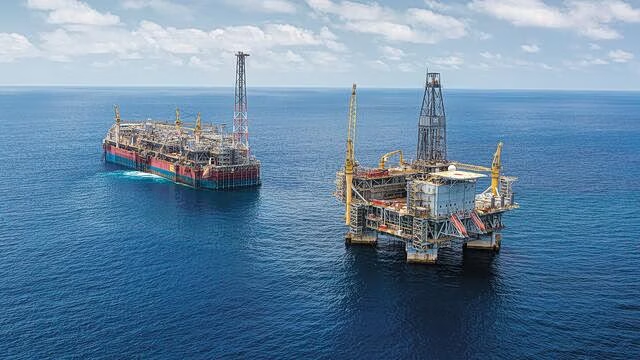
The drilling will be carried out using the Stena DrillMAX, a sixth-generation drillship built in 2007. Designed for deepwater operations, it can operate in water depths of up to 3,000 meters and drill as deep as 10 kilometers below the seabed.
The vessel is equipped with advanced systems, including dynamic positioning technology that allows it to maintain location without anchoring, dual-activity drilling capabilities to improve efficiency, and a blowout preventer system to enhance safety and control pressure during operations.
With a length of 228 meters and capacity for up to 180 crew members, the ship is built for extended missions and includes systems aimed at reducing emissions and improving energy efficiency.