 Μake us preferred on Google
 The Greek government set out on Monday the details of a multiyear package of tax cuts, income support and investment measures announced by Prime Minister Kyriakos Mitsotakis over the weekend at the Thessaloniki International Fair, laying out changes that will affect workers, pensioners, families, homeowners and businesses through 2030.
The measures will have a relatively limited budgetary impact at first, estimated at €605 million in 2026, before rising sharply to €2.2 billion in 2027 and eventually reaching €3.6 billion a year by 2030, according to estimates by the Ministry of Economy and Finance.
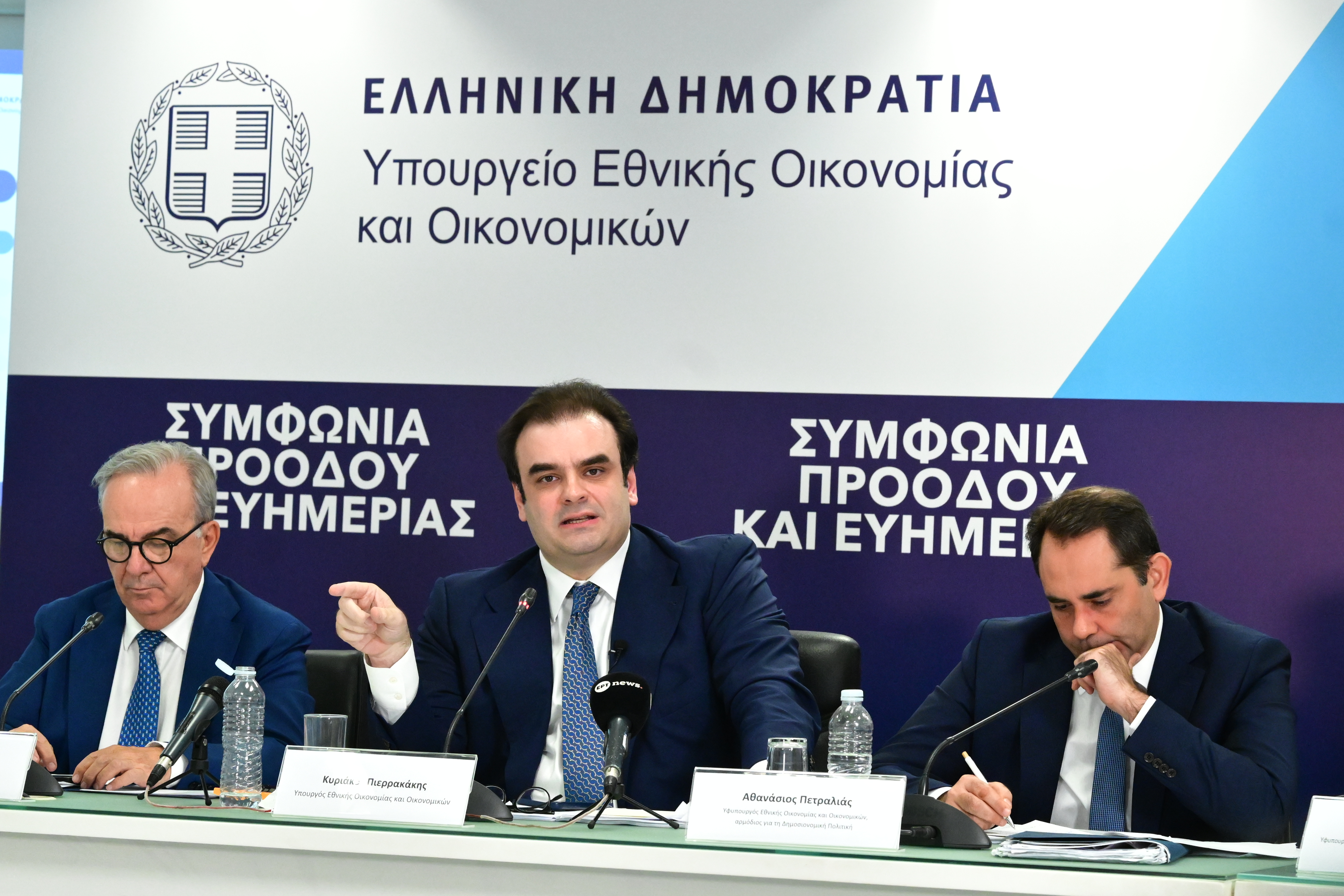
The measures were presented by Finance Minister Kyriakos Pierrakakis, Alternate Finance Minister Nikos Papathanasis and Deputy Finance Ministers Thanos Petralias and Dimitris Markopoulos, who is responsible for tax policy. Pierrakakis described the package as part of a broader economic strategy combining lower public and private debt with higher household income, investment and employment. The government’s goals for 2030 as outlined include gross domestic product of more than €310 billion, an average full-time salary of €1,800 and investment exceeding 20% of GDP.
Minimum wage to reach €1,000 in 2028
Among the most immediate changes is a further increase in the country’s minimum wage, which currently stands at €920 a month.
A new rise is planned for April 2027, followed by an increase to €1,000 from January 2028.For workers entitled to the maximum three seniority-based pay increases, the minimum wage could reach €1,300. The ministry estimates that the minimum wage will have risen by 54% in nominal terms between 2021 and 2028.
The increase also has wider consequences because some benefits and public-sector salaries are linked to the minimum wage.
Separately, employee social security contributions will be cut by 0.5 percentage point from April 2027, with the full reduction applied to workers’ contributions.
Public-sector employees will receive a €500 gross Christmas payment from December 2027. Their salaries are also due to rise again from January 2028 in line with the higher minimum wage, with the ministry estimating an average increase of about €80 gross a month.
Tax relief for families and farmers
The package also includes targeted tax relief for families with three children and for full-time farmers.
From the 2027 tax year, families with three children will pay no tax on income up to €20,000. The ministry estimates that 86,927 taxpayers will benefit directly, including 33,894 self-employed workers. It puts the effective tax-free threshold for these families at €25,364, up from €14,364, with a maximum annual benefit of €1,800.
A similar provision will apply to full-time farmers from the 2026 tax year. Income up to €20,000 will be taxed at zero, benefiting 47,091 of the country’s 245,907 full-time farmers. The maximum annual benefit is estimated at €2,900.
Family support will also be expanded through higher childcare subsidies and a new savings scheme for children. Childcare voucher amounts will rise by 10%, while the relevant income thresholds will increase by €2,000. The birth allowance for families with four or more children will increase by €1,000 per child.
State-backed investment accounts for children
The government also plans to introduce an investment account for children, under which it will match contributions made by parents.
An account can be opened during the first two years after a child is born. Parents will be able to contribute any amount, with the state matching their payments up to an initial limit of €1,200 a year. That ceiling will rise by 10% every five years, while investment income generated within the account will be exempt from income tax.
The ministry illustrated the scheme with the example of a child born in 2026 whose account is opened in 2027. If parents contribute the maximum amount eligible for matching each year through 2044, they would pay in a total of €24,652, matched by an equal amount from the state, giving initial capital of €49,304.
The final value would depend on investment performance. The ministry estimates that the account would be worth €64,109 at an average annual return of 3%, €77,062 at 5% and €93,173 at 7%. It said the figures were illustrative scenarios rather than guaranteed returns.
Higher annual payment for pensioners
The government will also broaden and increase the permanent annual payment made to pensioners.
The payment will rise from €300 to €400 net and will be extended to all pensioners over the age of 65, adding about 270,000 beneficiaries and bringing the total to 2.2 million.
Pensions will continue to be adjusted according to inflation and GDP growth. The total budgetary cost of pension-related measures is estimated at €895 million in 2026 and €1.677 billion in 2027.
Housing measures
Housing measures include a new €2 billion “My Home III” program, with broader eligibility than its predecessor. The maximum age for applicants will rise to 55 from 50, the maximum property value to €300,000 from €250,000 and the maximum mortgage to €230,000 from €190,000.
Income limits will also be raised for families with children, while families with four or more children will be allowed to buy larger homes under the program.
Existing incentives aimed at increasing the supply of long-term rental housing will be extended. These include the three-year income tax exemption for owners who place vacant properties on the long-term rental market, tax relief for renovation spending and the suspension of VAT on new homes. Restrictions on short-term rentals in parts of Athens and Thessaloniki will also remain in place.
From 2027, ENFIA, the annual property tax in Greece, will be abolished for homes in settlements of up to 2,000 residents, or 2,200 in Western Macedonia. The change adds 131 settlements and about 62,000 property owners to the exemption, taking the total number of eligible settlements to 12,855.
The government is also raising the cost of residential property purchases for some non-European buyers. From July 1, 2027, the transfer tax on home purchases by citizens of countries outside the EU and European Economic Area who are not long-term residents will rise to 15% from 3%.
The higher rate will not apply to commercial properties, land or other types of real estate. The government said the measure is intended to curb additional demand for housing and increase supply for permanent residents.
Business tax and investment measures
The package also includes tax changes for self-employed workers and companies, alongside measures intended to support investment.
For self-employed workers, the government will remove two surcharges that can push up presumed taxable income: one equal to 10% of annual payroll costs, and another equal to 5% of the amount by which a business’s turnover exceeds the average for its sector. The change is expected to affect about 156,000 sole proprietorships, at an estimated fiscal cost of €572 million in 2027.
For companies, the annual business levy will be phased out by 2029. It will be abolished in 2027 for headquarters and branches outside Attica, excluding the Islands regional unit, cut by 50% in Attica in 2028 and eliminated nationwide in 2029.
Corporate tax prepayments will also be reduced. The current 80% rate will fall by 5 percentage points a year from the 2028 tax year, reaching 50% in 2033. For self-employed professionals, the rate will fall from 55% to 50% from the 2027 tax year.
Businesses investing in machinery will be able to depreciate the cost over six years instead of 10, allowing them to deduct investment spending from taxable profits more quickly.
Two new Hellenic Development Bank programs, with combined funding of €1.5 billion, are expected to mobilize about €5 billion in financing by early 2027.
Public investment will also rise after the completion of the Recovery Fund program. The Public Investment Program will receive an additional €1.45 billion in 2028 compared with the limits set in the previous multiyear fiscal plan.
A further €1.2 billion will be allocated through the Social Climate Fund for measures including social housing, upgrades to student residences, heating support and transport assistance for vulnerable households and small businesses.
The package also contains a tax increase for some senior executives. From January 2027, remuneration above €60,000 received by board members and senior executives through profit participation will be taxed at 15%, up from 5%. The dividend tax for shareholders will remain at 5%.
Source: OT.gr