Nothing in German politics is as it once was. The state elections held on Sunday in the city-state of Berlin and in Mecklenburg-Western Pomerania in the country’s northeast – following the vote in Saxony-Anhalt two weeks earlier – have upended the old order and created new political realities. Once again, the word “historic” is being invoked to describe the scale of the change demanded by voters.
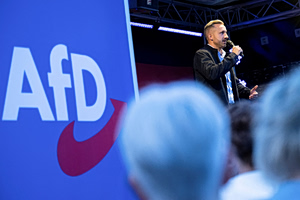
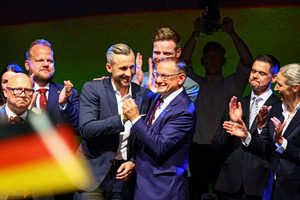
After the shock in Saxony-Anhalt, where the far-right Alternative for Germany, or AfD, emerged two weeks ago as by far the strongest political force with 44 percent of the vote, the party and its illiberal agenda continued their triumphant advance in Mecklenburg-Western Pomerania. It finished first there as well, although with 38 percent the far right again fell short of its stated goal of an outright majority.
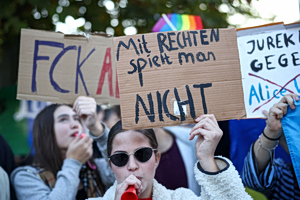
While the AfD’s victories confirm the broader shift to the right that pollsters have identified across much of Germany, the election in Berlin shows that the movement is not all in one direction. In the capital, the far-left party Die Linke more than doubled its share of the vote to over 25 percent. This result, too, is historic.
It is worth remembering that Die Linke is a successor to the communist party that once ruled East Germany. In a radically altered political constellation, it now has a realistic chance of forming a coalition government with the Greens and the badly defeated Social Democrats. That such a government would be led by a woman of Turkish immigrant background is further evidence of how profoundly German society has changed. What only a few years ago would have appeared unimaginable has now become almost politically normal.
Berlin and Mecklenburg-Western Pomerania produced very different results, but with one important feature in common: In both states, radical parties emerged as the winners. The great losers were the parties of the political center, squeezed by the advance of the extremes.
The scale of their losses is dramatic. Berlin was long considered a stronghold of German Social Democracy, and Willy Brandt once served as the city’s mayor. In Mecklenburg-Western Pomerania, the Christian Democratic Union failed to clear the 5 percent threshold for the first time in its history. This catastrophic defeat for the CDU in Angela Merkel’s home state demonstrates more clearly than countless commentaries and analyses that the venerable party is in a deep crisis – one that some describe as existential.
The state elections of the past two weeks were never merely about regional and local concerns. In every case, the results have far-reaching consequences for national politics. These elections were also referendums on the policies of the federal government and, by extension, on Chancellor Friedrich Merz.
The repeated heavy defeats suffered by his party have placed the chancellor under immense pressure. As disaster loomed, the media speculated about the abrupt collapse of his government. There was even talk of internal party maneuvers aimed at removing him from office ahead of time. But the coup never materialized, at least for now. In its hour of greatest need, the battered party closed ranks behind Merz.
In a move unprecedented by German standards – and thus historic in its own right – the chancellor addressed the public on Sunday evening, only minutes after the polls closed, and made clear his determination to remain in power. Merz called the result in Mecklenburg-Western Pomerania a “disaster.” But he also insisted that the moment demanded “backbone, steadfastness and patience,” adding that he had no intention of stepping down as either party leader or chancellor.
The elections are over; now come the coalition negotiations. The days of single-party government in Germany are long gone. Until recently, two parties could still form stable governments. Given the latest results, three are now required.
Germany is experiencing a radicalization of its parliaments that makes the formation of stable governments increasingly difficult. None of the other parties is willing to cooperate with the AfD. The coming weeks and months will show whether the CDU intends to maintain its rigid policy of exclusion – or whether the so-called firewall separating it from the far right will begin to weaken.
Stormy times lie ahead for the CDU-SPD federal government. As the chancellor’s loss of authority becomes increasingly apparent, the 70-year-old Merz is increasingly often described as a lame duck.
For Merz and his government, it is at best a small consolation that the next state elections will not take place until April of next year. Because of its federal system, Germany is in a state of almost permanent election campaigning. That is bad for a government seeking to push through an unpopular reform agenda. But as the latest election results demonstrate, it is ultimately also bad for the stability of the democratic order.
Dr. Ronald Meinardus is a Senior Research Fellow at the Hellenic Foundation for European and Foreign Policy (ELIAMEP).