 Μake us preferred on Google
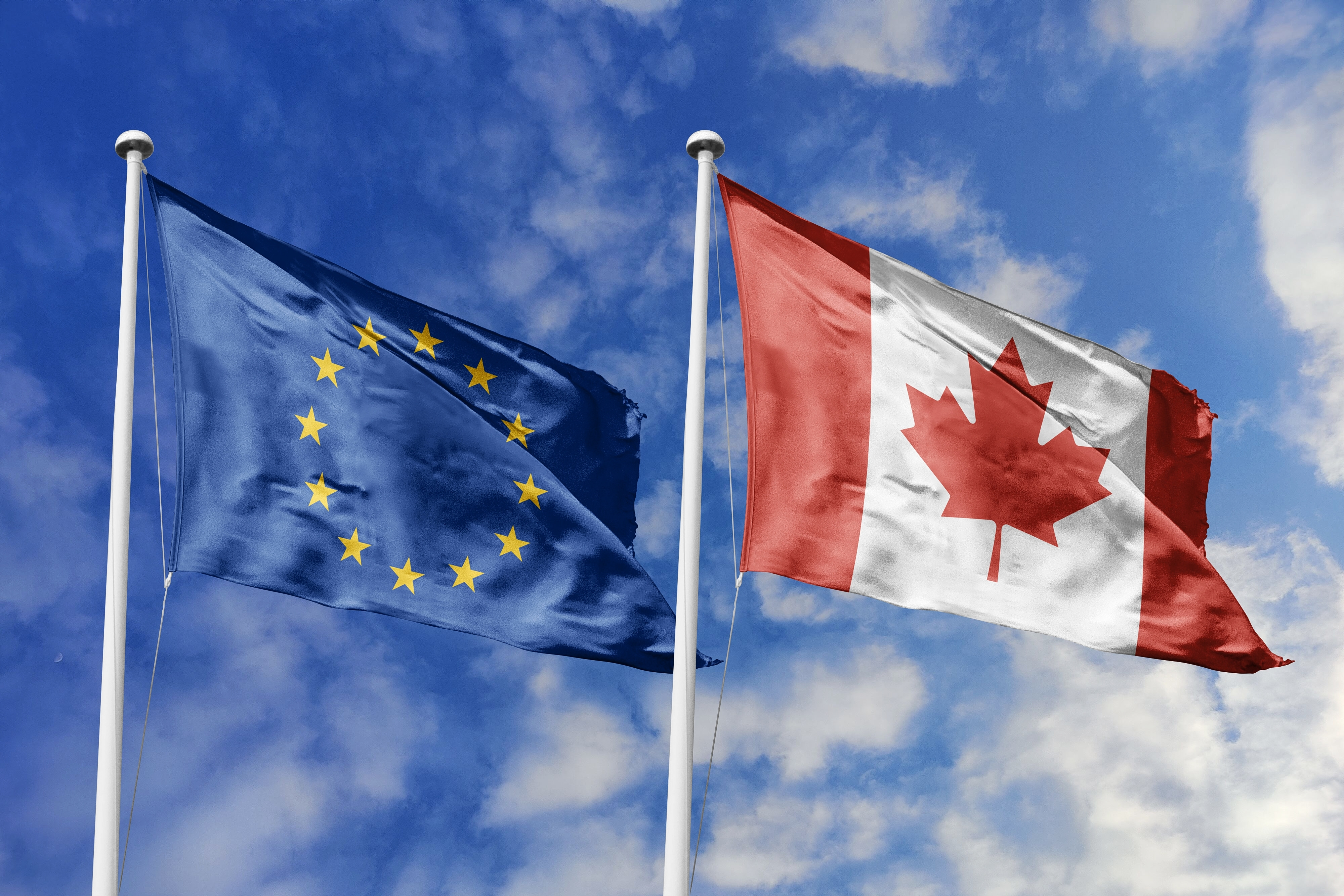
Surprise was the immediate reaction to European Commission President Ursula von der Leyen’s announcement in September that Canada was to become an “associate member” of the European Union. As EU and Canadian leadership have just met in Montréal for the EU-Canada Summit, it is important to reflect on the consequences of the European Commission’s approach and not only the promising developments.
Just days before the announcement in September, the Financial Times quoted one EU official saying that Canada’s expectations on associate membership need to be “managed”. It seemed as if Canada was leading the call for a closer relationship with the EU, not the other way around.
This ‘management of expectations’ seems to have come in the form of an internal rebellion within the EU – as Germany, France, Italy, and Greece raised serious objections to the term ‘associate member’ for the EU’s closest North American ally. These objections led to the term’s removal from the Summit’s carefully negotiated Joint Statement.
These four EU countries have valid reasons to do so. The most striking is that ‘associate membership’ is not mentioned in the EU Treaties. Appearing to give Canada special status when compared to the nine countries currently in the EU’s enlargement process as candidates would be diplomatically difficult to justify.
This reveals two features of the current state of the EU. First, that the Commission has acted recklessly – without any consultative process and in a seemingly ad hoc manner. It appears to be trying to bend the constraints placed on it by the EU Treaties. Second, that political theatre has a cost when it comes to foreign affairs.
A reckless Commission?
Under the Treaty on the Functioning of the EU the Commission cannot unilaterally determine the terms of a new institutional relationship between the EU and a third country, as it is arguably trying to do. Even in the case of international trade, Member States must give the Commission authorisation to conduct international negotiations, known as a ‘negotiating mandate’ granted by the Council. This was recently exemplified by the political and legal tensions surrounding the MERCOSUR trade agreement, which took decades to conclude.
This is precisely the point that German diplomats made at the Committee of Permanent Representatives (COREPER II) on 21 October – according to diplomatic sources who requested anonymity. The German-led push to remove the term has led to its replacement with “ever-closer association” in the official text of the Joint Statement. This concept, the Joint Statement underscores, will be defined by the 2027 Canada-EU Summit. The main objection to the Commission’s phraseology centres on what can be described as executive overreach and a breach of trust between the Commission and Member States.
Ursula von der Leyen’s unilateral announcement in her State of the Union address not only placed the initiative on legally questionable grounds, but also challenged a sacrosanct convention: major decisions concerning the EU’s external relationships should be developed in close consultation with Member States. After all, the EU is not a federated state, even if this situation may make observers believe that the Commission President acts like a federal chancellor.
The State of the Union announcement grabbed headlines. But the Commission president never managed to explain what an ‘associate member’ of the EU really is. This breakdown of communication has created a cacophony in Brussels and has regrettably overshadowed much of the EU-Canada Summit.
The Union cannot afford to make foreign policy decisions in a way that reflects a disjointed and ex post consideration of policy. Announcing ‘associate membership’ on the assumption that other EU Member States might follow suit was reckless, and leaves the EU in a far weaker negotiating position.
There is considerable merit in the idea that the EU should approach Canada as its key like-minded partner in the North Atlantic. Canada is the most democratic state in the region. It is led by a globally respected Prime Minister in Mark Carney, and is a reliable partner and counterweight to the turbulent White House. It is worth remembering that Donald Trump’s reaction to Canadian ‘associate membership’ of the EU was to threaten Europe with higher tariffs or to “stop trading with Europe on many things”.
The cost of political theatre
The proposed ‘Alliance for the Future’ between the EU and Canada is promising. It offers further cooperation on trade, Arctic security, critical raw materials, and other domains central to Europe’s strategic autonomy in a multipolar world. It also positions Canada as an increasingly important partner at a time of rising nativism in Washington.
This initiative seeks to address the “rupture” in the international system alluded to by Prime Minister Mark Carney in his remarks at the EU-Canada Business Forum Leaders’ Roundtable. Both he and President von der Leyen reiterated the need to explore “new frontiers” in the bilateral relationship. Given the concerns of Germany and the other three EU Member States over ‘associate membership’, this venture is entering uncharted territory.
It is disappointing that in the politically tortured debate over ‘associate membership’, the EU did not manage to find a concrete resolution to a key outstanding question in the EU-Canada relationship – full trade deal ratification.
As it stands, the principal framework under which the EU and Canada conduct transatlantic trade is the “Comprehensive Economic and Trade Agreement ” (CETA). Although ‘provisionally applied’ since 2017, nine EU Member States, including Greece, have yet to ratify the agreement, meaning that it has not yet entered fully into force.
The major obstacle to Greece’s ratification of CETA is feta cheese’s Protected Designation of Origin (PDO) status. The Greek position is that Canada has not provided adequate guarantees for the protection of the famous Greek cheese. European Commission sources, speaking on condition of anonymity, stressed that Greece is unlikely to ratify the agreement in the near future unless Canada provides further guarantees for the protection of feta cheese.
The Summit’s Joint Statement makes passing reference to these difficulties. It underscores that both the EU and Canada are committed to the implementation of the agreement while “fully respecting the ratification processes underway”. Furthermore, the EU and Canada have become committed to “building on the success of CETA” to crate a “common prosperity and economic security space”. With CETA still not fully ratified, this decision will require much work in the coming years.
The political tensions over the proposed ‘associate membership’ label for Canada have, regrettably, raised a more fundamental question of trust. The impression that the EU is slow and bureaucratic has existed for many decades. Now, however, the Commission’s behaviour might raise a different question. How can Canada trust a Commission that is out of step with the rest of the EU?
Odysseas Digbassanis is a Brussels-based public policy and foreign affairs analyst with experience at the International Labour Organization, the Permanent Representation of Greece to the EU, the Ecumenical Patriarchate of Constantinople, and in the private sector. He holds degrees in modern diplomatic history and politics from the London School of Economics (LSE) and the University of Warwick. The views expressed in this article are solely those of the author.