 Μake us preferred on Google
 The Thessaloniki International Fair is neither very international nor exactly a fair. In other words, it falls short of what it is supposed to symbolize: the country’s outward commercial orientation and productive development. So be it.
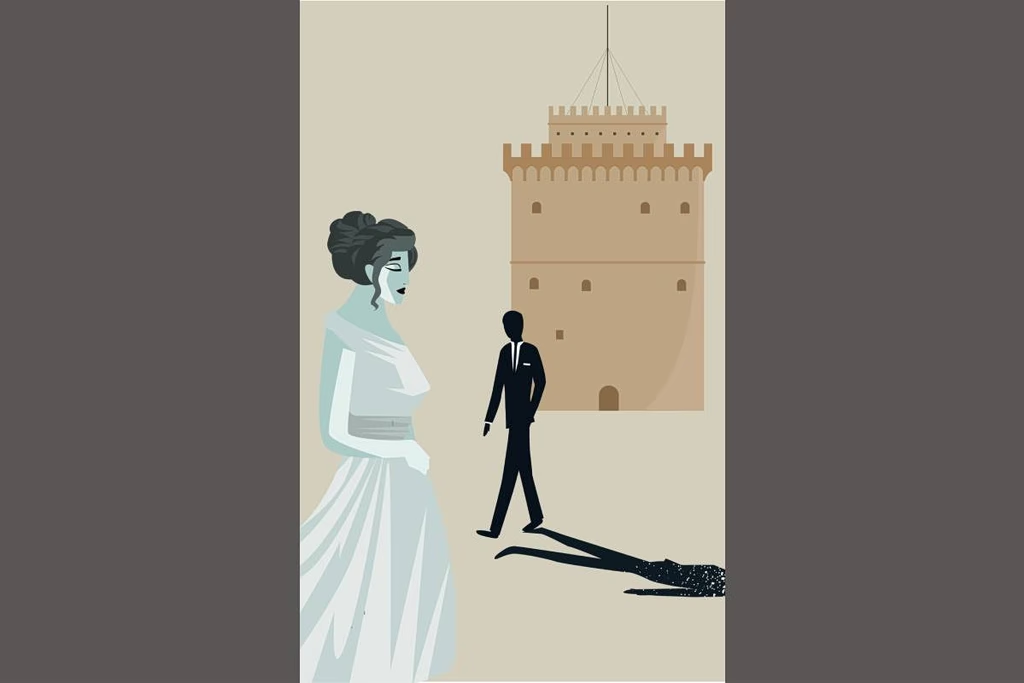
The TIF has been rewarded with other symbols. More inward-looking, perhaps even counterproductive, but political nonetheless. For a few days each year, the “Bride of the Thermaic Gulf” rises to the surface of current affairs. Not only as a platform for economic announcements and government measures, about which more is said and written before they are heard than afterward. But also as a place of pilgrimage. In the “co-capital” in the more official sense, or the “city of love” in the more lyrical one, half of Athens once traveled to Thessaloniki for the TIF, discovering its culinary charms in Ladadika and the allure of its nightlife in its late-night establishments. Strike up the band.
When was that? In the 1980s and 1990s, a period that has gone down in the political and social slang as the “beautiful PASOK years.” Even so, what can two weeks a year do for you? For the other 50, the bride followed the fate of the forgotten periphery. Not that she did not live her life. But she lived in a top-heavy state, stubbornly Athens-centric, as if she belonged to the remainder of a country that depended on a few top-heavy gestures of goodwill. That was her reward. More or less like throwing a biscuit to a puppy.
The metro is not a biscuit. It remains a question, however, whether it is too little and — above all — too late. The government that handed over the new line in recent days, after years of construction, is facing an electoral black hole of distrust and discontent that has spread throughout Northern Greece. The bride and her forgotten periphery are seeking an outlet in figures and political formations that cause unease, when they do not frighten the center of power.
Today, To Vima captures on its political pages the mood in the North, where there is fear that the Maximos Mansion will be expressed deafeningly at the ballot box. At the same time, it poses and answers a series of questions. How much weight do the prime minister’s announcements ultimately carry with public opinion? How is Thessaloniki receiving the politically and socially top-heavy “landing” from the capital? And what traps does the TIF conceal for the political system, and what does history teach us? Is the bride taking revenge? She is.
During the Metapolitefsi, we lived through our best years, but also our worst. And now, even though we are supposedly leaving them behind, the pathological structure of a country that develops unevenly remains. This creates new inequalities, new conditions of depopulation in the periphery and new causes of population decline. “There is money,” to recall that phrase that marked the history of the TIF, in a question from Giorgos Papachristos to George Papandreou. But money is circulated and distributed as a privilege accessible only to a closed caste. “Money does not reach society, or it reaches it in distorted ways,” as a government official puts it.
The bride is not a puppy. But could the political system be an old dog that cannot learn new tricks? Probably. The Prime Minister is expected to announce “two surprise measures,” beyond those that have been circulating for weeks. The economic team will flesh them out, and together they will wait to see their impact and “how they will show up in people’s pockets” from the beginning of the coming year, when the ballot boxes will also be set up.
And the “overall plan that the country lacks”? The “productive model that does not change”? Perhaps they will be discussed at an ideal TIF. At a Thessaloniki International Fair that will be both international and a fair.