 Μake us preferred on Google
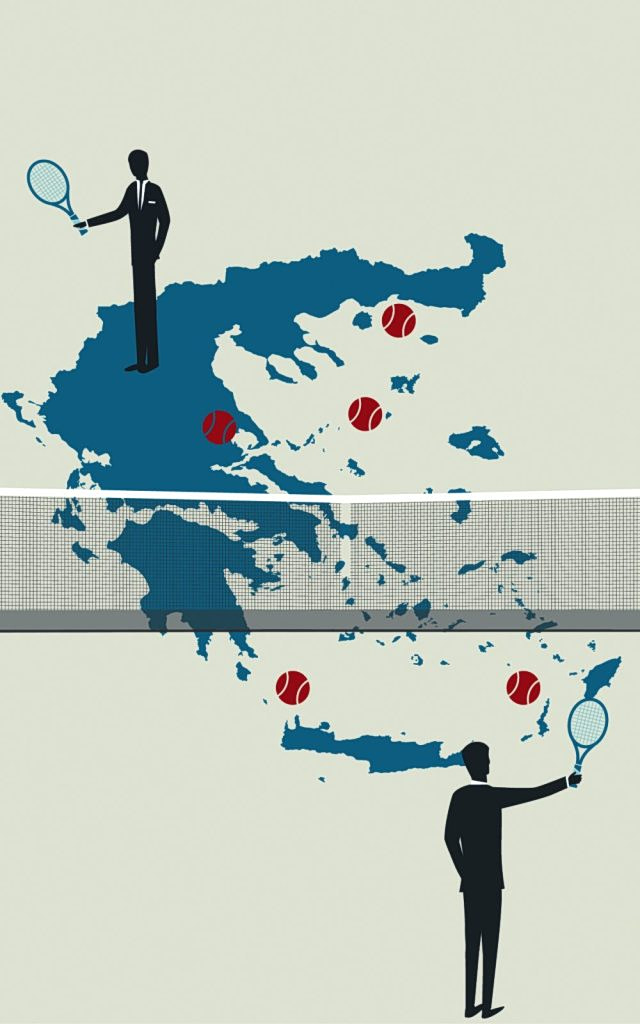
 Every scandal comes with its own color. It is painted “blue” or “green” depending on which side one occupies on the blame game field, a national sport with just a single rule. From their position, the player only needs to lift their racket and toss the little ball of responsibility to the other side. The game has no whistle to signal the end. It ends when the spectators’ interest fades enough that the last spotlight of publicity goes out, or when it no longer makes sense to write even a single column. Meanwhile, the ball is lost.
Every scandal also has its representative from the animal kingdom. “Locusts,” “rodents,” “crows,” “leeches”—here, one simply chooses the species and classification from the Encyclopedia of Animals. Who hasn’t heard of a “cat” slinking feline-like between people and situations, rubbing where it should rub, hiding where it should hide, only to disappear when it realizes it’s in danger?
In the slang of corruption, a series of words stand out: “lamogia” (crooks), “airitzides” (dodgers), and “daraveritzides” (deal-makers). But also “remoules” (small-scale thefts), “arpakhtes” (snatches), and “stisimata” (set-ups). “He takes it” or “he grabs it” means someone is being bribed. Bribery is called “miza.” And because the Greek language has never been stingy with its wealth, it also offers something more literary: the “iméteri” are our own people—or, in Greek that has no place for adulthood with all its burdens, responsibilities, and rules—the “our own kids.” From all this linguistic richness emerges an extraordinary combination of colloquial speech borrowing from other languages and an ancient language that has run intact through the centuries since the age of the tragic poets, remaining alive to this day. It is the “party of our own.”
Logically, the government attributes a series of corruption cases to “chronic pathologies.” Logically, this and other governments have promised to break the “abscess” and, more popularly, that “the knife will reach the bone.” Meanwhile, new scandals appear on the horizon with their palette of colors and the richness of their fauna. The flow seems unstoppable; with a little inspiration from mythology, one might think of the Lernaean Hydra. And if you cut off one head, ten more appear—not two, as in Heracles’ labor, but ten. Why?
Perhaps one explanation lies in the architecture of the private sector’s synergies with the state. In the architecture of a bureaucracy that is excessive and control mechanisms that exist only in form. Since the state is the country’s biggest client, one simply bypasses small and large obstacles as one can. One becomes the “cat” as much as needed until the right connections—connections that may eventually reach a ministerial office—transform them Ovidian-style into a “rodent.”
So what is the framework of rules that must be set to limit corruption within this vast range of transactions, while simultaneously ensuring that the private economy isn’t suffocated by excessive paperwork? This seems to be the ancient riddle of history—ancient because it has remained unsolved for a very long time.
Nothing suggests that this government will solve it. The Greek state, after all, remains clientelist in its own way. It can no longer appoint “armies of our own” in the public sector, but it is the one that distributes money, whether from European funds or its own. Meanwhile, the “lamogia” acquire new skills, as if corruption were the only uninterrupted training and lifelong learning program.
What remains? To let language offer other thrills from its wealth. Words like “snow” or “ring” acquire meanings beyond what they have today. Snow, the “black money” that turns white. Ring, the “assignment of a project” that can only be resolved in court. Why not?