 Μake us preferred on Google
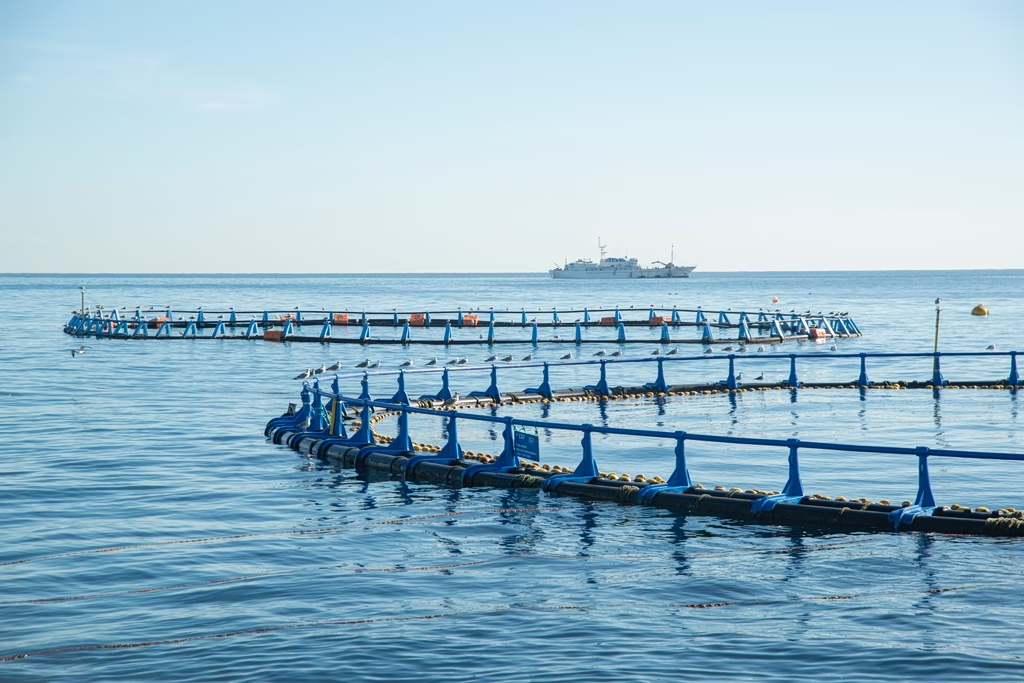
 Greece’s aquaculture sector has been hailed as a national success story for years: a competitive, export-driven industry that the government wants to grow by 5% before the end of the decade. Yet the framework meant to govern where fish farms operate has stayed unfinished for fifteen years, and the pressure to fix it is now coming from every side, communities, environmental groups and the industry alike.
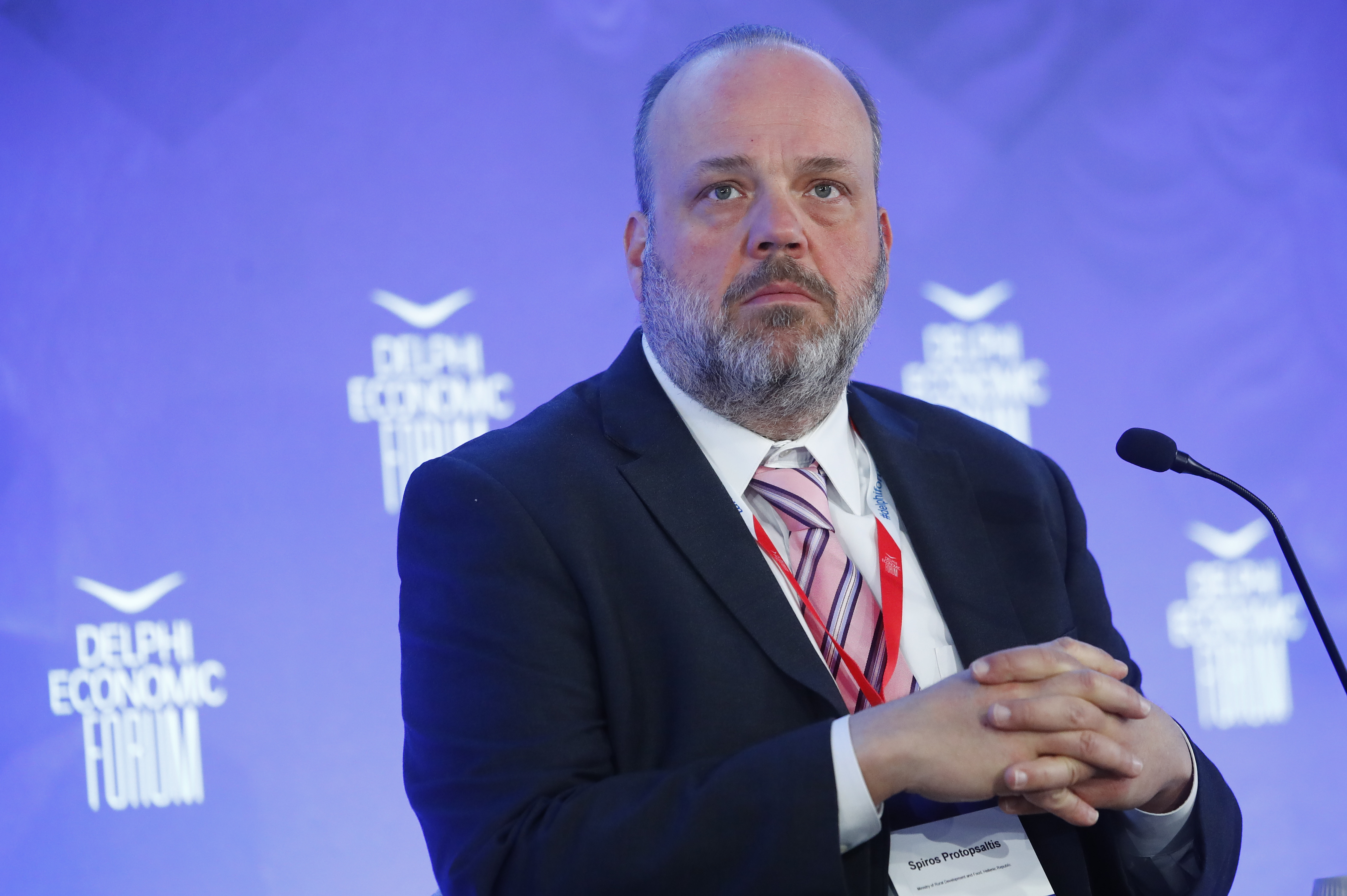
Spiros Protopsaltis, Secretary General for Rural Development and Food, has been in the role for a little over a year. He spoke to TO BHMA International Edition about the government’s goals for the aquaculture sector and what lies ahead for the long-delayed spatial planning framework. He described the standoff over fish farms as a matter of “confidence in governance” and acknowledged that community concerns over the environment, monitoring and enforcement are “genuine and legitimate.” He was candid about the delays, too: aquaculture zones promised for more than a decade remain in limbo, and until they are approved, no new farms can be licensed.
Greece is already widely recognised as a market leader in producing high-quality farmed fish. Building on this, Minister Schinas has set a target of 5% annual aquaculture growth through 2030. Where will this growth come from—expansion of existing farms, new licences, offshore or onshore facilities, productivity gains, or a combination of these? Beyond increasing production, how will the Ministry measure whether Greece’s aquaculture strategy has been successful, and what are the milestones and timelines?
Greece already has a strong production and export base in aquaculture. The target announced by Minister Schinas is to achieve an average annual production increase of 5% by the end of the decade, within a development model that combines productivity and competitiveness with sustainability and environmental responsibility.
This objective will not depend on one single factor. It will be pursued through a combination of modernisation, innovation, digital and green transitions, improvements in productivity and environmental performance, increased added value, and investments that comply fully with the applicable spatial-planning, licensing and environmental frameworks.
The 105 investment projects that were recently approved, with a total budget of €131 million, including over €87 million in public funding, constitute an important part of this effort. These projects aim to support the modernisation of aquaculture facilities, technological innovation, digitalisation and enhanced competitiveness of Greek aquaculture.
This does not amount to a general or automatic commitment to expand every existing facility, issue new licences in every area, or adopt a single production model, whether offshore, coastal or land-based. Each investment must be assessed on its own technical, economic, spatial and environmental merits.
Any increase in production must remain compatible with the environmental carrying capacity of the receiving area, the environmental conditions attached to each licence, the applicable spatial-planning framework and the need to avoid or manage conflicts with other uses of marine and coastal space.
In this context, the role of the Ministry of Environment and Energy is particularly important, as it is responsible for completing the institutional establishment of the POAYs through the relevant Presidential Decrees. In areas where a POAY has not yet been approved, new licences for the establishment of aquaculture units cannot be issued.
Progress in completing the Special Spatial Framework for Aquaculture and the Presidential Decrees establishing the Areas of Organised Aquaculture Development, known in Greece by the acronym POAY, is also a central part of our strategy. Clear spatial rules are necessary both for responsible investment and for the protection of the environment and coastal areas.
Success will not be measured solely by the number of tonnes produced. It should also be measured through the value and quality of production, export performance, the creation of employment and economic activity in island and coastal areas, traceability, resource and energy efficiency, resilience to climate change, fish health and biosecurity, and measurable environmental indicators.
The main milestones include, the development of digital monitoring and traceability tools, progress in the spatial organisation of the sector, and the implementation of the €4 million action supporting the organised operation and environmental monitoring of approved POAYs. Applications for this initiative may be submitted until 29 December 2028, while the funded operations must be completed by 31 December 2029.
The overall objective is not simply to produce more. It is to effectively strengthen a competitive, export-oriented and innovative sector that develops within clear rules, creates real added value for coastal communities and remains environmentally sustainable in the long term.
The European Union is simultaneously promoting aquaculture expansion, biodiversity restoration and blue carbon. If scientific evidence indicates that an aquaculture proposal would compromise Posidonia seagrass meadows or reduce blue-carbon storage, which objective takes precedence? More broadly, when aquaculture competes with tourism, fisheries, marine protection or local-governance objectives for the same coastal space, what decision framework does the Ministry apply?
The applicable environmental legislation and scientifically established environmental limits are binding. The development of aquaculture cannot override the legal obligations concerning the protection of sensitive habitats, biodiversity, protected areas and the marine environment.
When a proposed project may significantly affect a protected habitat, a Natura 2000 site or a Posidonia oceanica meadow, it must be assessed under the relevant European and national environmental legislative and regulatory frameworks.
Where the appropriate assessment required under the Habitats Directive applies, the competent authorities may approve a proposal only after establishing, on the basis of the best available scientific evidence, that it will not adversely affect the integrity of the protected site. The assessment must also consider the effects of the proposal in combination with other plans and projects.
Therefore, where reliable scientific evidence demonstrates that a proposed development would cause an unacceptable impact that cannot be avoided or adequately mitigated, the proposal cannot proceed in its original form. Depending on the circumstances, it may have to be modified, reduced in scale, relocated or rejected.
There is no policy objective of placing aquaculture above the protection of biodiversity or the marine environment. Sustainable aquaculture depends on healthy marine ecosystems and on the long-term preservation of the natural resources on which production itself relies.
When aquaculture competes with tourism, fisheries, navigation, marine protection or other coastal activities, decisions must be based on an integrated framework that includes spatial planning, environmental assessment, compatibility with existing uses, scientific evidence, consideration of cumulative impacts, and participation by the relevant public authorities, stakeholders and local communities.
The purpose of organised spatial planning through POAYs is precisely to move away from fragmented and uncoordinated development. It should identify where aquaculture can operate in an organised and environmentally responsible manner, establish clear rules and reduce conflicts with other activities.
Τhe need to assess all these spatial, environmental and socio-economic factors is also one of the reasons why the adoption of POAYs has taken longer in areas where there is interest in establishing them. The Ministry of Environment and Energy, as the competent authority, examines all the relevant evidence and follows the procedures prescribed by law before any final decision is taken.
The Ministry’s approach is therefore based on striking a balance, but not on at the expense of environmental safeguards. Economic activity can proceed only within the limits established by law and by sound scientific assessment.
Critics argue that current Environmental Impact Assessments do not adequately assess cumulative impacts or establish transparent carrying-capacity limits for entire coastal areas, and that environmental modelling is not always interpreted consistently when determining acceptable production levels. Does the Ministry have confidence that the current methodology accurately determines cumulative carrying capacity and environmental limits? If so, why? If not, what changes does the Ministry believe are needed?
Greece has an established statutory framework for environmental assessment, including Strategic Environmental Assessment at the level of plans and programmes, Environmental Impact Assessment at the project level and, where applicable, appropriate assessment under the Habitats Directive.
The Ministry applies this comprehensive framework and relies on the assessments and decisions of the competent environmental authorities. At the same time, no scientific or technical methodology should be considered static or incapable of improvement.
The reliability of an environmental assessment depends on several factors: the quality and duration of the baseline data, the suitability and transparency of the scientific models used, the consistent interpretation of their results, the consideration of cumulative pressures and the environmental monitoring that follows authorisation.
Carrying capacity should not be regarded solely as a theoretical figure calculated once during the licensing procedure. Environmental conditions change over time, while the combined impact of different units and other activities may also evolve. Monitoring data must therefore contribute to the continuing assessment of actual environmental conditions.
The Ministry supports the further strengthening and standardisation of environmental monitoring and the use of measurable environmental indicators. This includes clearer and more comparable technical requirements, reliable baseline data, better consideration of cumulative impacts at the level of a wider coastal area or POAY, and improved coordination between licensing, environmental and monitoring authorities.
The €4 million action for approved POAYs specifically supports programmes for monitoring their aquatic environment, studies necessary for their operation, and actions for environmental protection and upgrading. This demonstrates that organised spatial planning must be accompanied by systematic environmental monitoring.
The objective is not to replace the competent scientific and environmental authorities, but to strengthen the data and tools available to them and to ensure that the same fundamental standards are applied consistently.
At the same time, the Ministry is working to establish the appropriate institutional tools to facilitate more effective environmental monitoring. This effort will also be supported by legislative provisions that are expected to be submitted to Parliament shortly.
Where monitoring or inspections demonstrate non-compliance with environmental requirements, the competent authorities must apply the measures and sanctions provided under the applicable legislation. The framework must be capable not only of approving projects, but also of identifying problems during their operation and ensuring that the necessary corrective actions are taken and sanctions are applied.
Fifteen years after the POAY framework was introduced, only a handful of POAYs have received final approval. What has prevented implementation, what reforms are now being considered, and when—realistically—should citizens and industry expect the remaining POAYs to be completed?
The Ministry recognises that the implementation of the POAY framework has taken considerably longer than originally expected.
The establishment of a POAY is a complex, multi-stage institutional process. It requires technical and spatial studies, environmental assessment, consultation, coordination between several competent authorities, examination of competing activities and uses of coastal space, legal review and the completion of the institutional approval process.
The progress of individual proposals has not been uniform. In different cases, delays may relate to the maturity and completeness of the documentation, the need for supplementary studies or information, environmental or legal issues, the coordination of different authorities, competing coastal uses and concerns raised by local communities, as well as administrative capacity issues and logjams.
The answer is not to bypass environmental safeguards or public consultation. It is to make the process clearer, better coordinated and more predictable, with greater transparency concerning the stage reached by each proposal and the issues that remain outstanding.
The completion of the Special Spatial Framework for Aquaculture and the issuance of the Presidential Decrees establishing the POAYs remain national priorities. It should, however, be stressed that aquaculture spatial planning forms part of Greece’s broader national spatial-planning framework, for which the Ministry of Environment and Energy is the competent authority. The Ministry of Rural Development and Food contributes to this process within its own field of responsibility. Completion of the framework is essential in order to provide institutional stability, clearer licensing rules, protection of the environment and coastal areas, and organised rather than fragmented development.
The necessary improvements include clearer and more standardised technical requirements, better coordination among the authorities involved, more complete spatial and environmental data, early identification of unresolved issues, and more timely involvement of municipalities and local stakeholders.
The recently announced €4 million action is an important complementary measure, but it should be clearly understood that it principally concerns bodies that have already been assigned the management of approved POAYs. It finances environmental monitoring, operating studies, management costs, environmental-protection measures and public-information activities.
It would not be appropriate to provide one single completion date for all outstanding POAYs, because the technical and legal maturity of the individual case differs. The realistic approach is to assess each case separately, establish what remains outstanding and advance each procedure according to its actual stage of readiness.
The objective is to accelerate the process through better coordination and clearer rules, without weakening the environmental and legal scrutiny required for decisions that will shape coastal areas for many years.
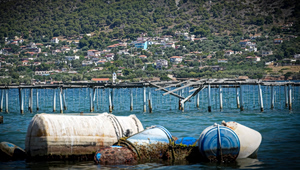
Looking back over the past three decades, abandoned farms, environmental degradation and conflicts with coastal communities have repeatedly emerged. How many licensed aquaculture sites are currently classified as abandoned, and what is the Ministry’s plan and timeline for their remediation? How many aquaculture operators have been fined or had licences suspended for environmental violations in the past ten years? What does the Ministry believe went wrong, and will future legislation introduce stronger safeguards, such as mandatory environmental restoration or financial guarantees, to prevent these problems from recurring?
Under the current allocation of responsibilities, the licensing, supervision and monitoring of aquaculture facilities, as well as the imposition of the administrative measures provided for by law, fall within the competence of the relevant services of the Regions and Regional Units.
Consequently, detailed information concerning facilities that have ceased operating, sites that may have been abandoned, as well as fines, licence suspensions or licence revocations, is maintained by the respective competent local authorities and is not currently consolidated into a single Ministry database.
For this reason, any nationwide figure would first have to be based on the collection and cross-checking of information from all Regions. It would not be responsible to provide an estimate before the relevant data have been officially confirmed by the competent authorities.
The Ministry of Rural Development and Food is responsible for developing and updating the institutional and regulatory framework governing the operation of aquaculture facilities. It monitors the implementation of this framework, assesses the information and observations received from the Regions and other competent authorities and, where gaps or operational weaknesses are identified, proceeds with the necessary legislative or regulatory interventions.
The fundamental principle is that the closure of an aquaculture facility must not result in abandoned equipment or an unresolved environmental burden in marine or coastal areas.
Operators are required to comply with the environmental conditions and obligations arising from their licences, while the competent authorities are responsible for conducting inspections and imposing the sanctions provided for under the applicable legislation.
As part of the continuing review and updating of the regulatory framework, the Ministry reviews proposals that may strengthen the clarity of responsibilities, the timely exchange of information between the Regions and the central administration, the recording of the status of licensed facilities, the implementation of decommissioning and site-restoration obligations, and the prevention of similar problems in the future.
Any proposal for additional safeguards, including restoration requirements or financial guarantees, must be examined carefully in cooperation with the competent authorities, taking into account the existing legal framework, proportionality and the need for the measures to be enforceable in practice.
The objective is to ensure that the regulatory framework does not address only the licensing and operation of an aquaculture facility, but clearly covers its entire life cycle, including the permanent cessation of activity, the removal of equipment and the restoration of the site.
Several municipalities argue that public consultations are highly technical and fail to clearly communicate the true scale, cumulative impacts and long-term implications of proposed developments. They also argue that decisions affecting their coastline are made centrally, while local communities bear the long-term consequences despite lacking the necessary technical knowledge and funds. Does the Ministry believe the current consultation process is fit-for-purpose? Under what circumstances would strong local opposition lead the Ministry to reject or substantially modify a proposed POAY?
The current legal framework provides for public consultation and for the participation of competent authorities and stakeholders. However, formal compliance with a consultation procedure is not, by itself, sufficient to build understanding or public confidence.
When studies and supporting documents are highly technical, local communities may find it difficult to understand the actual scale of a proposal, the difference between a wider planning zone and the areas that will actually contain installations, the proposed production capacity, the cumulative effects and the long-term monitoring arrangements.
The consultation process can therefore be strengthened through clearer non-technical summaries, accessible maps and visual material, a transparent presentation of existing and proposed production levels, explanation of alternative scenarios, and clearer information on environmental monitoring and the measures available where problems are identified.
It is also important that engagement takes place sufficiently early. Consultation is more meaningful when municipalities and local stakeholders are able to raise substantive concerns before a proposal has effectively reached its final form.
The €4 million action for approved POAYs includes activities to inform local communities and the wider public, alongside environmental monitoring and environmental-protection measures. This reflects the Ministry’s position that organised aquaculture must operate with clear rules, transparency and respect for the environment and local communities.
Strong local opposition – whether broad or narrow – does not constitute an automatic legal veto. At the same time, it cannot be dismissed or treated simply as an obstacle to investment.
The Ministry and all competent authorities must examine the substance of the concerns raised. Opposition may lead to the modification, reduction or relocation of a proposal, to requests for additional studies or information, or, where the applicable legal and environmental conditions cannot be met, to the proposal not being approved.
The final decision must be based on the law, scientific evidence, spatial-planning requirements and a reasoned assessment of the comments submitted during consultation. The aim should be decisions that are not only legally valid but also transparent, understandable and supported by credible environmental safeguards.
Opposition to aquaculture expansion has grown across several regions of Greece, with alliances now forming between municipalities. Does the Ministry believe this reflects misinformation, failures in communication, weaknesses in governance, legitimate environmental concerns—or something else?
It would be neither accurate nor productive to describe all local opposition as misinformation.
In many areas, concerns about environmental impact, the scale and concentration of production, tourism, fisheries, visual impact, monitoring, enforcement and the long-term use of coastal space are genuine and legitimate. Local communities are entitled to receive clear answers based on reliable and accessible information.
At the same time, parts of the public debate may be affected by incomplete information, misunderstanding of available information, or misinformation. For example, the overall boundaries of a proposed POAY may sometimes be interpreted as an area that will be entirely occupied by aquaculture installations, although the actual zones of production may represent only a part of the wider planning area.
The increase in opposition is therefore likely to reflect a combination of factors: legitimate environmental and spatial concerns, the long delays in finalising clear spatial rules, limited trust in monitoring and enforcement, prior experiences from older or poorly managed installations, insufficiently accessible consultation documents and, in certain cases, inaccurate information.
There is also a broader issue of confidence in governance. When spatial-planning procedures remain incomplete for many years, uncertainty is created both for local communities and for responsible businesses. Clear rules and timelines and effective enforcement are essential for both sides.
The proper response is not to dismiss the concerns municipalities and citizens, but instead to improve the quality of the data, the clarity of public information, consultation, environmental monitoring and the application of the rules.
The Ministry’s stated objective is an aquaculture sector that is competitive and sustainable, but also better integrated into marine space, with transparency and respect for local communities. Achieving this requires both scientific evidence and a serious, continuing dialogue with the areas directly affected.
In accordance with industry recommendations and best practices, will the Ministry require continuous environmental monitoring—including remote sensing, automated sensors or AI-assisted analysis—as a condition of licensing? Will it consider allowing large deep-sea open-pen fish farms?
The direction of policy is towards stronger, more systematic and increasingly digital environmental monitoring, proportionate to the size of each facility and the environmental sensitivity of the area in which it operates.
Primary responsibility for the environmental licensing and monitoring framework lies with the Ministry of Environment and Energy. The Ministry of Rural Development and Food supports this work within its own field of competence, including through environmental-monitoring programmes in approved POAYs and through the upgrade of the Integrated Fisheries Activity Monitoring System to cover aquaculture facilities, thereby strengthening traceability and the availability of monitoring data.
Technologies such as automated sensors, remote sensing, satellite data and advanced data analysis can offer valuable tools. They may support the earlier identification of changes in water quality, environmental pressures or deviations from expected conditions.
However, any mandatory monitoring requirement must be based on technically validated methods, common standards and a clear definition of responsibilities. The collection of data must also be connected to the applicable licensing and enforcement framework.
Artificial intelligence can assist scientists and public authorities by identifying trends or anomalies, but it cannot replace scientific assessment, validated sampling methods, field inspections or the responsibility of the competent public authorities.
In regard to large offshore or deep-sea open-pen facilities, the Ministry has not adopted a blanket position that would automatically approve or exclude an entire technological model.
Any specific proposal would have to be assessed under the applicable spatial-planning and licensing framework and would require full consideration of its environmental effects, technical safety, biosecurity, fish welfare, navigation, compatibility with fisheries and other marine activities, resilience to extreme weather, and capacity to respond to accidents or fish escapes.
Moving a facility further offshore does not automatically eliminate its environmental impact. Any such proposal must demonstrate through scientific and technical evidence that the site is appropriate and that the operation can be safely monitored, managed and eventually decommissioned.
The Ministry remains open to innovation, but innovation must operate within clear spatial, environmental and safety rules.
Minister Schinas recently announced 105 aquaculture projects worth €131 million. What are the principal categories of investment? How much public funding is expected to support expansion, environmental monitoring, scientific research, ecosystem restoration and the rehabilitation of areas affected by historic aquaculture?
The 105 approved investment projects have a total budget of €131 million, of which €87 million consists of public funding.
According to the Ministry’s official announcement, the principal objectives of these investments are the modernisation of aquaculture facilities, innovation, digital transition and the strengthening of the competitiveness of Greek aquaculture.
Depending on the content of each approved project, the investments may include the modernisation of installations and productive equipment, digital systems, improved resource and energy efficiency, improved environmental performance, product or species diversification, biosecurity, fish health, working conditions, traceability, quality and increased added value.
The €87 million figure represents the overall public funding for the 105 approved productive investment plans. The public announcement does not provide a final, consolidated breakdown allocating specific amounts between production expansion, environmental-monitoring equipment, scientific research, ecosystem restoration or the rehabilitation of historically affected sites.
It would therefore not be accurate to assign precise amounts to these individual categories without extracting and consolidating the data from the approved project files.
The broader Fisheries, Aquaculture and Sea Programme 2021–2027 also supports the sustainable management of marine and lagoon ecosystems, biodiversity protection, data collection, control and traceability systems, and local-development strategies in fisheries and island areas.
However, the amounts specifically allocated to scientific research, ecosystem restoration or the remediation of areas affected by historical aquaculture activity should be confirmed by the competent Managing Authority. They should not be estimated or included within the €87 million unless they are clearly identified in the approved project data.
For complete transparency, the Ministry can provide a detailed financial breakdown after the relevant information has been collected and verified by the competent services.