
 Μake us preferred on Google
The findings, published by the European Union Drugs Agency (EUDA) in its first survey examining public perceptions and attitudes toward drug-related problems, were presented by the Greek Documentation and Monitoring Centre for Drugs (EKTEPN) alongside the release of the European results.
The survey highlights a combination of concern over the local impact of drugs and strong public support for approaches emphasizing public health, treatment and the reintegration of people with substance-use disorders.
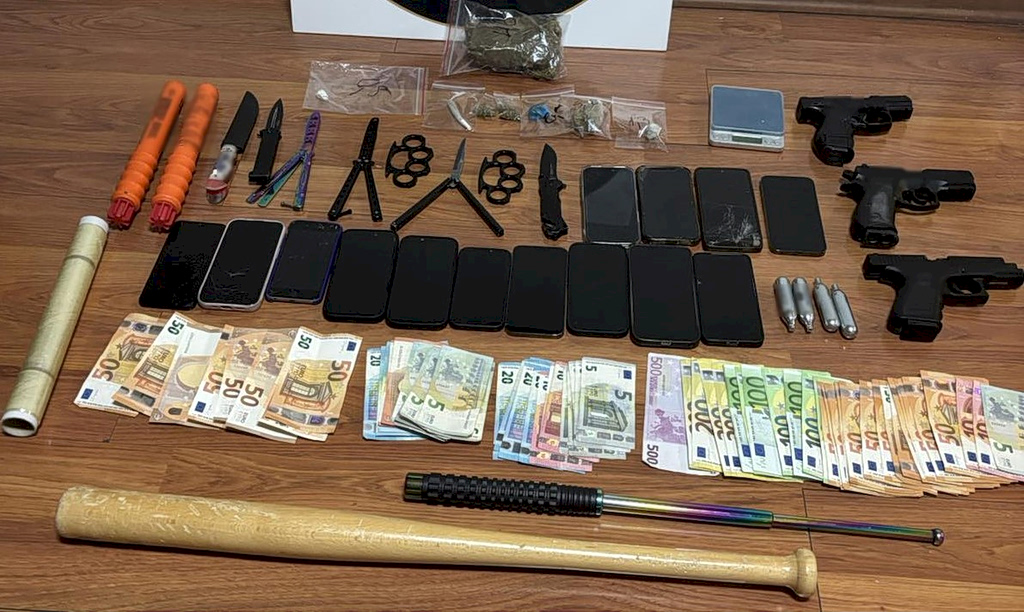
A coordinated police operation by the Immediate Drug Intervention Unit / D.D.E.E.A. / G.A.D.A. led to the dismantling of 2 criminal organizations with 11 young members who were trafficking narcotics to minors in the northern suburbs of Athens. Thursday, June 11, 2026 (Press Office G.A.D.A. / EUROKINISSI)
Drug use and trafficking seen as serious local problems
In Greece, 66% of respondents consider drug use a serious or very serious problem in their local area, while 64% say the same about drug trafficking. Both figures compare with 60% across the EU-27.
Meanwhile, 46% of Greek respondents perceive an increase in drug trafficking over the past five years, broadly in line with the EU average of 49%.
Regarding public health, the impact of drug use on mental health, including suicide and psychotic symptoms, is the most frequently cited concern in both Greece (45%) and the EU-27 (39%).
Other particularly prominent concerns in Greece include drug overdoses, cited by 34% of respondents compared with 24% across the EU, and infectious diseases such as HIV and viral hepatitis, cited by 24% against 15% at EU level. Greece records the third-highest proportion among EU member states for both perceived consequences.
In terms of public safety, the involvement of minors in drug use and trafficking, including their recruitment by drug dealers, is the leading concern in both Greece and the EU-27. The issue is cited by 38% of Greek respondents, compared with 30% across the bloc.
Access to drugs, attitudes toward cannabis regulation
Nearly half of respondents in Greece (48%) believe cannabis can be obtained easily within 24 hours, a figure matching the EU average. The corresponding proportions for cocaine and ecstasy/MDMA are 31% and 27%, respectively, compared with 35% and 32% across the EU-27.
Asked whether recreational cannabis use should be prohibited, regulated or allowed without restrictions, 44% of Greek respondents favored a ban and 33% supported regulation. The corresponding EU-wide figures were 38% and 32%, respectively.

Tougher action against traffickers, support for reintegration
When asked how to tackle drug production and trafficking, the most popular choices among Greek respondents were tougher measures against traffickers (38%) and dismantling criminal networks (36%). The figures are broadly in line with EU averages of 39% and 37%, respectively.
Regarding measures to address problems associated with drug use, the most popular option in Greece was helping people with addiction return to employment and everyday life, supported by 57% of respondents, compared with 43% across the EU-27.
Greece recorded the second-highest level of support among EU member states for this approach, behind Cyprus, where the figure stood at 58%.
Prevention through education and awareness-raising also received particularly strong support in Greece, at 49%, compared with an EU average of 39%. Greece shared the highest level of support for this approach with Croatia, Cyprus and Malta.
At EU level, the most frequently selected response was strengthening police action against drug trafficking and distribution, supported by 45% of respondents. In Greece, the figure was 47%.
When asked how people who use drugs and come into contact with the justice system should be treated, 63% of respondents in Greece favored treatment and support rather than criminal conviction or imprisonment, compared with 45% across the EU-27.
Greece recorded the second-highest level of support for this approach among EU member states, after Cyprus, at 65%.
Only 15% of Greek respondents favored criminal conviction or imprisonment, against 31% across the EU.
However, support for treatment-oriented policies does not necessarily translate into broader social acceptance of people who use drugs.
In Greece, 40% of respondents said they would accept a person who uses drugs as a neighbor, compared with 31% across the EU-27. Asked whether they would accept someone who uses drugs marrying into their family, the proportion fell to 18%, slightly below the EU average of 19%.