 Μake us preferred on Google
Prime Minister Kyriakos Mitsotakis had planned to take his government into the next national elections without further changes to his Cabinet. Instead, allegations that a deputy minister had used his political influence to benefit his daughter have forced an unexpected reshuffle, reviving questions about the conduct of officials in his administration.
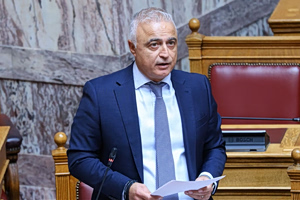
The scandal surrounding Lazaros Tsavdaridis, who stepped down as deputy development minister Thursday, has caused frustration within the governing New Democracy party, where some officials had already concluded that his position was untenable well before his resignation was announced. “Just what we needed right now,” one party official told To Vima.
Tsavdaridis came under scrutiny over allegations that his daughter had been included on the roster of a championship-winning junior handball team despite not actually playing, potentially qualifying her for a 10% bonus in Greece’s competitive university admissions system. He denied wrongdoing, insisting that his daughter had gained admission to university without using the bonus points. MEGA TV subsequently reported, however, that she had used the bonus to apply to another university, although she never enrolled there.
By Wednesday evening, a New Democracy official was already predicting that Tsavdaridis would struggle to keep his job. The official also criticized his decision to defend himself on television, describing the appearance as hasty and ill-advised. His explanations apparently failed to convince the prime minister’s office, which accepted his resignation the following day.
Surprise Calls and a Hurried Reshuffle
The resignation set off a series of changes that Mitsotakis had not intended to make so close to the elections. Shortly before beginning his engagements in Dublin, where he is attending a European summit, the prime minister personally called the MPs chosen for new government posts to inform them of their appointments. The calls caught even some of the recipients off guard.
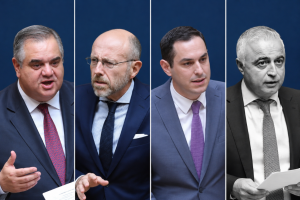
Vasilis Spanakis, until now a deputy minister at the Interior Ministry, was named Tsavdaridis’ replacement at the Development Ministry, taking over responsibility for commerce. His departure created a vacancy at the Interior Ministry, which will be filled by Vangelis Liakos, a New Democracy lawmaker representing West Attica.
Mitsotakis also brought Dimitris Vartzopoulos back into government, restoring him to his former role overseeing mental health policy at the Health Ministry. Vartzopoulos had previously left the Cabinet after his name surfaced in the OPEKEPE agricultural subsidies scandal. Government spokesperson Pavlos Marinakis defended his return, saying Vartzopoulos was among the lawmakers who had been unfairly accused by opposition parties. “There were not even grounds for a referral,” Marinakis said, arguing that the former deputy minister had been vindicated.
Meanwhile, the industrial policy portfolio previously held by Tsavdaridis will be taken over by Development Minister Takis Theodorikakos.
The three appointees are scheduled to be sworn in at 12:30 p.m. Friday at the Presidential Mansion, before President Constantine Tassoulas and in the presence of Deputy Prime Minister Kostis Hatzidakis.
An Unwelcome Distraction for Mitsotakis
The speed of the reshuffle reflects the prime minister’s efforts to prevent the controversy from disrupting government business. The timing is particularly unwelcome for Mitsotakis, who had hoped to avoid further changes to his Cabinet before the elections and had recently pressed ministers to accelerate work on his government’s priorities.
At a Cabinet meeting on Nov. 2, he gave ministers six months to deliver on 90 commitments, including tax measures announced at the Thessaloniki International Fair, another minimum wage increase and faster progress on major infrastructure projects.
Less than two weeks later, the government has been forced into a mini-reshuffle, while bringing back a former deputy minister whose earlier departure was linked to another politically damaging affair.
Greece-Cyprus Power Link Discussed in Dublin
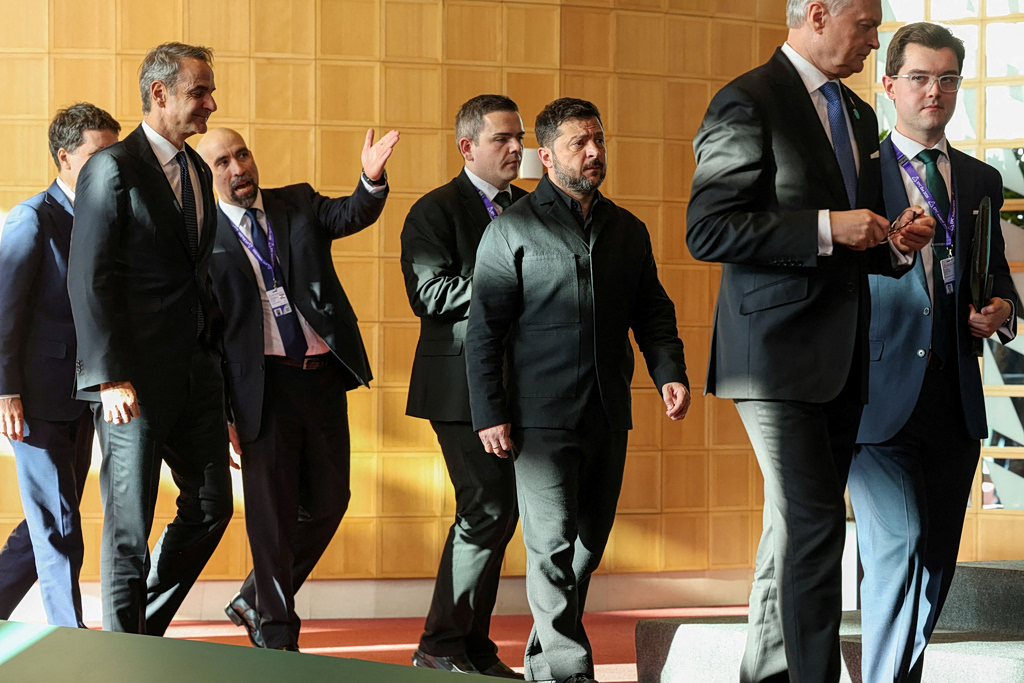
While all this was unfolding, Mitsotakis was on his way to Dublin, where he met Cypriot President Nikos Christodoulides on Thursday on the sidelines of the ninth European Political Community summit. Mitsotakis and Christodoulides discussed the Greece-Cyprus electricity interconnection as survey work for the project moved forward amid renewed tensions with Turkey. Christodoulides also raised the project in a separate meeting with French President Emmanuel Macron.
The summit’s agenda included European competitiveness, innovation, energy interconnections and energy costs. Mitsotakis was scheduled to co-chair a discussion involving European Commission President Ursula von der Leyen and Canadian Prime Minister Mark Carney, among others.
The Greek prime minister remains in Dublin on Friday for an informal European Council meeting, where discussions will also address Europe’s role in efforts to end the war in Ukraine.