 Μake us preferred on Google
Greece has always lived at a crossroads. It sits where Europe, Asia and Africa come closest to one another, and its ports have welcomed traders from every direction for thousands of years. So it is no surprise that in a single week this October, two superpowers seemed to meet there.
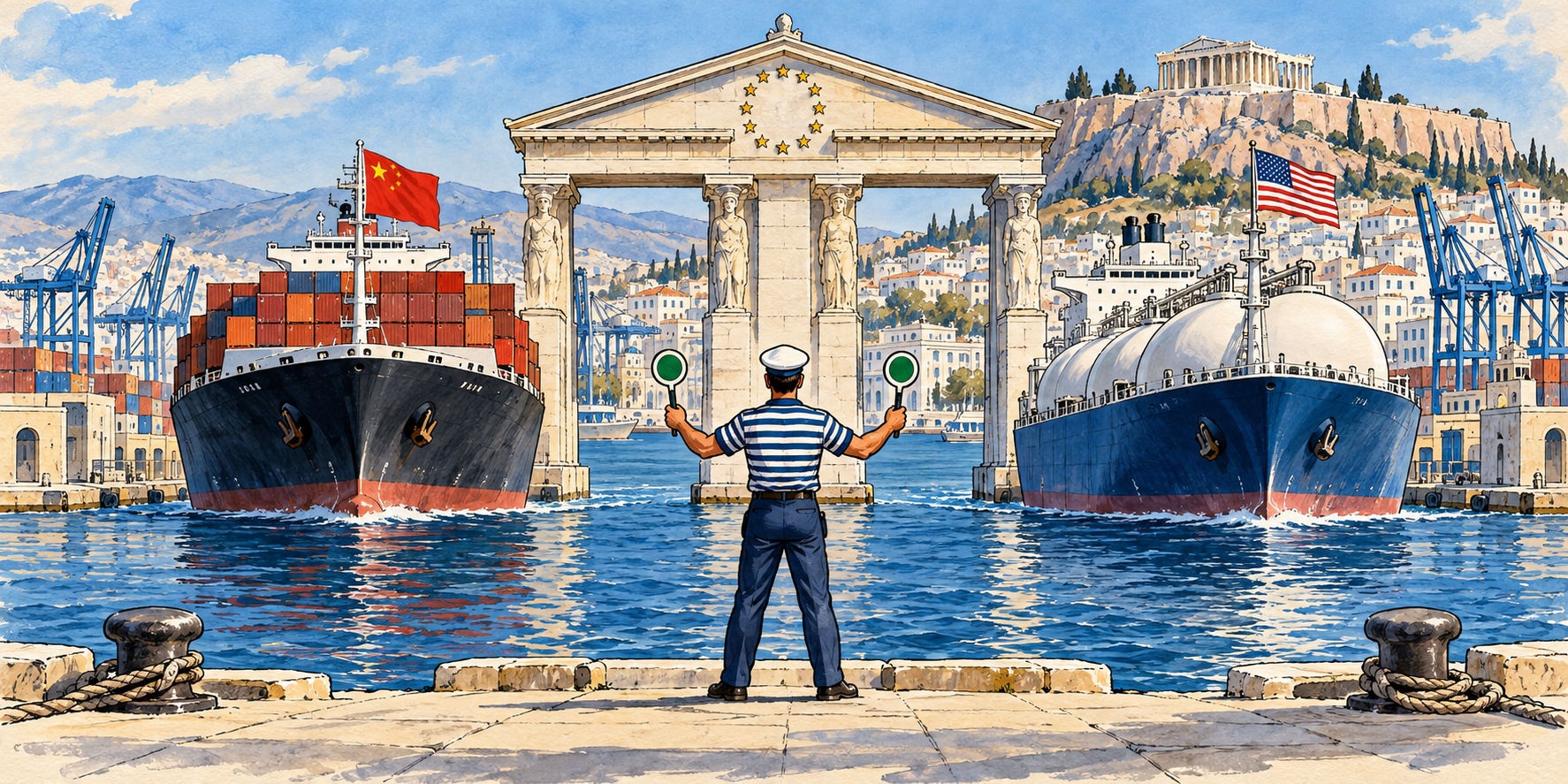
On Oct. 13, the Port of Piraeus marked 10 years since China’s state-owned COSCO Shipping took majority control of the company that runs it. Two days later, U.S. Secretary of State Marco Rubio and Greek Foreign Minister Giorgos Gerapetritis discussed more American liquefied natural gas and new energy corridors through Greece. Many would say Greece is now caught between Washington and Beijing. But is it?
China’s role grew during Greece’s hardest years, when it was often treated as Europe’s black sheep while fighting for economic survival. In 2016, COSCO paid 280 million euros for 51% of the Piraeus Port Authority and raised its stake to 67% in 2021. In 2017, China’s State Grid bought 24% of Greece’s power grid operator, known as ADMIE, in a sale required under the bailout terms. Trade has followed: Greek exports to China rose 68% in 2025.
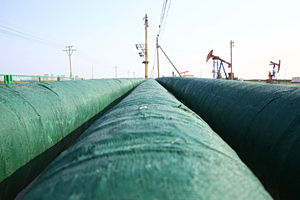
The American energy push is more recent. Washington wants Greece to be the starting point of the Vertical Corridor, a route that would carry American LNG north through Bulgaria, Romania and Moldova to Ukraine. In January, a Greek joint venture signed its first deal to supply U.S. LNG to Naftogaz, Ukraine’s state energy company. The corridor still faces obstacles, and an early capacity auction drew little interest. But the political message is clear: Washington sees Greece as a key energy route for the region.
Being caught in the middle would mean having to choose, and Greece settled that question half a century ago. In June 1976, then-Prime Minister Konstantinos Karamanlis told the Hellenic Parliament, “We belong to the West.” That answer still holds: Greece is a member of the European Union and a NATO ally. What has changed is the West itself. It is less a place on the map than a set of values and commitments, built on shared rules for trade, data and investment. The real question is whether belonging to the West requires Greece to cut ties with China. The West’s own record suggests it does not.
The West has never left China. Much of its manufacturing moved there decades ago, and China now accounts for nearly 30% of global manufacturing. In 2023, European Commission President Ursula von der Leyen described the EU’s approach as “de-risking,” not decoupling, arguing that a full break with China was neither realistic nor in Europe’s interest. On Oct. 9, Brussels and Beijing reached a deal on cars, rare earths and market access instead of walking away from the table. That came a few months after the EU introduced a 3-euro customs duty on each type of product in low-value e-commerce parcels, a measure widely seen as aimed at Chinese platforms such as Shein and Temu. If the EU chooses to manage the relationship rather than end it, it is hard to argue that Athens should be held to a stricter standard than Brussels.
The strongest objection is that Greece is also a NATO ally, and Washington takes a harder line on Beijing than Brussels does. That concern is fair. The U.S. did not de-risk TikTok. It required a sale of the app’s American operations, a deal that closed in January. Athens could one day face a similar request: limit China’s role in exchange for American gas, investment and security support.
That scenario overlooks two points. First, the past cannot be overturned. COSCO already owns 67% of the company that runs Greece’s largest port. Germany kept COSCO’s stake in a Hamburg terminal below 25%, but it set that limit before the deal closed in 2023. Greece sold under bailout pressure, with little room to negotiate. The lesson is not to walk away but to attach clear rules to any future sale of strategic assets.
Second, geography gives Greece weight. The same crossroads that once drew traders now draws both powers: Beijing values Piraeus as a gateway to Europe, and Washington is counting on Greek terminals to move its gas north toward Ukraine. A country both sides rely on has more room to set its own terms.
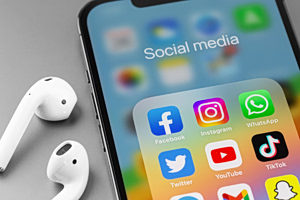
Setting terms is where rules come in. In 2023, Ireland’s data regulator fined Meta 1.2 billion euros for transferring European users’ data to the United States. In 2025, the same regulator fined TikTok 530 million euros for sending European users’ data to China, a decision the company said it would appeal. Europe did not choose Washington over Beijing. It applied the same rules to both. Greece can take the same approach: keep trade, investment and dialogue open, and hold every partner to the same terms.
This debate is not abstract for my generation. We live between Washington and Beijing every time we open our phones. In a 2025 European Parliament survey, 47% of Europeans ages 16 to 30 said they used Instagram for political and social news, and 39% said they used TikTok. We use American and Chinese platforms side by side, and we will inherit the port deals, energy contracts and data rules being decided today. Treating our future as a choice between two camps overlooks how we already live.
So where does the West belong? In Piraeus, and in the Greek terminals that carry American gas north, as long as the same rules apply to everyone who uses them. The United States is Greece’s ally, and China is its strategic partner. These are different relationships, and Greece can keep both. Greece belongs to the West, and that is why it does not have to choose between Washington and Beijing. Belonging is measured by the rules a country keeps, not by the partners it avoids.
Christina Liani is the co-founder of Know4EU, a youth-led platform for EU education and civic engagement, and vice chair of the International Relations and Communication Committee at the Hellenic National Youth Council (ESYN). She is also a master’s student in Black Sea and Eastern Mediterranean Studies at the International Hellenic University. The views expressed here are her own.