

 Μake us preferred on Google
 It was August 6, 1995, when one of the greatest revolutions in human history began: the day the inventor of the World Wide Web created the first website and paved the way for the internet that would conquer the world.
British scientist Sir Tim Berners-Lee, then working as a programmer at CERN, the European nuclear physics laboratory, posted a bare-bones, static page at info.cern.ch, without images or graphics, explaining how the new system worked.
Berners-Lee had envisioned the Web as a space where people could share information through documents linked by hyperlinks, which users could locate through a simple search function.
On that first page, he described the WWW project as combining information-retrieval and hypertext techniques to build an easy-to-use yet powerful global information system, adding that it was built on the idea that much academic information should be freely available to anyone.
The page was hosted on a personal NeXT computer, on which Berners-Lee had taped a note reading “This machine is a server. DO NOT POWER IT DOWN.”
The historic page was later lost, but CERN recreated it in 2013.
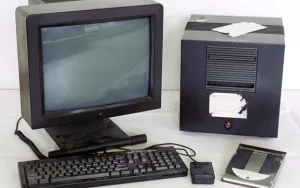
The computer NEXT, who hosted the first website is now on display at CERN
HTTP
The idea for the Web was born in March 1989, when the Berners-Lee published his proposal for what he then called “Information Management.”
The Web was meant to be a way to prevent the loss of important information within businesses and the scientific community. It was envisioned as a universal system of linked information, in which different documents would be connected to one another through hyperlinks.
Berners-Lee’s supervisor at CERN, Mike Sendall, famously scrawled “vague, but exciting” on the proposal before eventually approving it.
Within about a year and a half, just before Christmas 1990, Berners-Lee had built the Web’s infrastructure and designed the first page.
He wrote the HyperText Transfer Protocol (HTTP), which defined how information would be transmitted between computers, and HyperText Markup Language (HTML), used to build the earliest web pages.
One of the first practical uses of his creation was an internal phone directory for CERN staff.
The following year, in 1992, the first image was uploaded to the Web: a kitschy photo of CERN’s own parody girl band, Les Horribles Cernettes.
In 1993, the Web was made publicly available under an open license, meaning anyone could set up a server and build websites.
That same year, the Mosaic browser was released, and CERN hosted the first-ever conference on the World Wide Web, which became known as “the Woodstock of the internet.”
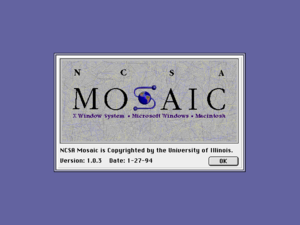
The Mosaic Broswer
A quarter century later, the Web is dominated by social networks, search engines, and online shopping. It has evolved well beyond static pages into interactive sites built in new programming languages, filled with photos, videos, and animation. And the revolution continues now with the Internet of Things and AI services.