 Μake us preferred on Google
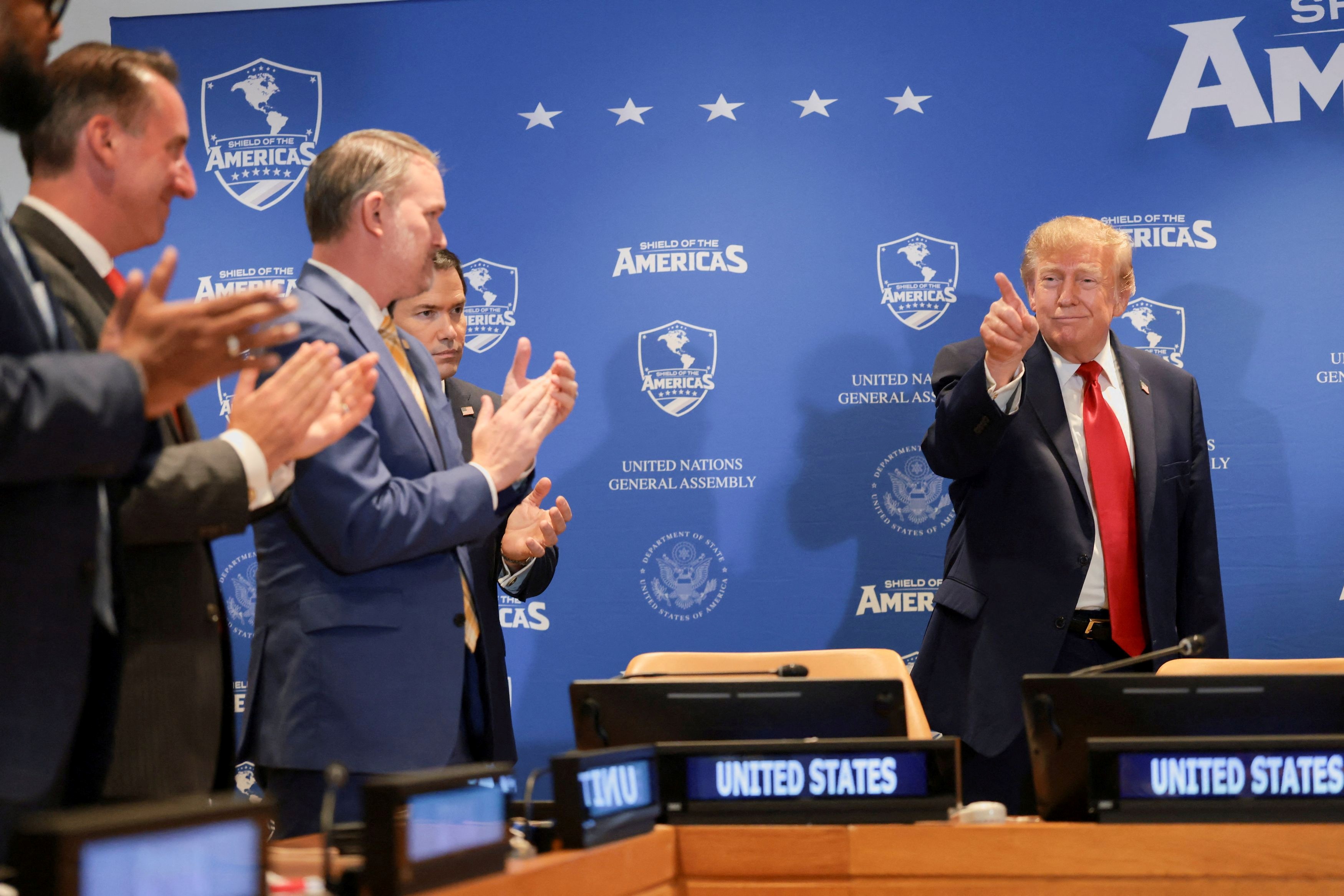
 President Trump labeled himself a man of peace while threatening to “annihilate” Iran and wield American power against other nations, in a speech at the United Nations aimed in part at selling skeptical voters on his foreign-policy vision ahead of the midterm elections.
During his roughly 35-minute address Tuesday to the U.N. General Assembly, Trump argued that his forceful interventions had made the world a safer place.
“While others have talked, I have acted,” he said. “While others have spoken of peace, I have made peace. While others have ignored threats, I have confronted them.”
Even as he labeled himself a peacemaker, Trump warned other countries that he was prepared to take military action, raising the possibility of escalating the war in Iran and hinting that his administration could soon bring “fundamental change in the situation in Cuba.”
In a demonstration of Trump’s split-screen views on matters of war and peace, the U.S. president said the choice he faces in Iran was either striking a deal over its nuclear program or a full-on bombing campaign.
“Do I annihilate the Islamic Republic and do it quickly, never giving them a chance to kill and destroy people and countries again? Do I drive them into hell with no chance of survival and no hope of future greatness or generations?” Trump asked.
While Trump spoke to a room full of world leaders and foreign dignitaries, the real audience for his speech was the American public, which has grown weary of the war in Iran. The war has sparked an energy shock that has increased the price of gasoline just weeks before the midterms.
He predicted that Tehran would make a deal with the U.S. after the election to dismantle its nuclear work and end the war. After that, Trump argued, “oil prices will come plummeting down.”
“We are reasserting American power, including American military power, where necessary, in our region and around the world, to create a safer future for all of us,” Trump said.
Trump predicted that Cuba’s communist government “will fall,” saying his administration is seeking significant changes on the island he described as an “absolutely failed state.”
“Freedom will be coming to Cuba,” Trump said. As he spoke about Cuba, the country’s delegation filed out of the chamber.
After Trump’s speech, a packed schedule of meetings and pull-asides will lay bare the unfinished business of his foreign-policy interventions, challenging his image as a peacemaker.
Trump sat down with Ukrainian President Volodymyr Zelensky and will meet separately with Gulf leaders. His repeated attempts at mediation have failed to end Russia’s war against Ukraine, while the Iran war has led Tehran to target the energy infrastructure of Middle Eastern nations and restrict trade in the Strait of Hormuz. Both conflicts have hamstrung the global energy market, hurting Republicans’ political standing as gas and oil prices rise .
Trump said of recent Ukrainian strikes on Russia: “It is a very serious hit on Russia, it’s also a serious hit on the price of diesel.”
During his U.N. speech, Trump again predicted that Russia and Ukraine were on the brink of peace. “We will get that one done,” he said. Both nations were exhausted with the conflict, Trump added. “They’ve had it.”
The president’s busy day in New York comes amid a White House push to package Trump’s foreign-policy interventions into headline-grabbing wins for Americans ahead of the midterms. On Tuesday, Trump signed an agreement giving the U.S. a greater military and business presence in Greenland , the large Arctic island in Denmark’s kingdom, following nearly two years of diplomatic pressure and the occasional threat that upset relations with trans-Atlantic allies. Trump promised that the U.S. would soon be building “two very major military bases” on the island.
He will also meet with interim Venezuelan leader Delcy Rodríguez after announcing a deal in which the Pentagon will take a stake in the country’s oil, a move that the U.S. president says will lower gas prices for Americans.
“We’re working closely with the leaders of Venezuela,” Trump said. “It’s perhaps the biggest deal ever made—to the victor go the spoils.”
The nearly seven-month war with Iran loomed over the gathering of world leaders, as U.S. and Iranian officials signaled they were open to renewed negotiations. Trump told reporters that the U.S. and Iranian delegations had huddled for three hours in what he described as “a very good meeting.” He said his son-in-law Jared Kushner, and Steve Witkoff, a special U.S. envoy, had attended the meeting.
Trump said he saw two choices for the Iranians: make a deal or risk further conflict — “It’s greatness, potential greatness, or obliteration.”
Earlier, Secretary of State Marco Rubio left the door open to the prospect of Trump meeting with Iranian President Masoud Pezeshkian on the sidelines of the event. “The president is open to a meeting with him or anybody. Now, whether something productive will come out of it, it’s harder to tell because the ultimate decision maker in Iran is the supreme leader,” Rubio said in an interview with Fox News on Tuesday morning.
Trump renewed his call for regime change in Cuba, saying that the U.S. wouldn’t allow “a haven for foreign adversaries to threaten America on our own doorstep.” He accused Cuban leaders of propping up communists and political dissidents in the U.S. before declaring “communism will never be coming to America, but freedom will be coming to Cuba.”
On Wednesday, the Board of Peace—a body Trump founded to resolve the humanitarian crisis in Gaza—will meet and outline the progress it has made since the war between Israel and Hamas ended.
Another test awaits Trump when he welcomes Chinese leader Xi Jinping for a three-day state visit that begins on Wednesday.
Once hawkish toward the world’s second-largest economy, Trump now seeks friendlier relations with Beijing and wants to avoid stiff economic and military competition. The summit, expected to be more about optics than substance, will likely see Trump and Xi discuss matters such as artificial intelligence, rare earths and Taiwan, U.S. officials said.
Trump on Tuesday continued to advocate for the development of AI, which he said he wanted to rebrand as “super intelligence.”
“The use of the word artificial makes intelligence…sound fake and it is not fake. It’s actually amazing,” Trump said, adding that the U.S. would use the new name on government documents. He described the rebranding effort of the technology as a test of his own influence. “Let’s see if I have any power,” Trump said. “Maybe I do and maybe I don’t.”
Earlier this week, the White House removed CNN from a planned assignment covering Trump’s trip to New York after the president banned the cable news network and two other outlets from the White House. Major television networks had suspended some of their coverage of Trump in protest. When a CNN reporter tried to ask him a question at the U.N. on Tuesday, Trump responded, “You said you weren’t going to cover me. You shouldn’t be covering me.”