
 Μake us preferred on Google
 U.S. President Donald Trump met Venezuela’s interim President Delcy Rodriguez in New York on Tuesday, bringing the two leaders together for the first time since U.S. forces captured former Venezuelan President Nicolas Maduro in a January raid.
The brief meeting took place during a reception hosted by Trump on the sidelines of the United Nations General Assembly, where Rodriguez was making her first visit to the United States since taking office. She is scheduled to address the General Assembly on Wednesday.
The talks came as Rodriguez’s government seeks to deepen ties with Washington, particularly in energy, mining and security.
Rodriguez described the encounter as a “historic step” toward stronger relations between the two countries. In a message posted on Telegram afterward, she said Venezuela and the United States should manage their relationship through dialogue and that her administration would pursue diplomacy aimed at achieving “concrete results and collective benefits.”
As reported in Reuters, the White House said the meeting included Trump, Secretary of State Marco Rubio, Treasury Secretary Scott Bessent, White House Chief of Staff Susie Wiles and Stephen Miller.
Venezuela Seeks Investment and Economic Deals
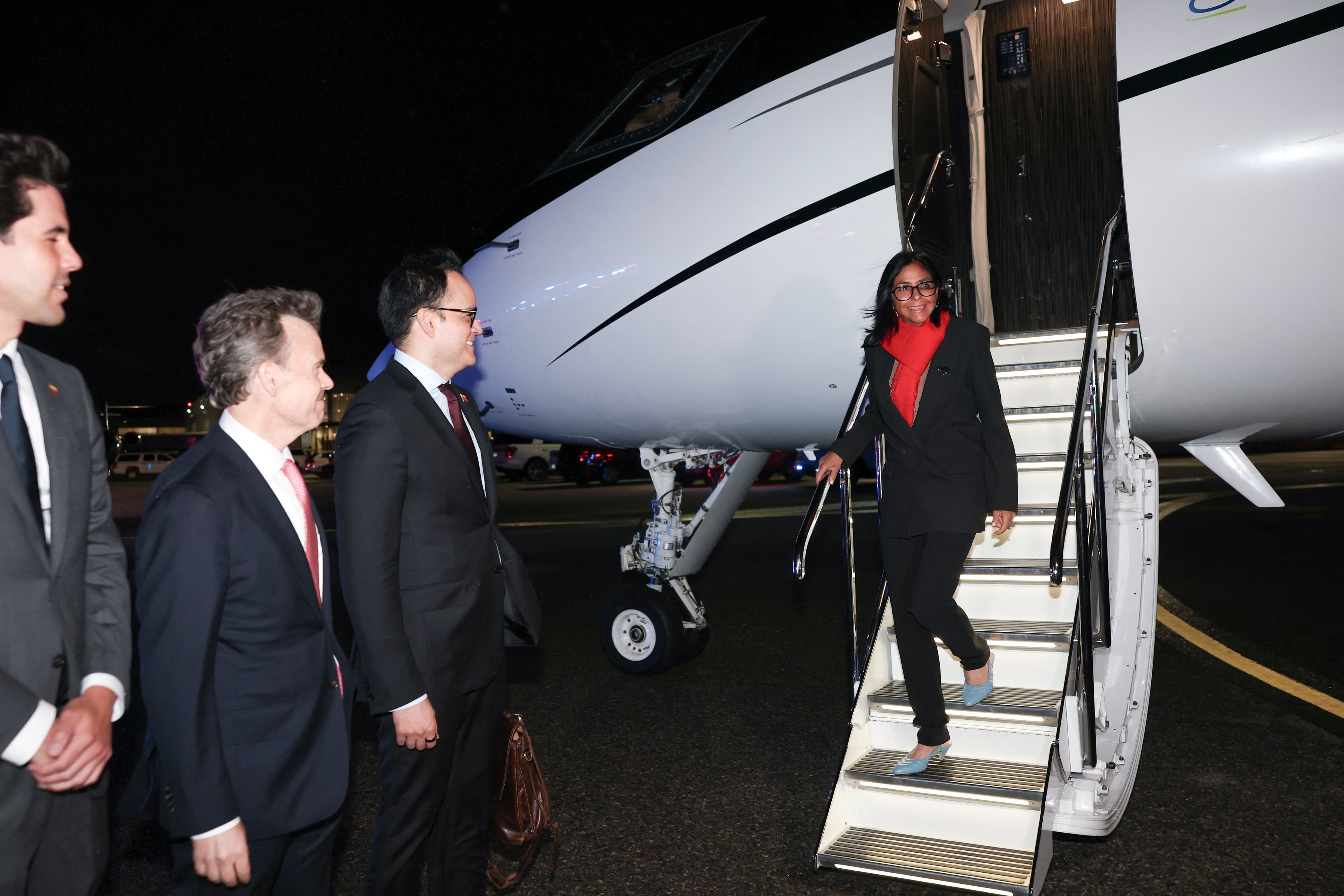
Rodriguez arrived in New York on Monday with a delegation that includes Venezuela’s vice president for the economy, its oil minister and officials from state oil company PDVSA.
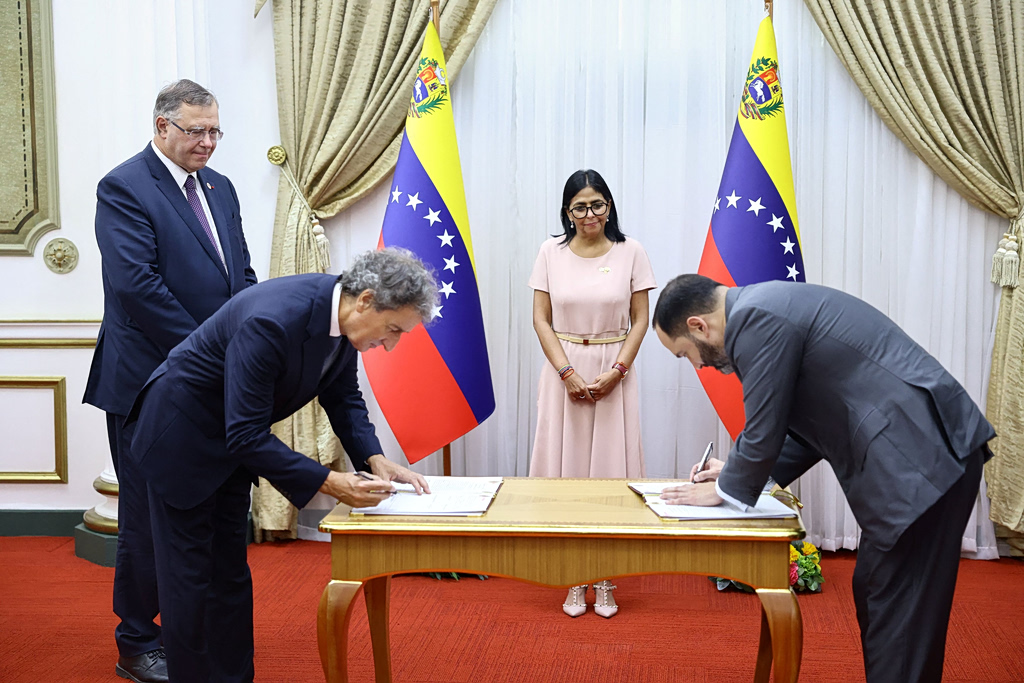
Venezuela’s acting President Delcy Rodriguez and Patrick Pouyanne, CEO of TotalEnergies, look at PDVSA President Hector Obregon and Javier Rielo, senior vice president for the Americas, Exploration and Production at TotalEnergies, sign a memorandum of understanding to boost bilateral energy cooperation at Miraflores Palace in Caracas, Venezuela, September 19, 2026. Miraflores Palace/Handout via REUTERS ATTENTION EDITORS – THIS IMAGE HAS BEEN SUPPLIED BY A THIRD PARTY
Two people close to the delegation said its focus was on making Venezuela “investable.” The group has held discussions with U.S. officials, companies and multilateral lenders on energy, mining and debt.
The economic agenda comes as the Trump administration pushes for greater investment in Venezuela’s oil industry. Trump said in his U.N. address that an oil agreement signed with Caracas last month was “perhaps the biggest deal ever made” and has said he wants $100 billion in investment to flow into the sector.
The head of the Inter-American Development Bank is also working to secure approval for a $2.5 billion loan for Venezuela, although some members of the bank’s board have pushed back against the proposal.
Opposition Supporters Demand Elections
The closer engagement between Washington and Caracas has drawn criticism from Venezuelan opposition supporters.
More than 50 people gathered outside the U.N. on Tuesday carrying Venezuelan flags and signs including “No Vote, No Oil” and “New Face, Same Regime.” Many said they wanted Trump to press for free elections in Venezuela.
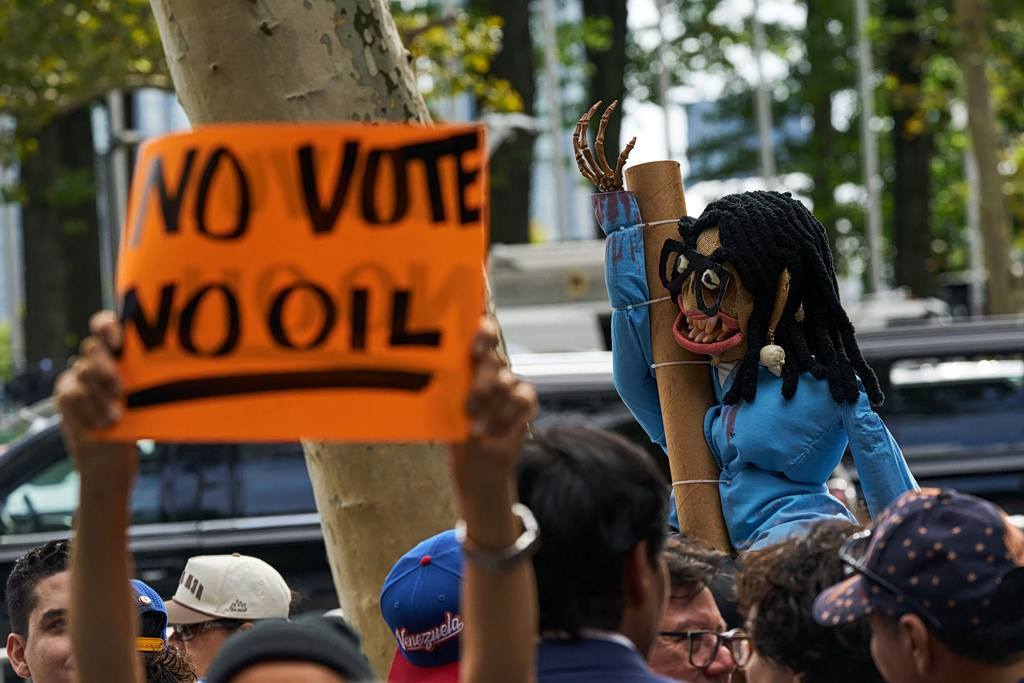
An effigy of Venezuela’s interim President Delcy Rodriguez is displayed by members of the Venezuelan diaspora at a demonstration against Rodriguez at Dag Hammarskjold Plaza, on the sidelines of the 81st United Nations General Assembly in New York, U.S., September 22, 2026. REUTERS/Bing Guan
The demonstrators sang the Venezuelan national anthem and chanted that Rodriguez would end up in Brooklyn with Maduro, referring to the federal jail where her predecessor is being held pending trial on drug-trafficking charges.
Trump has developed a working relationship with Rodriguez, who previously served as Maduro’s vice president. Critics of the administration’s approach say Washington has sidelined the opposition led by Maria Corina Machado by moving away from demands for free elections while pursuing oil and investment agreements with the interim government.
Machado has been living in exile since late last year. Her team and media reports said Tuesday that she had made three unsuccessful attempts to return to Venezuela by sea and air in recent hours.
At the U.N., Trump called Maduro an “outlaw dictator” and said hundreds of political prisoners had been freed since his capture. He also portrayed the U.S. operation as evidence that Washington would use its military power to protect its interests in the Western Hemisphere.