 Μake us preferred on Google
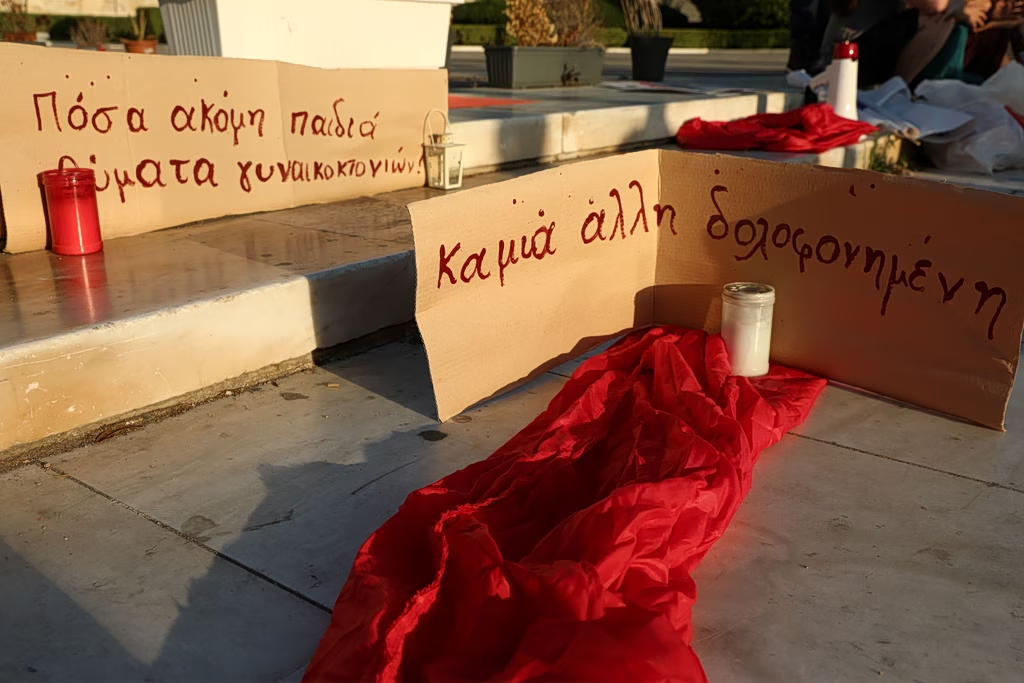
 “It’s not love if he hits you. It’s not love if he humiliates you. It’s abuse.” Nektaria wrote those words on social media in June 2024. Nearly two years later, in February, she was found dead on the stairs of the Athens home she shared with her partner in Kolonos. An autopsy found signs of repeated beatings, some fresh, others long healed, and cirrhosis of the liver. Her 38-year-old partner is being held in pretrial detention. Nektaria, 31, became Greece’s first femicide victim of 2026.
Alas, she would not be the last. Eleftheria Giakoumaki was shot once in the head by her former partner in April. In June, a 41-year-old man in Kalamata confessed to killing his 39-year old-wife, Vasiliki. That same month in Drama, in northern Greece, a 50 year police officer killed his estranged wife, 45-year-old Antigoni, who was also on the force. He stabbed her seven times inside her own home before taking his own life. In August, a 48-year-old man in Nea Smyrni, shot and killed his 45-year-old former partner and then killed himself. A few days later, a 53 year old man in the village of Dialambi, in Rodopi, told police he had killed his 44-year-old estranged wife in a fit of rage.
On Monday, September 21, a 25-year-old woman was found dead along a cycling path in the town of Igoumenitsa, in northwestern Greece. Her former partner had traveled there from Athens, carrying a knife. According to reports, they had broken up almost a month earlier. When the 27-year-old man was found injured nearby, he first tried to cast himself as a victim, telling police that four masked men had ambushed the couple and tried to rob them. It didn’t take long for his story to unravel under questioning. He later confessed to killing his former partner, Penelope, claiming it was over a financial dispute.
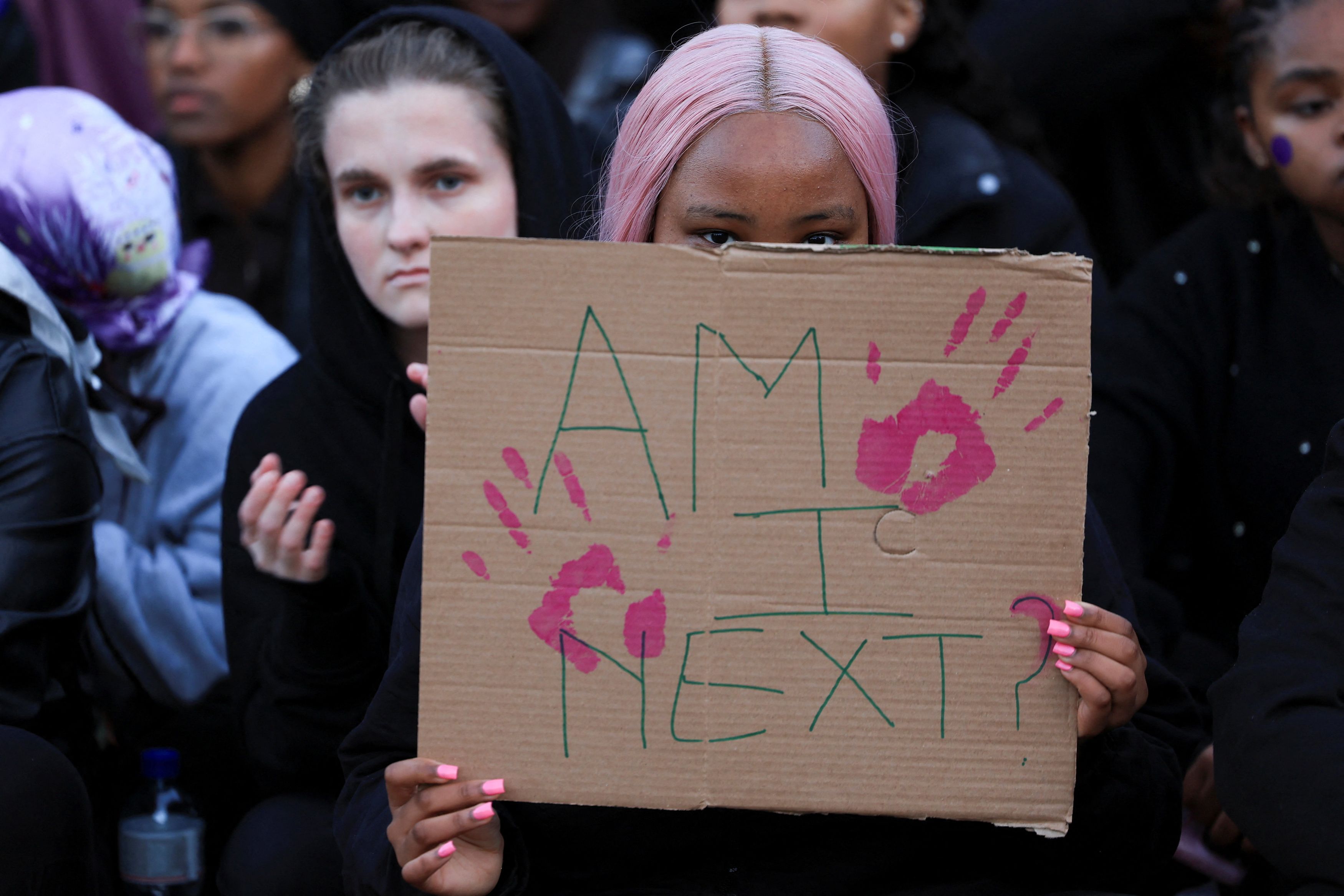
She is the 11th woman killed in a suspected femicide in Greece this year, according to the Diotima Center, which tracks violence against women in the country. The center has recorded at least 100 such killings since 2020, a toll that has repeatedly provoked public outrage.
What Police Data Show
According to Hellenic Police’s own data femicides tied to domestic violence spiked sharply in 2021 and 2022, before falling back in 2023. The numbers rose again in 2024 and stayed elevated in 2025, still well above the levels recorded through most of the previous decade.
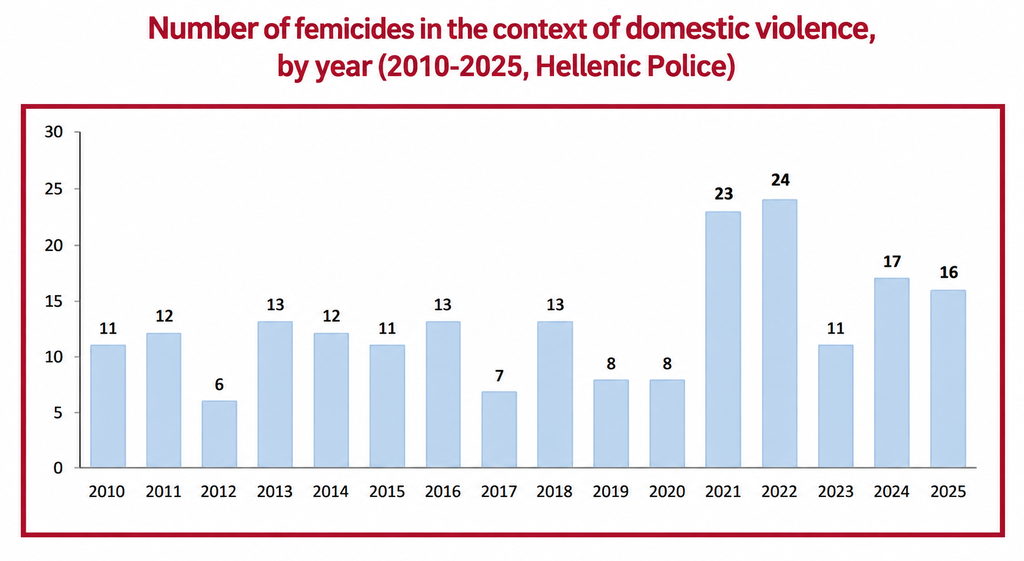
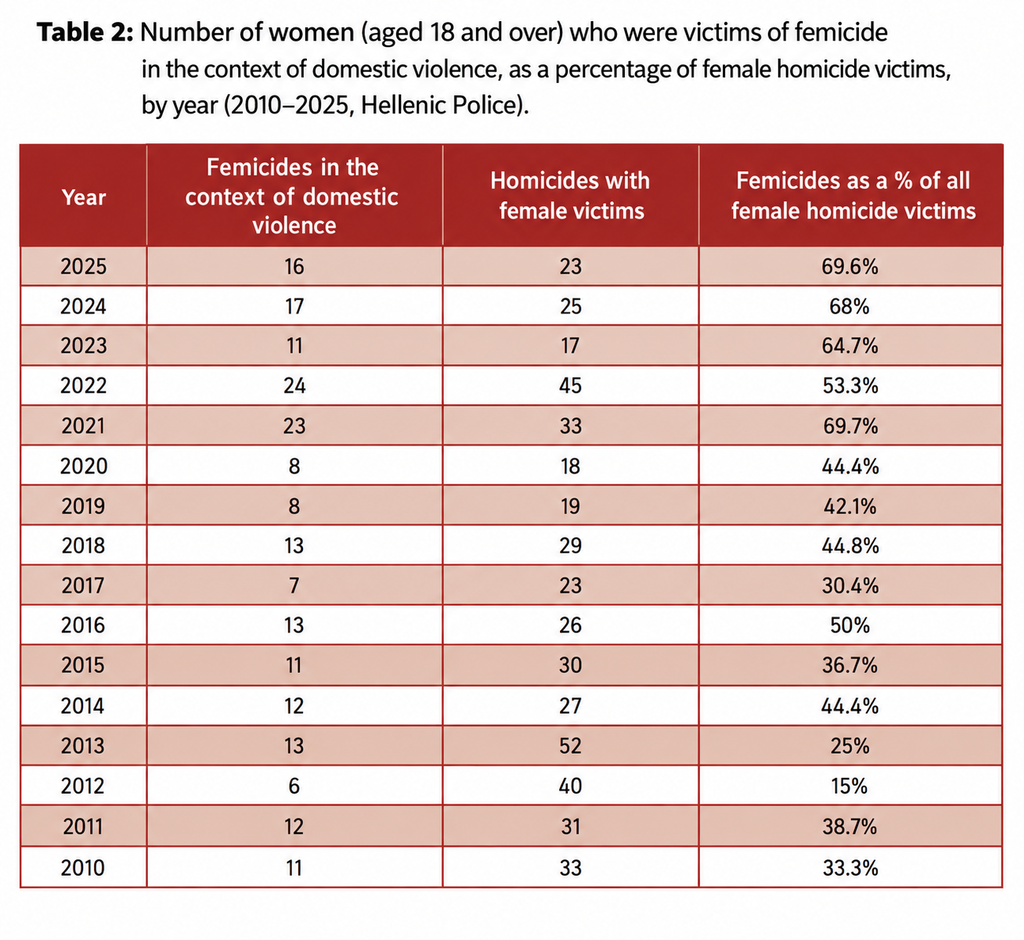
In 2025, 16 women were killed by a male family member or partner, while femicides tied to domestic violence accounted for 69.6 percent of all homicides with female victims, the highest share in 16 years. In 2022, the worst year on record, according to Police data, 24 women were killed in domestic violence related incidents.
Data from Greece’s General Secretariat for Equality and Human Rights are equally revealing. In a single year, reports of domestic violence to the police by women nearly doubled. The Secretariat recorded 18,640 women as victims of domestic violence in 2024, an 88.5 percent increase over 2023. The upward trend continued into 2025, with reports rising almost 3 percent over 2024.
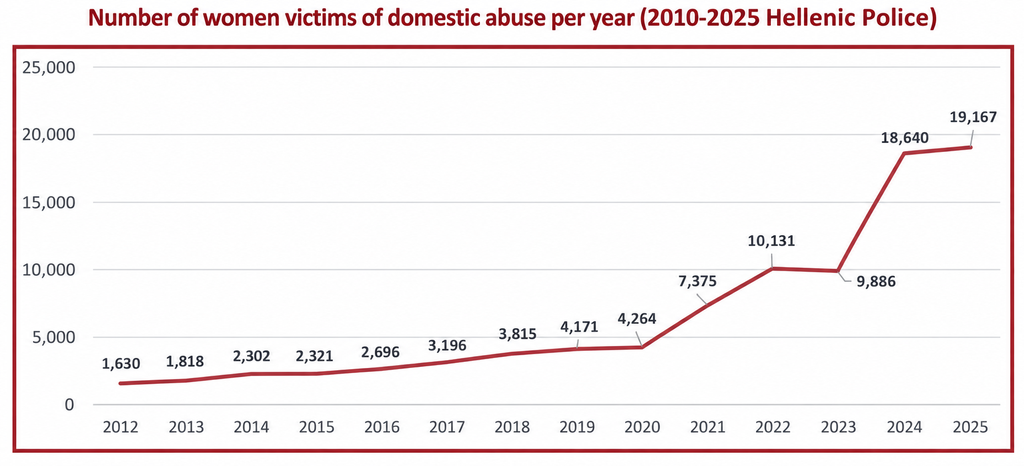
Women have consistently made up about three in four people who report domestic violence to police. In 2024, they accounted for 73.3 percent of complaints, men for 26.7 percent.
In 2020, Greek Police recorded 4,264 women as victims of domestic violence. By 2025, that figure had climbed to 19,167, an increase of roughly 349.5 percent in five years. The trend has carried into 2026. More than 6,500 domestic violence complaints, across all victims, have already been filed since the start of the year.
In 2025, 5,550 women gained access to a digital panic button app, and in the first five months of 2026 alone, another 1,492 women received one.
The Perpetrators
In most cases, the victim had, or once had, a romantic or marital relationship with the attacker. Police data on the relationship between victims and perpetrators show that, for another year running, partners and spouses accounted for the largest share of domestic violence, at 55.6 percent.
Spouses make up the largest single group of perpetrators, responsible for 24.6 percent of cases, or 6,746 in total. Permanent partners account for another 12 percent, or 3,295 cases, while the share involving former partners, 12.4 percent, or 3,406 cases, has been rising compared with previous years. The share involving former spouses has held relatively steady, at 6.9 percent, or 1,883 cases.
Part of a Global Pattern
Globally, nearly 50,000 women and girls were killed by an intimate partner or another family member in 2024, according to a joint report by the United Nations Office on Drugs and Crime and UN Women, an average of 137 deaths a day. Those killings accounted for roughly 60 percent of all women and girls killed intentionally worldwide that year.
The 2024 total is slightly below the 51,100 victims estimated for 2023. The report states this is not evidence of an actual decrease, and attributes the change to differences in data availability across countries rather than to fewer killings.
Men account for roughly 80 percent of all homicide victims worldwide and women 20 percent, but the relationship between victim and killer differs sharply by gender. Nearly 60 percent of women killed intentionally in 2024 were killed by an intimate partner or family member, compared with 11 percent of men killed. According to the authors of the report, “The largest share of intentional killings of women and girls worldwide are perpetrated by intimate partners or other family members. This implies that the home continues to be the most dangerous place for women and girls in terms of the risk of homicide.”
The report notes that femicide is often not an isolated act but the culmination of existing, ongoing violence. It cites a global estimate that roughly one in four women and girls aged 15 to 49, 25.8 percent, have experienced physical or sexual violence by a current or former husband or male partner at some point in their lives.
The Response So Far in Greece
Greece has tightened its legal framework around domestic violence and expanded specialized police units and support tools in recent years, but the frequency of new cases has not eased. Experts who study the issue argue that prosecution alone cannot resolve it, and point instead to earlier intervention, education, public awareness campaigns and stronger support services for victims as the factors most likely to prevent future killings.
Source: TA NEA