Primary school enrollment across the European Union declined slightly between 2023 and 2024, though trends varied considerably from country to country, according to new figures from Eurostat. The number of children enrolled in primary education reflects a mix of factors, including population size, demographic structure, and differences in the official age at which children begin compulsory schooling.
Across the bloc, 23.2 million pupils were enrolled in primary education in 2024, down 0.2 percent — roughly 35,000 students — from the previous year. France recorded the largest primary school population, with 4.1 million pupils, followed by Germany (3.3 million), Spain (2.8 million) and Italy (2.6 million). Malta, Luxembourg and Cyprus reported the smallest numbers, with 27,537, 43,020 and 60,596 pupils respectively.
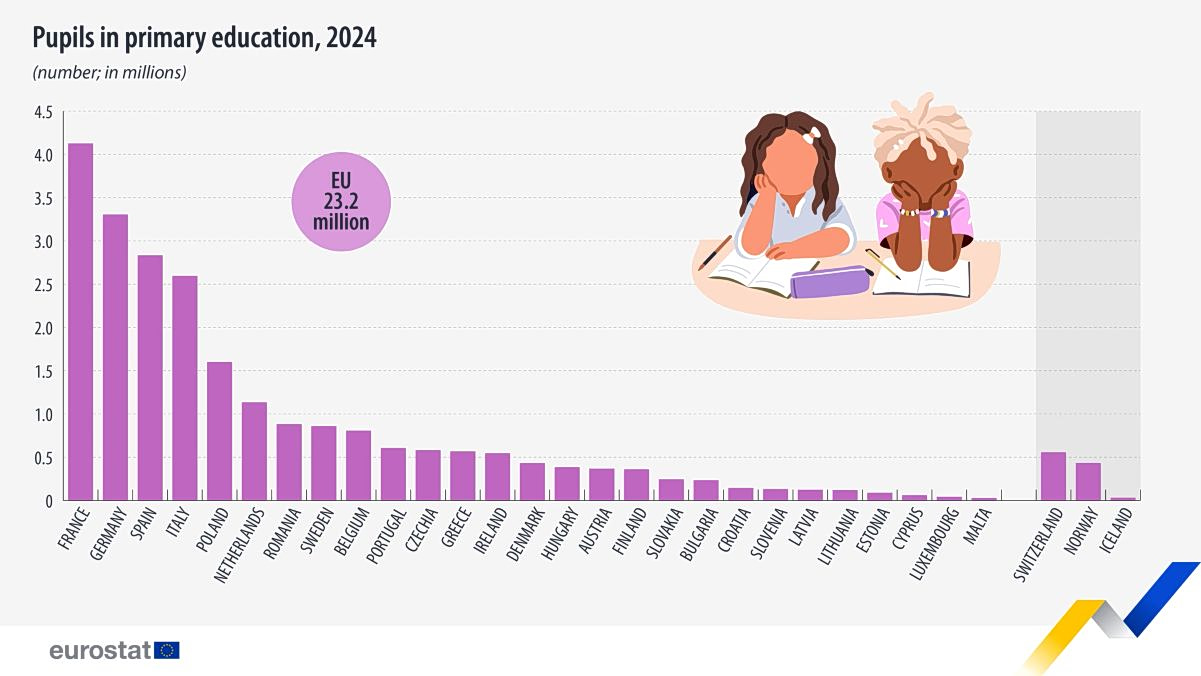
Over the past decade, primary enrollment rose in 15 EU countries between 2014 and 2024 and fell in the remaining 11 for which data is available. Luxembourg posted the steepest increase, at 21.4 percent, followed by Slovenia at 18.2 percent. Poland saw the sharpest decline, down 25.7 percent, while Croatia and Portugal also recorded notable drops of around 10 percent.
Pupil-teacher ratios continue to fall
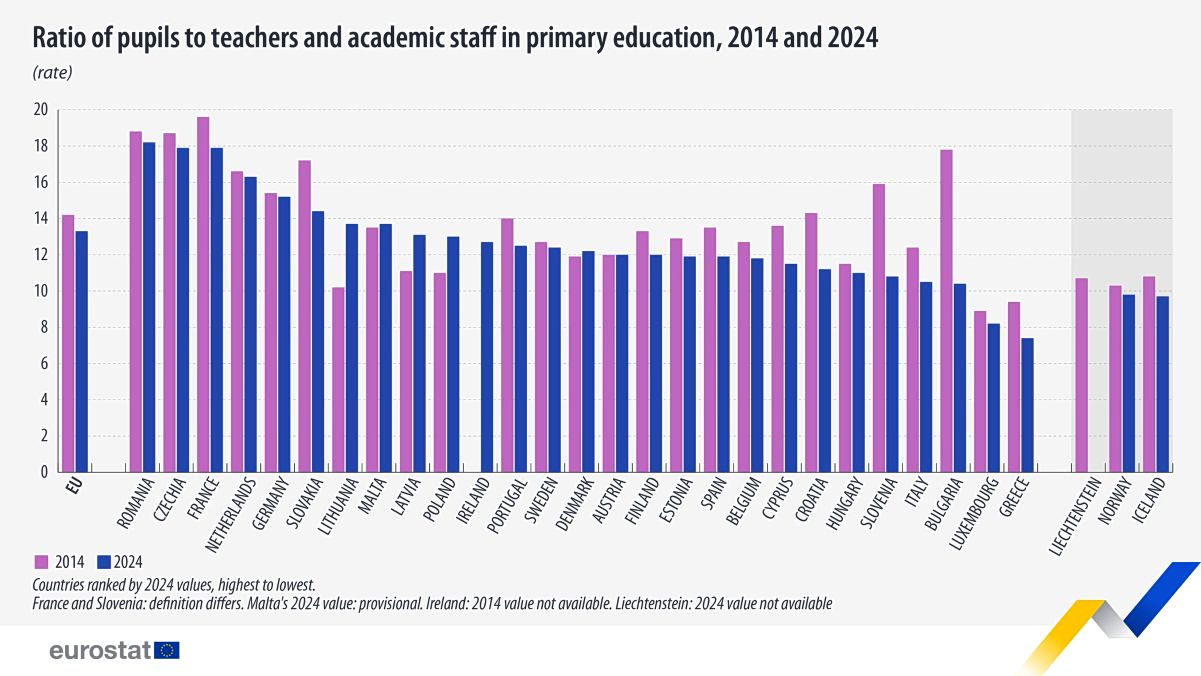
Eurostat’s data also show a decade-long decline in the ratio of pupils to teachers across the Union. In 2024, Greece reported the lowest ratio in the bloc, at 7.4 pupils per teacher, while Romania recorded the highest, at 18.2.
The agency cautioned that these figures reflect the level of available teaching resources rather than the quality of education, and should not be read as a proxy for class size. Factors such as geographic dispersion, demographics, and the uneven size of schools — from small rural institutions to large urban ones — can pull national averages significantly lower.
The EU-wide average stood at 13.3 pupils per teacher in 2024. Greece and Luxembourg were the only member states to report ratios below 10. At the other end of the spectrum, Germany (15.2), the Netherlands (16.3), Czechia and France (both 17.9) and Romania (18.2) all exceeded 15.
Compared with 2014, the EU-wide ratio fell from 14.2 to 13.3, a trend seen in 23 member states — most sharply in Bulgaria (17.8 to 10.4) and Slovenia (15.9 to 10.8). Austria’s ratio held steady at 12.0. The remaining countries recorded increases, led by Lithuania, where the figure climbed from 10.2 to 13.7.