 Μake us preferred on Google
 Greece’s ferry sector is seeing its first vessel withdrawals linked directly to surging fuel costs, raising concerns about a difficult winter for operators and prompting renewed calls for changes to the rules governing conventional passenger-car ferries.
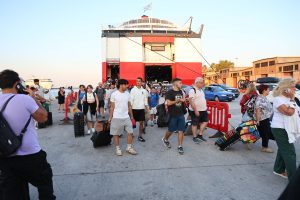
For the first time in recent years and unusually early in the year, three conventional passenger-car ferries have been withdrawn from service on routes connecting Rafina with the Cyclades and the Dodecanese islands.
The vessels are the Aikaterini P. operated by Fast Ferries and Superferry operated by Golden Star Ferries, both of which ended their seasonal service on the Rafina-Cyclades route earlier than usual, and Lefka Ori of Attica Group, which was withdrawn early from the Dodecanese route.
The Aikaterini P. arrived Monday, September 14, at the shipbuilding and repair zone in Perama after completing its route connecting Tinos, Mykonos, Naxos, Paros and Rafina.
The Superferry docked in Piraeus on the evening of September 13 after also completing its service on the same route. Both vessels are now entering their annual lay-up period.
The withdrawal of the Lefka Ori means the Dodecanese route is now being served by two vessels instead of three.
Marine fuel prices nearly double
The withdrawals are directly linked to the sharp rise in marine fuel prices, which has significantly changed the economics of ferry operations.
According to industry figures, the price of Marine Gas Oil (MGO) stood at €1,300 per metric ton on September 9, 2026, compared with €993 on June 1 and €658 on Febuary 24.
That represents a 30.9% increase since June and a 97.6% increase since February. In less than seven months, the cost of the fuel has therefore nearly doubled.
The impact is particularly significant for conventional ferries, which have high fuel consumption. The pressure is expected to be especially difficult after the end of the peak tourism season, when passenger traffic declines substantially.
Industry executives estimate that if fuel prices remain at current levels, further cuts to ferry services could follow.
Government moves to ease costs
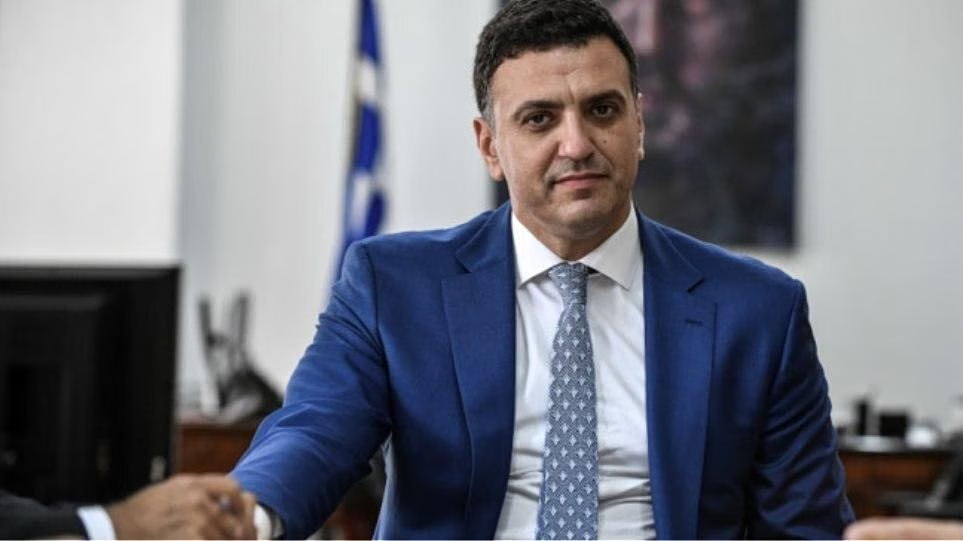
In response to the higher operating costs, Shipping Minister Vassilis Kikilias, in cooperation with the Finance Ministry, has introduced a measure removing the cost of mandatory discounts that ferry companies must provide to certain social groups.
The cost of those discounts will now be covered by the state budget, as has been the case for years in road passenger transportation.
However, the fuel crisis has also revived discussion about the broader regulatory framework governing Greece’s ferry sector.
Under the current system, a conventional ferry is generally required to operate on a route for a 12-month period. Industry representatives argue that the system should become more flexible, allowing shorter operating periods under certain conditions.
Their argument is that if an operator is committed to running a vessel throughout the year, including during months when a route is unprofitable, the company may ultimately decide not to operate the vessel on that route at all.
Calls for more flexible ferry schedules
Other proposals under discussion include reducing passenger-car ferry services during periods of low demand and using roll-on/roll-off (ro-ro) vessels to cover part of the demand for freight transportation.
Ferry companies have not implemented broad fare increases over the past two years, following interventions by the Shipping Ministry.
Unlike airlines, which can respond to higher fuel costs by raising fares and reducing capacity, ferry companies have much more limited options.
As industry representatives put it, “a ship is not a train where you can remove carriages,” while replacing a large vessel serving a particular route with a smaller one is not an easy or immediate process.
The fuel crisis, therefore, is no longer simply an issue of higher operating costs. It is also highlighting the need for a clearer and more flexible regulatory framework that would allow ferry companies to adjust capacity while maintaining stable and adequate connections to Greece’s islands.