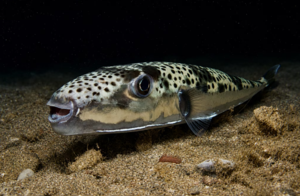
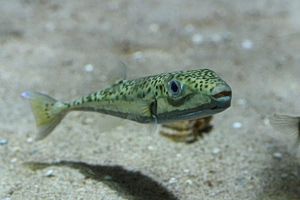
One of the most talked-about marine “stars” in Greek media these days is, unexpectedly, a fish: the silver-cheeked toadfish. It has been making headlines during the summer season in Greek waters such as the Saronic Gulf. This is a non-native species, a migrant from the Red Sea, which has been living in Greece’s saltwater ecosystems for around 20 years. Due in part to the “tropicalization” of marine waters caused by the climate crisis, it is not only surviving, but thriving.
This is an invasive species whose growing population is placing significant pressure on native fish populations. It is also highly toxic if consumed, as its flesh and internal organs contain a powerful neurotoxin dangerous to human life.
However, the silver-cheeked toadfish is far from the only foreign species transforming Greek seas. Today, TO BHMA-Science, with input from experts, answers key questions about the risks—and also the opportunities—linked to these marine invaders, which are expected to increase as Mediterranean waters continue to warm. As scientists emphasize, the sea does not become hostile unless we treat it as such.
1. Why is there so much attention on the silver-cheeked toadfish now?
The silver-cheeked toadfish (Lagocephalus sceleratus) is already established in Greek seas. However, as Associate Professor of Fisheries at the Department of Ichthyology and Aquatic Environment at the University of Thessaly Dimitris Klaoudatos explains, the most alarming factor is not just its continued spread—already confirmed in the Saronic Gulf and the Northern Aegean—but its increasing presence in shallow waters and near beaches, along with the detection of juvenile specimens, indicating successful reproduction and permanent establishment.
The increased attention is due both to this expansion—favored by rising sea temperatures—and to the summer season, when human presence in the water increases significantly, raising the likelihood of encounters.
According to Klaoudatos, the danger is twofold: toxicological, due to tetrodotoxin (TTX), an extremely potent neurotoxin that is not destroyed by cooking and has no antidote; and mechanical, as its strong beak-like jaws can cause serious bite injuries. A recent study in the Eastern Mediterranean recorded 27 deaths from consumption and 28 bite incidents between 2004 and 2023. In Greece, however, no fatalities have been recorded to date.
On the other hand, Paraskevi Karachle, Research Director at the Institute of Marine Biological Resources and Inland Waters of the Hellenic Centre for Marine Research (HCMR), considers public panic over the species to be exaggerated. She notes it was first observed in Greek waters in 2005 in Rhodes and Crete and has since spread, with highest densities now in Crete and the Dodecanese. She stresses that the likelihood of injury is very low and that the main issue is ecological damage and impacts on fisheries. Consumption is strongly discouraged: “We never eat a fish we do not know is 100% safe.”
2. How many other invasive species exist in Greek seas, and which are dangerous?
According to the latest scientific data, more than 240–250 non-native marine species have been recorded in Greek waters. Across the Mediterranean, the total exceeds 1,000 non-indigenous species when all taxonomic groups are included, from microalgae and invertebrates to fish.
Klaoudatos highlights several species of concern. Beyond the silver-cheeked toadfish, the lionfish (Pterois miles), with its venomous spines, and the nomadic jellyfish (Rhopilema nomadica), which causes painful stings, require attention. The blue crab (Callinectes sapidus) is not toxic but can cause injuries with its strong claws. Meanwhile, species of the Siganidae family—such as the marbled spinefoot (Siganus rivulatus) and dusky spinefoot (Siganus luridus)—are edible but possess venomous spines requiring careful handling.
3. Through which routes do invasive species enter?
Experts identify the Suez Canal as the primary gateway into Greek and Eastern Mediterranean waters, through a process known as Lessepsian migration. This refers to tropical and subtropical species from the Red Sea and Indo-Pacific moving through the canal into the Mediterranean.
This route accounts for the majority of introductions: of more than 1,000 Mediterranean non-native species, about 50% are Lessepsian (rising to 57% in the Eastern Mediterranean).
A second major pathway is ship ballast water and hull fouling, responsible for around 45% of introductions. Aquaculture is another source, through intentional imports or accidental escapes from farms. Finally, releases from private aquariums also contribute, often when owners can no longer keep rapidly growing fish.
4. Is climate change increasing invasive species in the Mediterranean?
Yes. The increase is well documented, and the climate crisis is accelerating both establishment and spread, Klaoudatos notes. A study published in Mediterranean Marine Science found that established non-native species in the Mediterranean increased by about 40% in just 11 years.
Rising sea temperatures make Greek waters increasingly suitable for tropical species that previously could not survive at these latitudes, while also reshaping ecosystems and creating new ecological niches. Models suggest continued expansion northward and westward toward the Aegean, Ionian Sea, and Adriatic. As a semi-enclosed sea, the Mediterranean tends to accumulate invasive species, intensifying pressure on native ecosystems.
5. Are there monitoring systems for these species in Greece?
Karachle notes that since 2007, HCMR has operated the Hellenic Network on Aquatic Invasive Species (ELNAIS).
ELNAIS is a dynamic online platform collecting spatial data on aquatic non-native species, including both established populations and occasional sightings. It was created to support national and international collaboration in research and management of invasive aquatic species in Greece.
Current data on the platform include records up to 2020, with an update in 2023 and a forthcoming further revision.
Existing data show uneven distribution across Greek seas. The highest concentrations are in the southeastern Aegean, the Dodecanese, and Crete—main entry points for Lessepsian species. Fisheries studies show that invasive species now make up an increasing share of catches in both biomass and species diversity.
The silver-cheeked toadfish is now widely established from the Dodecanese to the Saronic Gulf and the Northern Aegean. Lionfish has also expanded northward into both the Aegean and Ionian Seas. In the Pagasetic Gulf and along Thessaly’s coastline, invasive species are present but at significantly lower abundance compared to southern regions, as is also the case in the Corinthian Gulf.
6. Should control measures be taken, and what kind?
Control measures are now essential, although complete eradication in open seas is practically impossible once a species is established, Klaoudatos stresses.
The goal is population control and impact reduction. For the silver-cheeked toadfish, strict bans on trade and consumption must be enforced alongside public awareness campaigns and targeted removal efforts already initiated by authorities.
For lionfish, organized diver removal campaigns combined with commercial exploitation can significantly reduce local populations, as demonstrated in the Caribbean. For blue crab, developing markets and exports could help control populations while also creating economic opportunities for coastal communities.
Karachle adds that scientific research must continue seeking sustainable solutions. At HCMR, the LagoMeal project explored using silver-cheeked toadfish to produce fishmeal for aquaculture, with promising experimental results.
She also emphasizes the role of citizens: edible invasive species can be consumed safely when properly identified, helping reduce pressure on native fish stocks. Through citizen science, individuals can contribute observations via ELNAIS.
7. What does the future hold for Greek seas?
The overall trend is clear and unlikely to reverse in the foreseeable future, Klaoudatos says. The Mediterranean is warming faster than the global ocean average, making Greek waters increasingly suitable for warm-water species and less favorable for some native species.
Changes already observed in Crete—where invasive species are increasing in fisheries—may foreshadow developments in northern Greek seas. Models predict further movement toward northern and western Mediterranean regions, including the Aegean and Adriatic.
In the coming decades, the Mediterranean may become increasingly “tropicalized,” with major shifts in marine community composition and a higher presence of warm-water and invasive species.
Both experts emphasize, however, that nature is inherently adaptive. Future Greek seas will likely be different—new species, new balances, new risks, and new opportunities. Ultimately, the outcome depends on human behavior: the sea will not become inhospitable unless we treat it as such.