
 Μake us preferred on Google
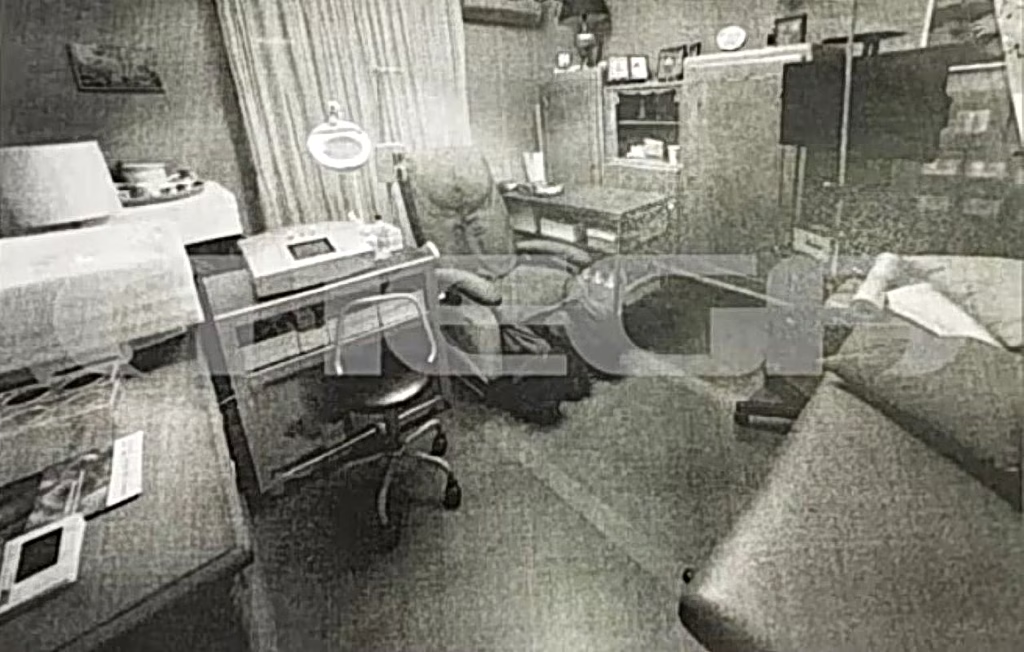
 Authorities are investigating a man who is described as a “doctor-hypnotist” in connection with the death of singer Giorgos Mazonakis, after a 56-year-old doctor allegedly sent him a photo showing Mazonakis connected to a plasmapheresis machine shortly before his death.
The photo was reportedly taken at the private medical practice on Karneadou Street in Kolonaki, Athens, where Mazonakis underwent the procedure before suffering cardiac arrest.
When questioned by the investigating magistrate about whom she had sent the photograph to, the 56-year-old doctor reportedly named the man now under investigation.
Authorities seek to identify photo recipient
Investigators are trying to establish whether the “doctor-hypnotist” was the person who received the image showing Mazonakis connected to the plasmapheresis machine.
No official identification has been made so far, as prosecutors have yet to approve the lifting of telephone privacy restrictions, which would allow authorities to examine relevant phone records.
Investigators are also examining the man’s possible role in the wider case. In particular, they are looking into whether he was the person who initially introduced Mazonakis to the 56-year-old doctor.
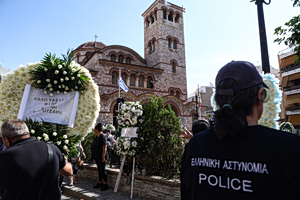
The investigation comes as the two doctors facing charges in connection with Mazonakis’ death were remanded in custody following lengthy statements to authorities.
Doctors dispute account of emergency response
The two doctors have denied making any mistake or critical omission and have rejected allegations concerning their handling of the plasmapheresis procedure.
They have also attributed part of the outcome to the response of Greece’s National Emergency Aid Center (EKAB), claiming that the ambulance arrived at the Kolonaki practice without a stretcher.
According to their account, emergency responders moved Mazonakis from the first floor of the practice to the ambulance using a chair. They argued that cardiopulmonary resuscitation (CPR) was interrupted during the transfer, which they said was contrary to protocol.
The doctors maintained that Mazonakis suffered cardiac arrest at 4:15 p.m., while the call for an ambulance was made at 4:21 p.m.
EKAB workers reject doctors’ claims
The president of the EKAB employees’ union, Giorgos Mathiopoulos, rejected the doctors’ claims and said the emergency crew followed the established procedures for treating cardiac arrest and made every possible effort to resuscitate the singer.
Mathiopoulos said the practice’s own defibrillator was not functioning when the rescuers arrived.
He also alleged that one of the doctors was performing CPR on Mazonakis with one hand. According to Mathiopoulos, rescuers asked the doctors what medical procedure had been performed and were told that treatment had not yet begun. He said the rescuers then asked about the patient’s medical history but did not receive a specific answer.
Mathiopoulos said the emergency crew used a laryngeal mask, an Ambu bag with oxygen and an automated defibrillator, and performed three cycles of CPR without a response.
The rescuers then moved Mazonakis to the ambulance using an ambulance chair and an Ambu bag, he said.
“If all these things had happened at the moment he suffered the cardiac arrest, if the doctors had followed these steps, the singer had many chances of being resuscitated,” Mathiopoulos said, according to the report. He described the doctors’ claims as “unacceptable excuses.”
EKAB union accuses doctors of shifting blame
The EKAB Employees’ Union also issued a statement following the doctors’ allegations.
The union accused the doctors facing charges in the case of attempting to shift responsibility for their handling of the singer’s medical emergency onto EKAB rescuers.
It said the emergency responders had acted according to established protocols in an effort to revive Mazonakis and criticized what it described as an attempt to blame the rescuers for the outcome.
The union said the statements showed a lack of remorse and a lack of respect for both human life and the emergency workers who “daily fight on the streets” and attempted to revive the singer.