A new dynamic is taking shape in Greece‘s relationship with its citizens living and working abroad, defined above all by a gradual reversal in migration flows. That is the central finding of the OECD Diaspora Review: Greece, a study by the Organisation for Economic Co-operation and Development and Greece’s National Documentation Centre (EKT) presented in early July 2026. But what has made returning home attractive to Greeks abroad, most of whom left during the country’s 2009–2018 financial crisis?
Between 2010, when the crisis took hold, and 2024, an estimated 775,000 Greeks emigrated, while some 470,000 returned, roughly six in ten. According to the data, the turning point came in 2023, when 46,000 citizens came back and 37,000 left, with the gap wideneding to almost 52,000 arrivals against about 32,000 departures, in 2024.
The most recent figures show that more than half of returnees are between 20 and 39 years old, about three in five hold a university degree, and nearly half of those in work are employed in highly skilled professional roles.
Katerina Psychogiou belongs to that group, and she spoke to TO VIMA International Edition about her experience. A law school graduate, she left Greece in 2016 after working in Athens for a few years, “to pursue further studies and eventually work abroad, right in the middle of the financial crisis,” she said. Manolis G., who left in 2015 for postgraduate studies in computer programming, is part of the same generation.
Tax breaks and faster recognition
In 2020, the government of Kyriakos Mitsotakis announced a series of measures aimed at drawing young people back, a step in the right direction, though whether they have been, or will prove, sufficient remains to be seen. The package included a 50% cut in income tax on salaried or business income earned in Greece for seven years, under certain conditions. A broader tax reform for young people and families has since added zero income tax up to age 25 and reduced rates up to 30.
The measures also introduced automatic recognition of university degrees, a process that had previously been notoriously slow, and simplified recognition of certain medical specialties obtained in the United States, the United Kingdom, Switzerland, Canada, Australia and New Zealand.
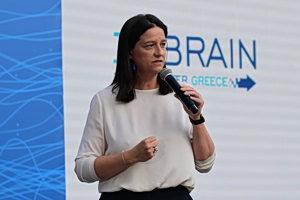
Outreach events played a role as well. Rebrain Greece job fairs, held in cities with large Greek communities, including London, New York, Amsterdam, Düsseldorf, and Stuttgart, drew more than 6,500 people, who met with 120 of the largest companies operating in Greece. Manolis attended the Düsseldorf fair while studying there. “That’s where the seed was planted to return home and start my own business with two fellow Greek students,” he said. “We believed something was changing and that conditions might be more favorable.”
Meanwhile, Greece’s 2024–2027 Diaspora Strategy aims to keep Greeks abroad connected to home. It includes building networks of Greek academics, scientists, and entrepreneurs overseas, creating programs for younger generations, and improving consular services.
Family over finances
Yet the annual conference of the nonprofit initiative BrainReGain, titled “Return. Talent. Impact,” held on May 29 at the Athens Concert Hall with Greek scientists, policymakers and academics in attendance, suggested that financial incentives and tax relief may not be the real driving force behind the return of highly skilled Greeks. Family and social ties may matter more.
For Katerina, those were the factors that tipped the scales toward Greece. “After six years abroad, I felt that the circumstances had improved sufficiently to give Greece another opportunity. The COVID-19 period also contributed to this decision. While working remotely from Greece, I realized that I had missed my family, my friends and, more generally, the Greek way of life,” she explained. “My return was therefore based on a combination of factors: the opportunity to be closer to my family, the lifestyle that Greece offers, and the perception that the timing was more favorable than it had been in 2016.”
Manolis likewise cited his family, along with a limited social life abroad, as key factors in his decision.
A bumpy landing
Both, however, said that settling into the Greek workplace was anything but smooth. Manolis noted that although he and his partners launched a company built on cutting-edge technology, he found that starting a new business is still governed by heavy bureaucracy and receives little support from the state. “That could prove a deterrent for many highly qualified people who want to return,” he said.
For her part, Katerina said that coming back made clear that many of the Greek system’s longstanding “pathologies” did not disappear with the official end of the crisis. “Several of the same mentalities and institutional weaknesses remain and are likely to continue to do so for some time,” she said, which helps explain why many young Greeks are still moving abroad.
She added that, professionally, she knew the Greek labor market would differ from what she had experienced abroad. She adjusted her expectations before returning and did not expect to find the same opportunities, working practices, or professional standards. “This preparation probably helped me approach the transition more realistically,” she noted.
In Katerina’s view, the return of young Greeks is itself changing those mentalities for the better. “An increasing number of Greeks who have studied or worked abroad are now returning, bringing with them different ideas and experiences regarding corporate culture and introducing a different perspective into Greek organizations,” she said. Over time, she believes, this may help bring Greek workplaces closer to European and international standards and weaken the older mindsets that continue to hold them back.
No regrets
Looking back on their move home, both young professionals agree it was the right decision, despite the difficulties. “There are certainly aspects of living abroad that I miss, and the transition has not been entirely straightforward. Nevertheless, I am glad that I decided to give Greece another opportunity,” Katerina concluded.
Manolis put it this way: “Greece will not offer you the opportunity to make a lot of money fast, but for me quality of life is very important, which is why I gave it a second chance. What I would advise anyone is to do your research before you move back.”