 Μake us preferred on Google
 For thousands of young people across the country, getting their university entrance exam results and landing a spot at a university does not mark the beginning of carefree years. And when the exam session ends, vacation does not begin. There are no schedule-free days or evenings, no ferry tickets to the islands, no leisurely dips in the sea.
For all of these students — especially those studying far from their parents’ home — there are instead tight schedules and fatigue, suitcases packed with work clothes, fixed-term contracts, and shifts that start in the morning and end late at night. Along with all of that comes the hope that they will make ends meet a little more easily, help out their families, or manage to save enough money over three or four months to carry them through the academic year.
The phenomenon is not new, of course. But it is more pronounced than ever. A Greece of expensive rents, rising utility bills, sky-high transportation costs, and an ever-increasing cost of living has fundamentally transformed what it means to be a student. Especially for young people studying far from home, student life has long since ceased to mean lecture halls, friend groups, and learning. It is now inseparable from work.
The Relentless Cost of Living
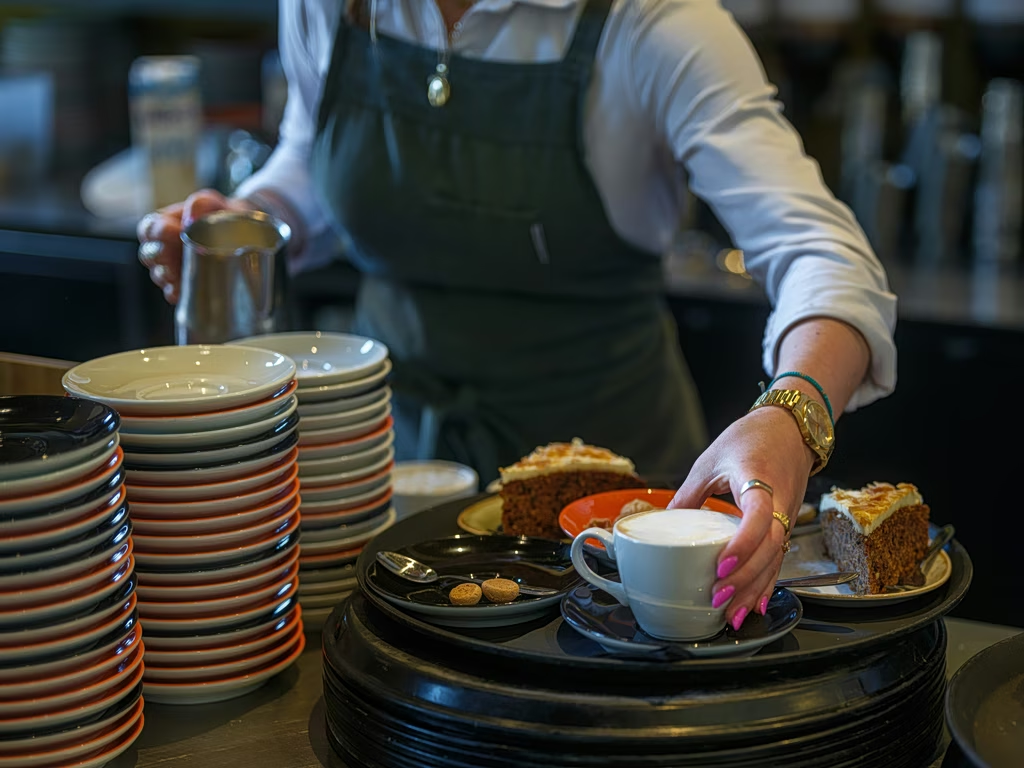
With a serving tray in hand, behind a bar, at a hotel breakfast buffet, at the front desk of a guesthouse, in a kitchen, in a tourist shop as a sales clerk, or even on a farm — thousands of students now spend months or entire academic years. For many of them, seasonal work is the only way to secure some of the money they need to cover even their most basic daily expenses.
These are not necessarily young people from low-income families. On the contrary, in many cases their parents do everything they can to support them. Yet the students themselves know full well that the financial weight is significant. They watch their parents struggle with the same rising prices, the same expenses, the same uncertainty. And they choose to chip in.
“Not to be a burden on them,” “to be able to pay for some things on my own,” “to stand on my own two feet,” “not to constantly ask for money.” These phrases recur almost word-for-word in the accounts of young people who work alongside their studies. Behind these words lies a generation coming of age differently from those before it — a generation called upon to take on financial responsibilities from a very early age, learning what rent, utility bills, work shifts, social security contributions, and savings mean before they even have their degree in hand.
The Dark Side
This reality has its darker side, of course. Many students are forced to juggle demanding academic programs with grueling work schedules. There are days when exhaustion wins out over studying. Weeks when coursework falls behind. Summers swallowed up by twelve-hour shifts and constant obligations.
And yet, within these difficult circumstances, something deeply hopeful also emerges: the persistence of a generation that does not abandon its goals. That does not take for granted that everything will be handed to it. That seeks ways to stand on its own feet and claim its future on its own terms. Because behind every student serving coffee on an island, behind every young woman working in a hotel or a souvenir shop, there is a person who returns to the lecture hall in the fall with their eyes fixed on their degree — a degree often earned twice over: with textbooks in the backpack and a serving tray in hand.
Against this backdrop, we spoke with three young people currently enrolled in university about their decision to work alongside their studies. About the difficulties they encountered, and about the sense of independence that comes from being able to rely, at least in part, on themselves.
Their stories may start from different places, but they all reach the same conclusion: working while in college has shifted from a choice to a necessity. Today’s young people are not looking for money just to have fun — they are working to complete their degrees without feeling like a constant financial burden on their families.
“Most People I Know Work”
Petroula Vlassi is 22 years old, an Economics student at the Athens University of Economics and Business, and every summer she returns to Corfu to work in hotel operations.
“I’m from Corfu, where my family lives. I got into my program in 2022 and I’m currently in my fourth year. I started working summers as far back as the summer after my university entrance exams, before I was even officially a student. Since then, every summer alongside my studies — in between the summer exam session and the September resit session, sometimes even more — I’ve been doing seasonal work at a hotel,” she tells us.
She continues: “The reason I started and keep doing it is that I don’t want to rely on my parents financially for everything. Expenses keep going up: for example, my rent in my first year was noticeably lower than what I pay now. But beyond my expenses, I work so I can afford something extra for myself — a trip, or going out. I usually leave in July, but this year I started in April: I went, came back for the exams, and I’ll leave again. I work service at a hotel. The money I save covers me for three to four months after I get back, which is a very significant stretch.”
Based on her experience, “most of the students I know work — either seasonally or part-time throughout the year, alongside university. Especially those who come from other parts of the country and rent in Athens. I don’t think that if I didn’t work I wouldn’t be able to finish my degree — it’s just that I would struggle a lot more and have no cushion at all. With what my parents can give me, I would be very limited.”
“I Saw Where Money Really Comes From”
Vasilis Rizos, 23, is a Natural Sciences student at the University of Ioannina and got an early introduction to the realities of the job market.
“When I got into the program in Ioannina, expenses were something that weighed on me — meaning I would have to rent a place and also pay for transportation, since I was born and raised in Larissa. My parents could support me, but we had agreed on a set amount they would send me each month, and I didn’t want to ask for more. So I decided to rely on myself to cover my growing needs. In short, my parents cover my basic survival and I work for the quality of life on top of that,” he says candidly.
“I started out doing service work. I didn’t want to have to think twice about buying a second beer — I wanted to be able to pay for it myself. I started in 2024 waiting tables. Then I learned the buffet station, then bar work on the evening shift. At some point I was doing everything, including dishwashing and closing up the place afterward. I have no regrets at all. I learned a lot, I got into the job market early, and I saw where money really comes from. Working three five-hour shifts a week, I was making about 300 euros a month — money that mostly went to gas. There were years I worked many more hours than that. If you consider that 300 euros in Ioannina is roughly a month’s rent, that’s a significant amount.”
He wraps up: “This year I’m in my fifth year and I’ve stopped working, having saved up some money so I can focus on studying and get through the courses I still owe. That’s partly because there were times when after several consecutive days and hours of nonstop work I’d come home and find it hard to open a book for school. Most of my friends look for work every summer to do a season, and many of them actually work part-time during the winter too. You can’t have your parents cover everything: by around your second year, we all figure out that it just doesn’t add up unless you work.”
“I Was Stressed, But I Grew Up Faster”
Angeliki Matafia, 21, is a Psychology student at the University of Ioannina and has been combining work and studies since almost her very first day as a student.
“I’m originally from Athens. It never crossed my mind that I would have to leave home. I had listed Athens as my first choice and didn’t get in there, and Ioannina was my next. When the results came out I was really upset, because I didn’t know if I would be able to make it work and I didn’t want to retake the exams. I was going to have to support myself and live far from my family. But I matured a lot faster because of it — and working played a big role in that,” she notes.
As she explains, “the money issue stressed me out. I didn’t want to become a burden to my parents; the expenses are a lot. Rent runs between 300 and 350 euros plus utilities. I chose to work both during the school year and in the summer. It was quite hard finding a schedule that lined up with my class hours. Mostly I work as a waitress, with shifts that could stretch to 12 hours. I always leave after the exam session to work June through August. This year I’m going to Lefkada for the season — either as a sales clerk in a shop or waiting tables again, depending on where the money is better.”
As for what she does with the money she earns from work: “Whatever I save this year I’m planning to put toward getting my driver’s license. I can’t say the seasonal earnings last very long — two to three months. But even that matters. During the summer season, they cover our social insurance contributions, and that’s also something I factor in. Now going into my fourth year, I’ll keep doing seasonal work this year and next — out of necessity, not really by choice. It just doesn’t work any other way.”