 Μake us preferred on Google
 Tim Holding looked at the property’s condition and thought, “Oh my God, this is going to be really hard.” Felicity Selkirk, though, knew Château de Purnon was one of a kind. “Welcome to our home,” she said. And that’s how the wonderful, and costly, journey began to save one of the finest examples of late 18th-century French architecture.
Tim Holding and Felicity Selkirk left their lives in Australia behind to open a new chapter in France. In 2020, they made the decision that would change their lives.
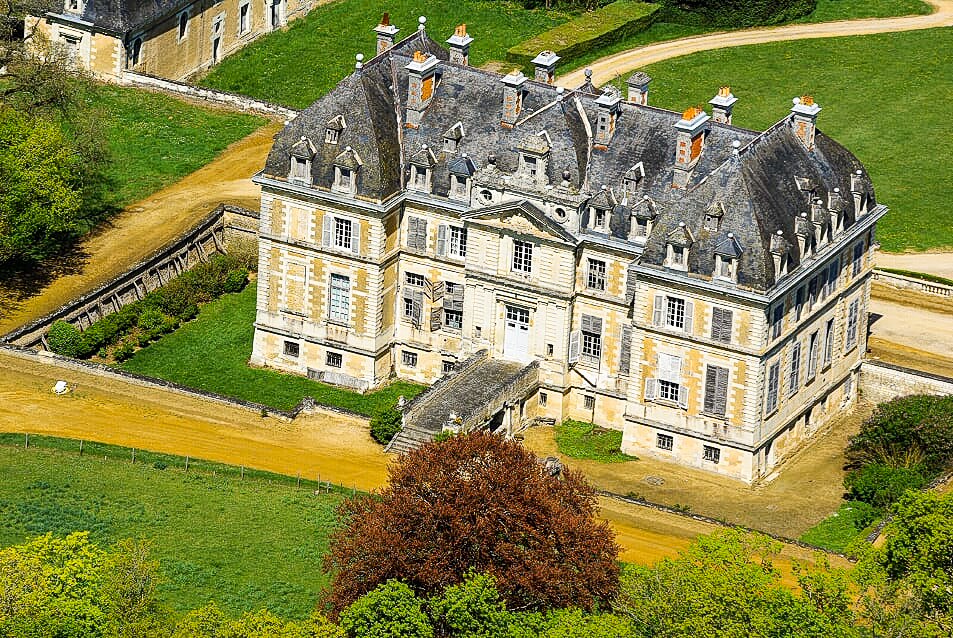
When the Australian couple first laid eyes on Château de Purnon, just south of the Loire Valley on the edge of the Scévolles forest, the slate roof was riddled with holes, the shutters had begun to rot, and the wooden beams had suffered severe damage.
A century of neglect threatened to bring total ruin to the French château. The entire roof was on the verge of collapse.
Felicity and Tim were determined to save the 105-room listed building, investing a lifetime of savings and committing the rest of their lives to restoring the imposing “grand lady” and bringing back her former glory.
Restoring a building like Château de Purnon takes a great deal of patience. “When we arrived, we were eager to get started right away. The excellent architect specializing in heritage restoration urged us to slow down,” Tim recalls.
Under the guidance of Frédéric Didier, France’s chief architect for historic monuments, every decision is grounded in preservation, traditional craftsmanship, and historical accuracy.
View this post on Instagram
Every slate on the new roof has been cut by hand and fastened individually with nails. Stonemasons are carefully restoring the centuries-old masonry, while the extensive walls surrounding the estate are being rebuilt brick by brick.
As Felicity explains: “when we first arrived, our architect told us we were waking up an elderly lady who had been asleep for a long time, so we needed to wake her gently. It turned out to be excellent advice.”
The Long History of Château de Purnon
The Purnon estate was purchased in 1771 by the Marquis Antoine-Charles Achard de la Haye, a cavalry lieutenant colonel in King Louis XVI’s army and an aide to the Duke of Orléans, and his wife, Bénigne Modeste de la Motte-Baracé.
Didier, who has studied the château’s original plans, says that unusually for the time, it was designed with a shared bedroom for husband and wife, rather than separate quarters. “And the children had rooms right next to their parents, which was also unusual. It’s a genuine piece of history, and that’s extremely rare.”
In 1893, Daniel Jérôme Robineau de Rochequairie purchased Purnon. His noble title was marquis, ranking above count but below duke. In 2013, his grandson Gilles de Rochequairie died, and under French inheritance law, the château passed to a large group of relatives.
On May 19, 2020, two members of the de Rochequairie family met the couple at Purnon for a historic handover. Pierre de Rochequairie, Gilles’s son, struggled to hold back tears. Pierre’s aunt, Nicole de Rochequairie, handed the Australians the 17-centimeter key to the château’s main door. “Here’s the key to paradise, I hope.”
A Triumph of Heart Over Reason
Holding and Selkirk acquired Purnon for €709,685. They haven’t disclosed the price themselves, but it’s published on the French government’s property records website.
Unrenovated châteaux are relatively cheap, by the standards of this kind of investment, but restoring them can cost millions, particularly once the roof is included. Specialist real estate agencies warn buyers they may need at least $80,000 a year for lighting, heating, insurance, and upkeep.
As Holding and Selkirk discovered, it’s impossible to heat rooms with 4.8-meter-high ceilings. “It’s like being in a freezer in winter,” says Selkirk, a former aerial skiing champion, in an interview.
“If you’d told me the day I retired from politics, ‘You’re going to go restore a château in France,’ I’d have said, ‘Are you crazy?'”
Indeed, when Holding left politics in 2013 at age 40, all he knew was that he wanted a second career, without being sure what it would be.
View this post on Instagram
“When Tim first talked to me about buying a château, I tried to ignore it. I kept thinking, ‘When is this conversation going to end? Why does he keep talking about this ridiculous idea?'” Felicity Selkirk recalls.
The idea gradually took shape, and eventually, in June 2019, Selkirk suggested they visit a property Holding liked. She did it, she says, to “put the idea to rest once and for all,” not because she actually wanted to buy it. When they called to inquire, the owners had just accepted an offer.
Selkirk felt an unexpected, unfamiliar disappointment. Six months later, after visiting 15 châteaux across France, they arrived at Purnon, three and a half hours southwest of Paris by car. They didn’t need to see anything else. It was love at first sight.
“We’re going to spend everything we have,” Holding says of their mission. “We don’t have children, so it’s not like we’re squandering an inheritance. We obviously won’t go into debt over it. But we will save the château.” Purnon’s charm proved irresistible: a triumph of heart over reason.
The “Silent Guardians” of Purnon
Over the six years since, the couple has made impressive progress, repairing the façade, installing new plumbing and electrical systems, and completing major roof restoration work using a total of 47,000 hand-cut slates.
They document every step of their journey and share it with their followers, who now number half a million on YouTube and 630,000 on Instagram.
The château, its two main outbuildings, the moat, and the north entrance gate were designated Historic Monuments on May 10, 1995.
“This year, major restoration work will begin on several of our main rooms, the Grand Salon, the Music Salon, and a reception hall, along with several other spaces,” Tim says.
View this post on Instagram
“In the château’s heyday, these rooms welcomed guests and hosted events. They’re beautifully decorated, and we’re looking forward to working with our heritage architect to uncover their beautiful details and bring them back to life. Our majestic lions have been returned to their place on the château’s bridge, and our striking gates, installed in 1812, have been restored.”
View this post on Instagram
This August was dedicated to Purnon’s “silent guardians,” the marble lions that once stood proudly, witnessing both the château’s most glorious moments and its decline. For nearly two and a half centuries they stood watch, until they too became part of that decline.
“It’s deeply moving to know that a jewel of French architecture, once on the verge of being lost forever, has been saved for future generations. A new generation of lions is beginning its own watch on the château’s bridge,” Holding says.
A Project That Will Take More Than One Generation
Given the sheer scale of Château de Purnon, along with its 18 outbuildings and 23 hectares of parks and gardens, it’s perhaps no surprise that the restoration won’t actually be completed within Felicity and Tim’s lifetime.
“We’re not troubled by the fact that restoring the entire Château de Purnon estate will be a project spanning more than one generation,” Tim says.
“We’re grateful that previous generations had the wisdom to plant trees they knew they’d never live to benefit from. In that same spirit, we feel it’s our responsibility to leave something behind for the future.”
With information from Château de Purnon, Homes To Love, and The Sunday Morning Herald.