There comes a moment, Christos Kehagioglou says, when light ceases simply to illuminate a landscape and becomes the protagonist itself. For him, that moment came on Andros. “I felt that I, too, as an observer, was there with everything around me, within the light.” That experience gave rise to an artistic exploration that has occupied him for years and lent the title “In the Light” to a series of exhibitions that began in 2022.
Following Athens, Thessaloniki, Brussels and Luxembourg, the fourth part of the series is now being presented at the Ochra Blue Art Space on Lemnos. A place that seems strangely well suited to this body of work. Open, bare, with expansive horizons and a quality of light that Kehagioglou describes as insular yet northern at the same time.
The sea, the land and the horizon are still there in his paintings. And yet nothing seems entirely fixed. At times, the image moves towards abstraction; at others, it returns to the actual landscape, while light dissolves things and reassembles them. It is an obsession he continues to explore after more than four decades of work.
His path, after all, has never been exclusively about painting. Born in Thessaloniki in 1960, he studied civil engineering, later film directing, and subsequently philosophy of art at the Sorbonne, where he explored the relationship between cinema and painting. He has worked with moving images, directed films and video works, and presented his paintings in more than forty solo exhibitions in Greece and abroad.
On the occasion of his exhibition on Lemnos, Christos Kehagioglou talks to us about the light that precedes and outlives us; about the Greek landscape; about what cinema has brought to his painting; and about an ancient art form which, amid the ceaseless stream of images that defines our age, continues to ask something remarkably simple of the person standing before it: to stop and look.
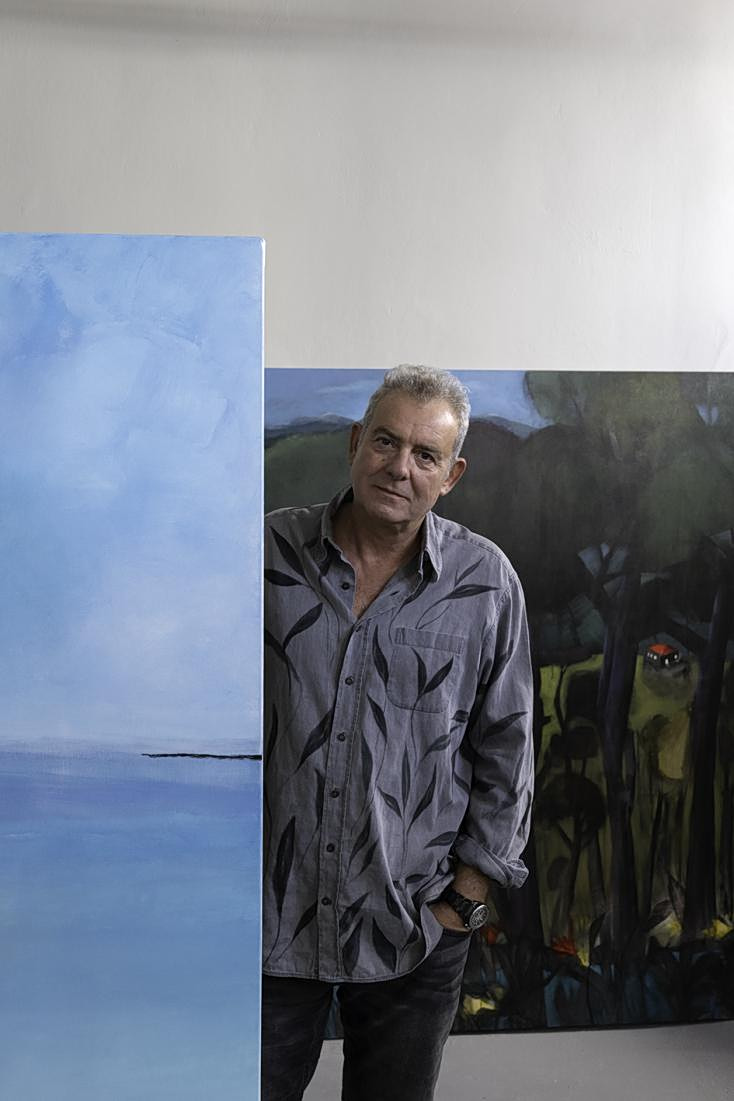
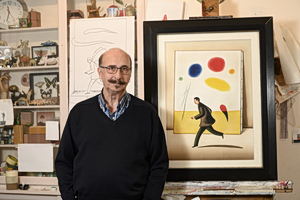
Photograph of Christos Kehagioglou, taken by the artist himself.
You say that in “In the Light,” you are no longer trying so much to paint the landscape itself as that which transforms it—namely, light. When did you realize that the landscape alone was no longer enough?
Landscape and light are two inseparable entities in painting. Usually, for a painter, light is what gives color to a landscape, what gives it an emotional dimension. So the landscape is the protagonist, while light is the painterly means through which it is brought to the fore, given meaning and life.
While painting on Andros, however, I could feel an inversion taking place. I felt that I, too, as an observer, was there with everything around me, within the light. And I tried to convey that sensation through painting: that the light was now the protagonist and the landscape was being shaped by it, emerging from within it, almost as though it were its creation. Even our gaze itself seemed born of that light. It was in this sense that “In the Light” came about.
The first part of “In the Light” was presented in 2022, and since then this body of work has travelled from Athens and Thessaloniki to Brussels and Luxembourg. What has changed in your painting over these four years?
I think my relationship with light itself has grown progressively deeper, as has the approach, the technique through which I try to capture it materially on canvas, as a crystalline, ethereal and transparent entity. Over these years, I have been exploring, in ever greater depth, the different possibilities of rendering it in this way.
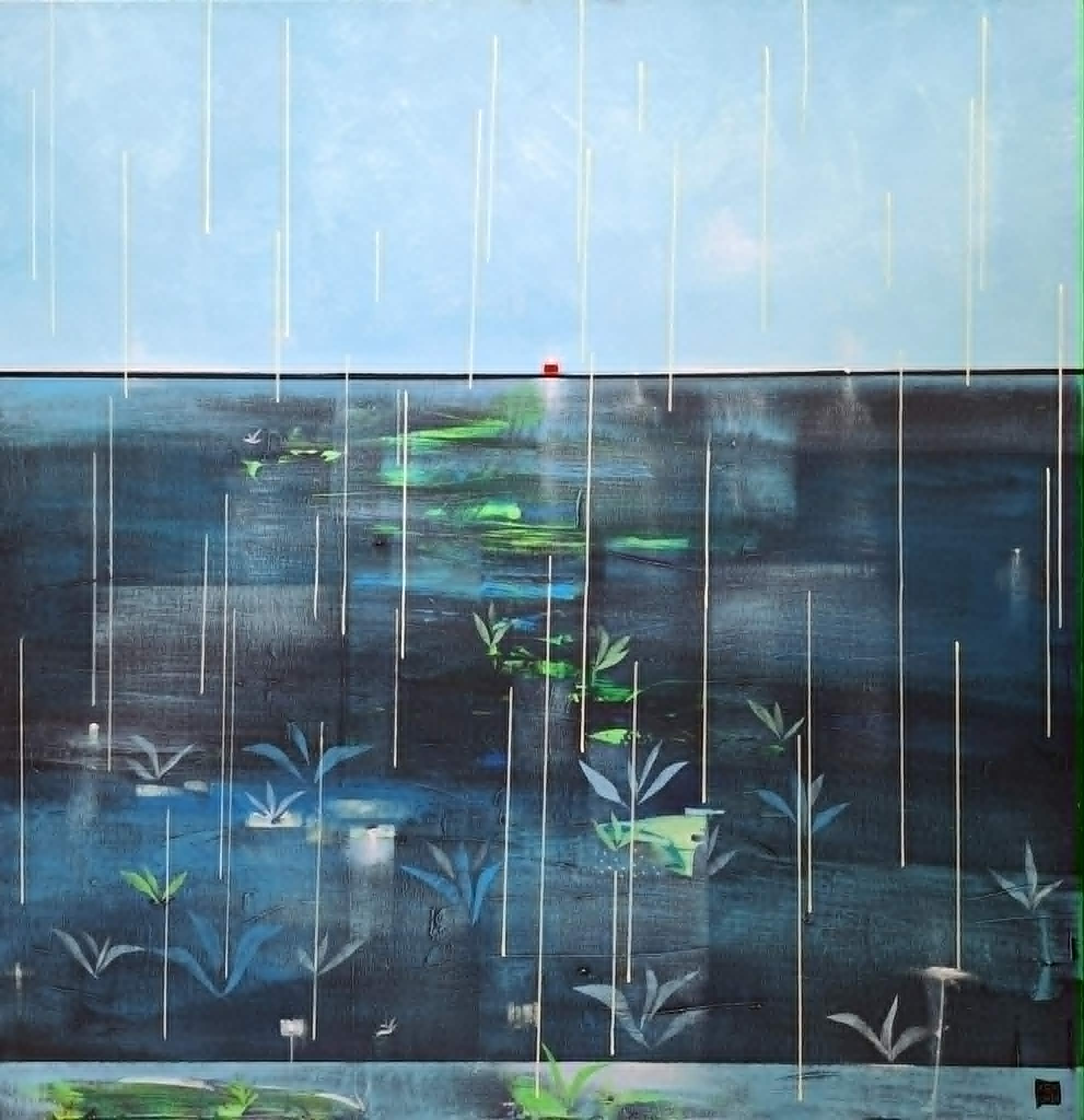
In your text for the exhibition, you connect light with something far greater than the image itself—with those who lived before us, with memory, with something like a “soul of the world.” Can a painting convey something of this collective memory without telling a specific story?
Yes, I believe that is precisely what I am attempting to do. To allow the image to escape the constraints of a specific moment, place or period; to free itself from the need to tell a story and acquire an autonomy of its own.
Light interests me precisely because it exists beyond human time. It is the same light that people saw thousands of years ago and, in a sense, it will continue to exist when we are no longer here. It illuminates things, reveals them and makes them disappear; it changes them ceaselessly, while itself remaining unchanged.
Perhaps that is why I feel it can carry something of a collective memory without having to convey anything specific. It can become a spiritual and timeless force connecting human beings with the world and with time. It is this eternal, almost cosmic dimension of light that I would like to be able to capture through painting.
Sotiris Kakisis always returns to the same phrase when writing about your painting: “in Greece—unquestionably in Greece!” How Greek do you consider your painting to be? And what, ultimately, does “Greek light” mean without falling into the stereotype of blue skies, sunshine and the Aegean?
It is both a stereotype and a truth. Greece, and the Aegean in particular, has a very distinctive quality of light. The light is so bright and powerful that I often feel it almost vibrating, like an otherworldly energy that permeates everything, dissolving things within it and then reassembling them. Perhaps it is there, more than in the azure, the sun or any other recognisable element, that
I find the meaning of “Greek light.”
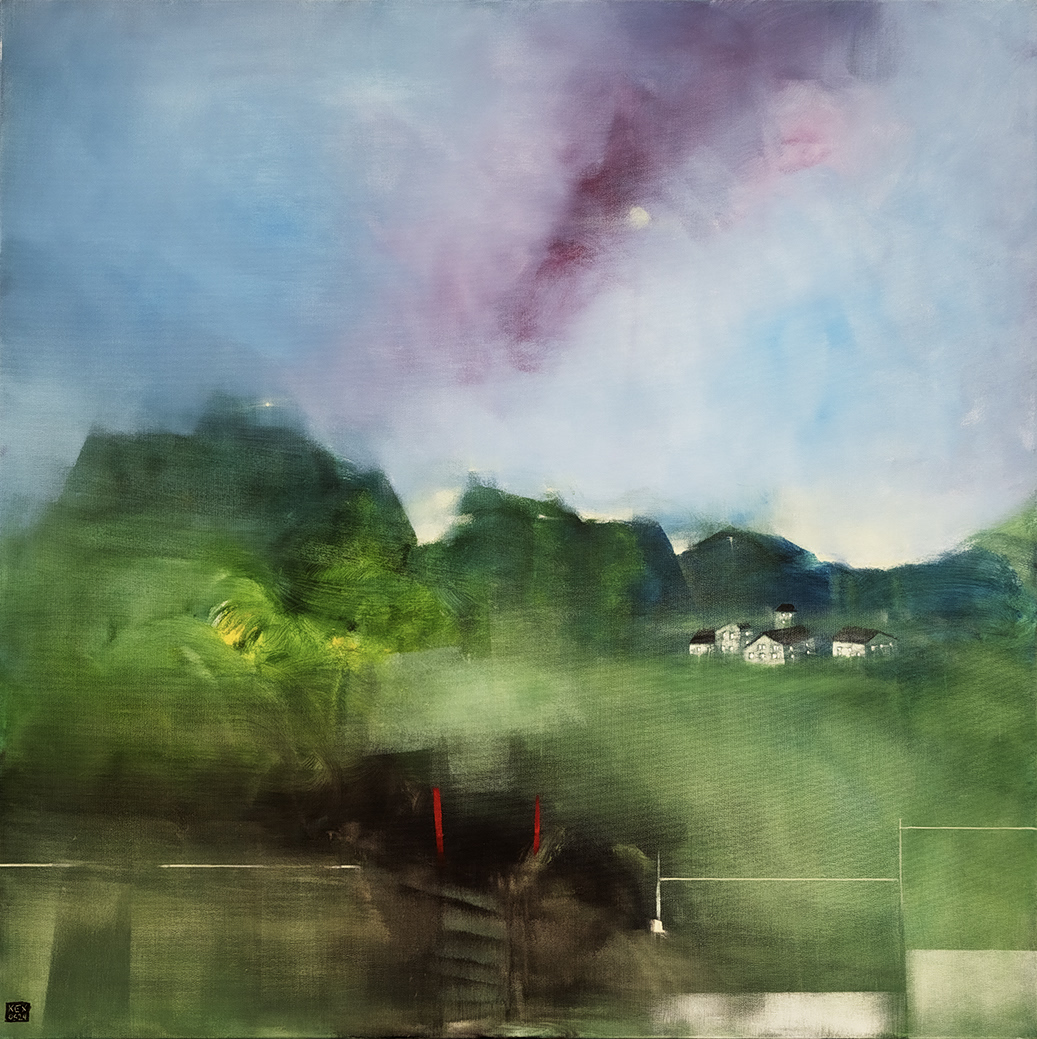
Lemnos has a landscape quite different from the image we usually have of a Greek island—barer, more open, at times almost austere. What did you recognise there from your own painterly world?
Lemnos does have a very distinctive landscape. It is open and austere, as you describe it, and it gives me a sense of something more ancient, I would say, more primordial and raw. For my work, this is deeply inspiring, because it brings me closer to that timeless quality I was describing earlier. It is as though the landscape carries within it a sense of time far broader than our own.
You studied civil engineering, film directing and philosophy of art, yet you have devoted the greater part of your career to painting. Tell us, where do these worlds meet—if, indeed, they do?
I believe the arts meet at many points; deep down, they share common ground. Beyond that, each develops its own language. By working, both practically and theoretically, within different systems of language, I think your way of observing becomes sharper and more finely attuned.
Cinema teaches you to hear the sound of an image, to seek out the particular frame, to see uninterrupted movement, to read the world as though it were a story. Painting, as the mother of the visual arts, teaches you to compose, to seek out the subtlety of light, the power of shapes and color. Engineering, too, has proved very useful to me in terms of systems, structure and ways of organizing things. And, of course, philosophy helps you to think, to ask questions, to doubt, to understand better and to reflect.
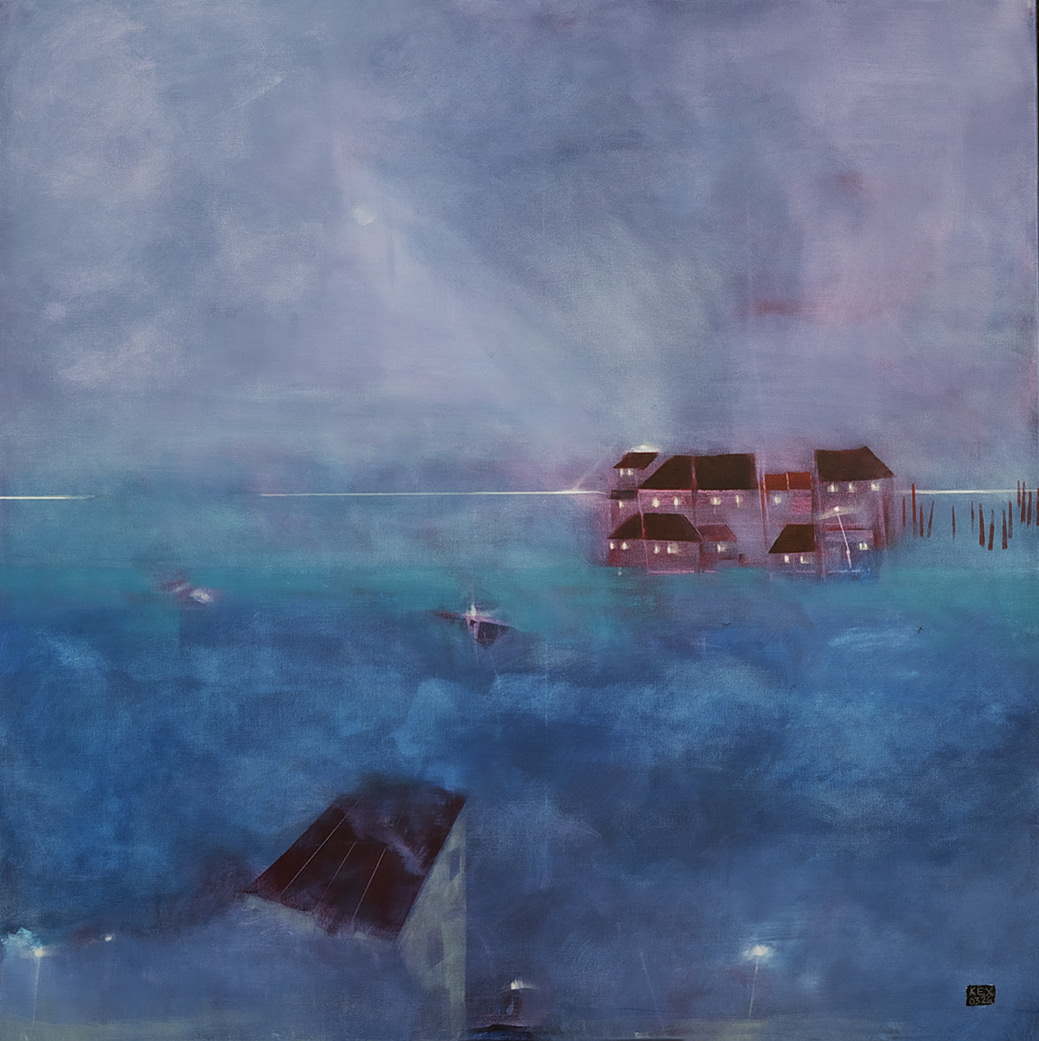
There is a recognizable world in your painting—sea, land, horizon—but at the same time a fragmented world that often verges on abstraction. Does the distinction between figurative and abstract painting still interest you, or do you consider it outdated?
I think these terms have largely been superseded in our era, although they remain useful as a means of understanding one another. I feel my work balances on a line: on one side, there is the specific image, the place, its particular elements and characteristics; on the other, the power and freedom of abstraction.
When an image of mine acquires clear figurative elements through specific references, I try to liberate it through abstraction. Conversely, when it slips into an entirely abstract world, I try to discover within it those elements that can function as figurative hints. It is precisely this movement back and forth that interests me.
You have more than forty solo exhibitions behind you and a career spanning several decades. Is there a danger that, at some point, an artist can become too good at what they already know how to do? How do you avoid repeating yourself?
I am constantly searching in my painting for something that will surprise me. I want each work to bring something new, something I am seeing develop in that way for the first time. To avoid repetition, it is important to keep searching, to experiment with techniques and materials, to pose new questions. Not to become complacent and, above all, never to believe that you have arrived somewhere.
There is something wonderful about mastering something, then immediately setting out on a new journey armed with what that mastery has taught you.
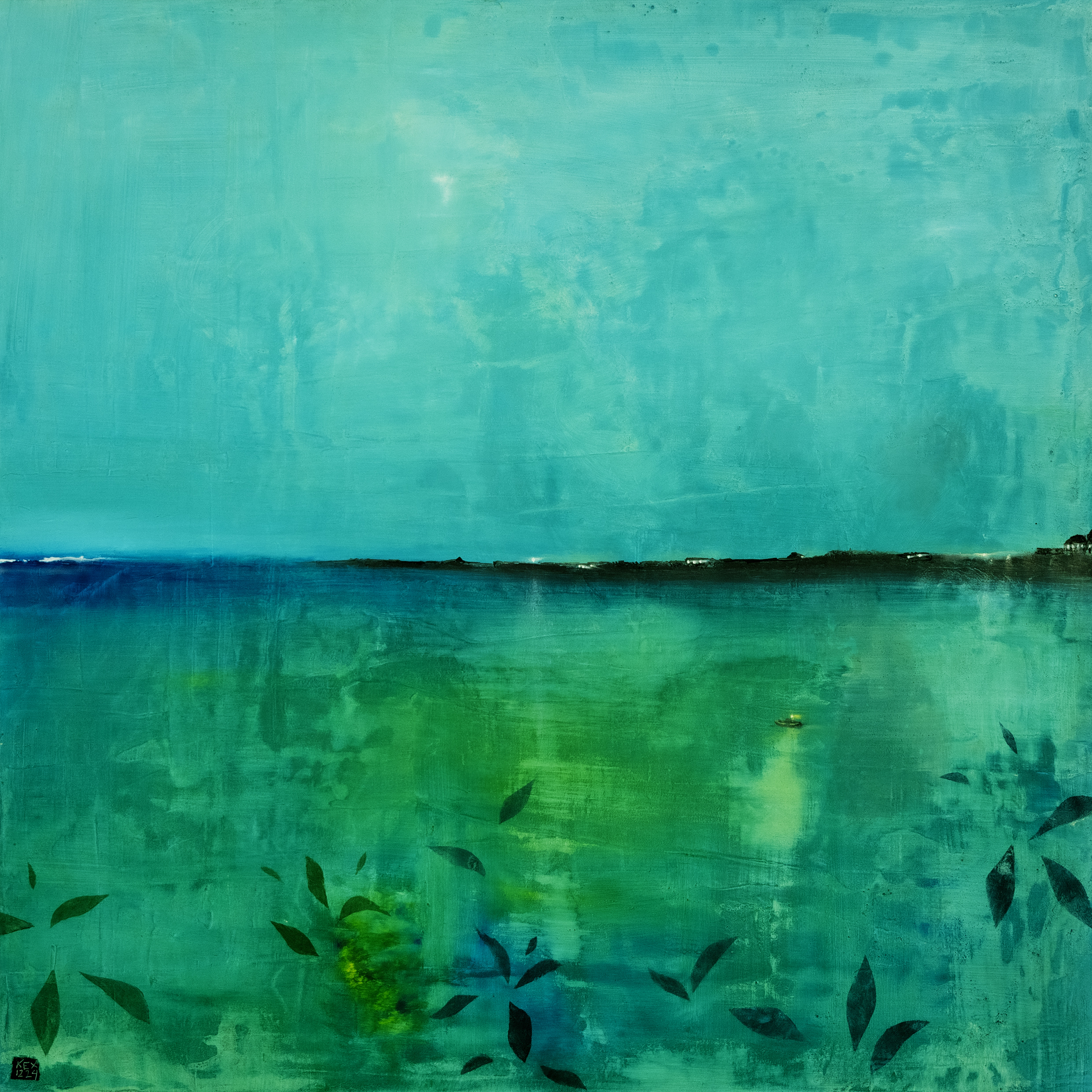
How can painting engage the contemporary viewer in a conversation? What can it still offer that a screen cannot?
As a way of creating images, painting is as old as humanity itself. From prehistoric cave paintings to a work made today, there is something that remains astonishingly unchanged: one human being leaving a trace on a surface with their hand, and another human being, at some point, standing before it and looking at it.
Technology will continue to give us increasingly impressive images and possibilities. But painting has something a screen cannot replace: it is a real object; it has materiality, scale, a surface, imperfections, traces, time. What you see in it is not only an image, it is also the process by which another human being sought to bring that image into existence.
And perhaps it asks something different of the viewer as well: to stop. To give it time. It imposes neither a duration nor a single, specific reading. You can walk away after a second or remain in front of it for a long time.
That is why I very much like the word “conversation,” as you use it. Painting creates a quiet, free and multifaceted dialogue, a form of communication that exists alongside language. And, in an age in which images flash before our eyes at tremendous speed, this ability to stand in front of a single image, to feel its material presence and, through it, the trace of another human being, may be becoming increasingly precious.