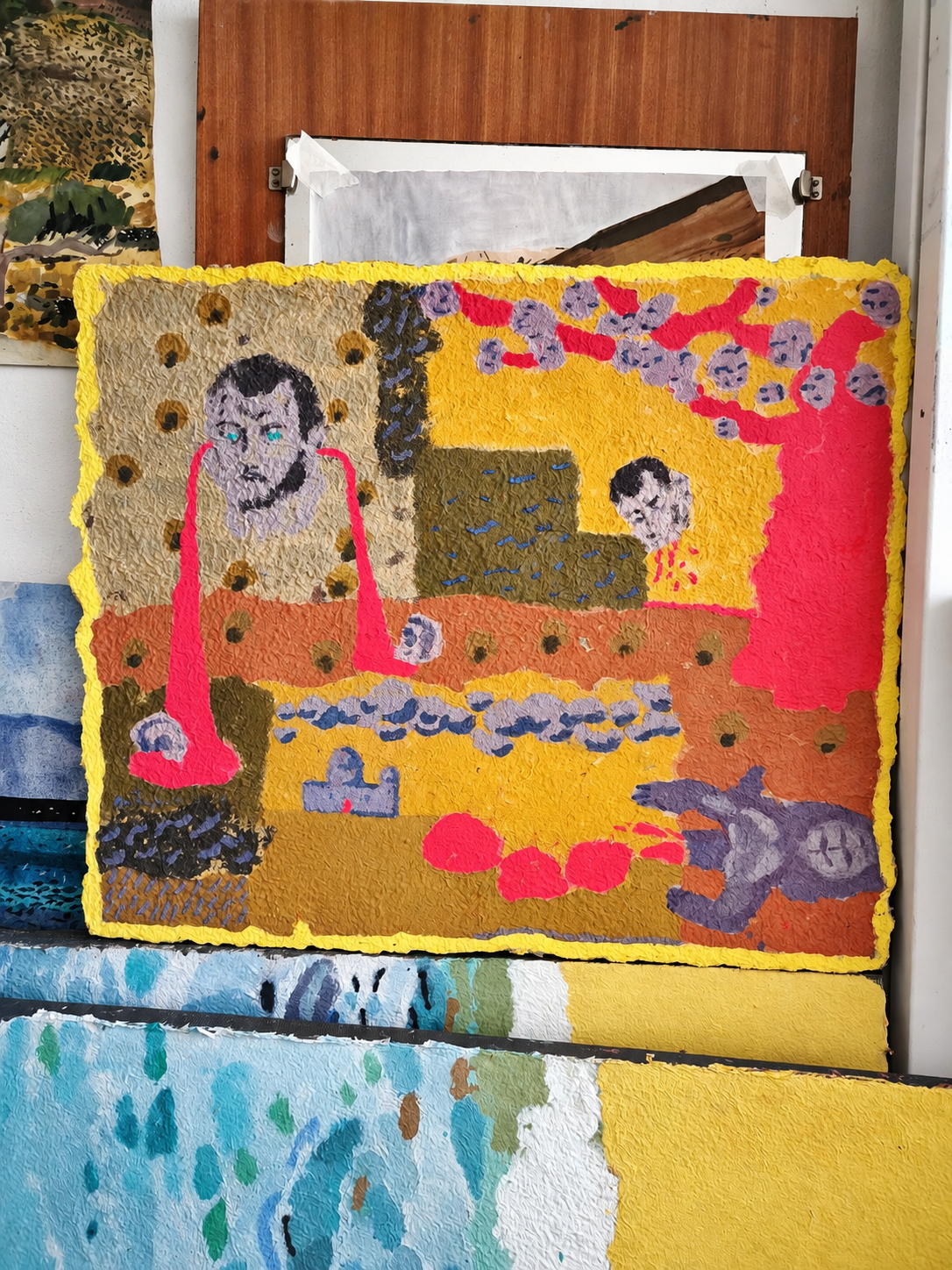
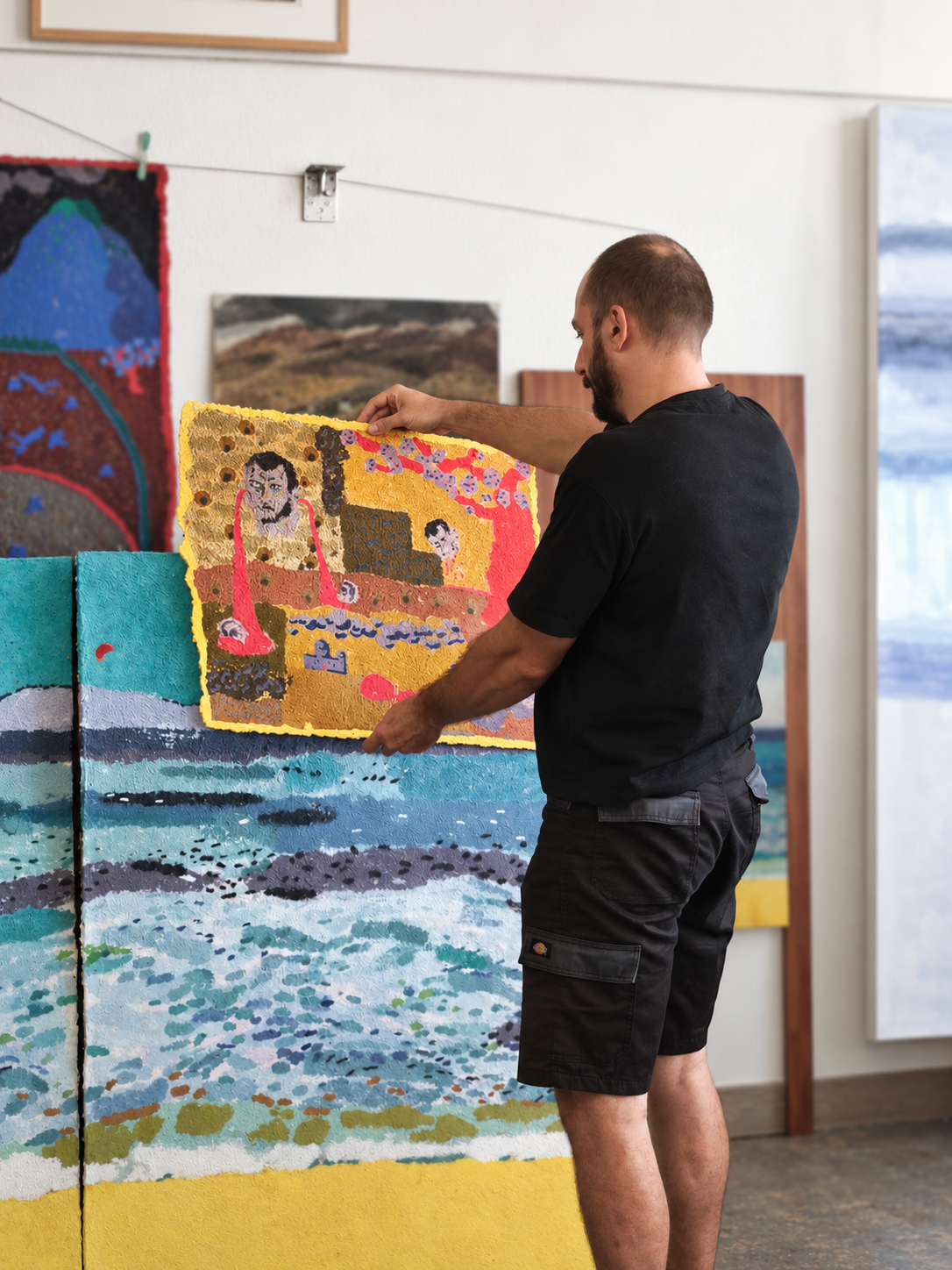
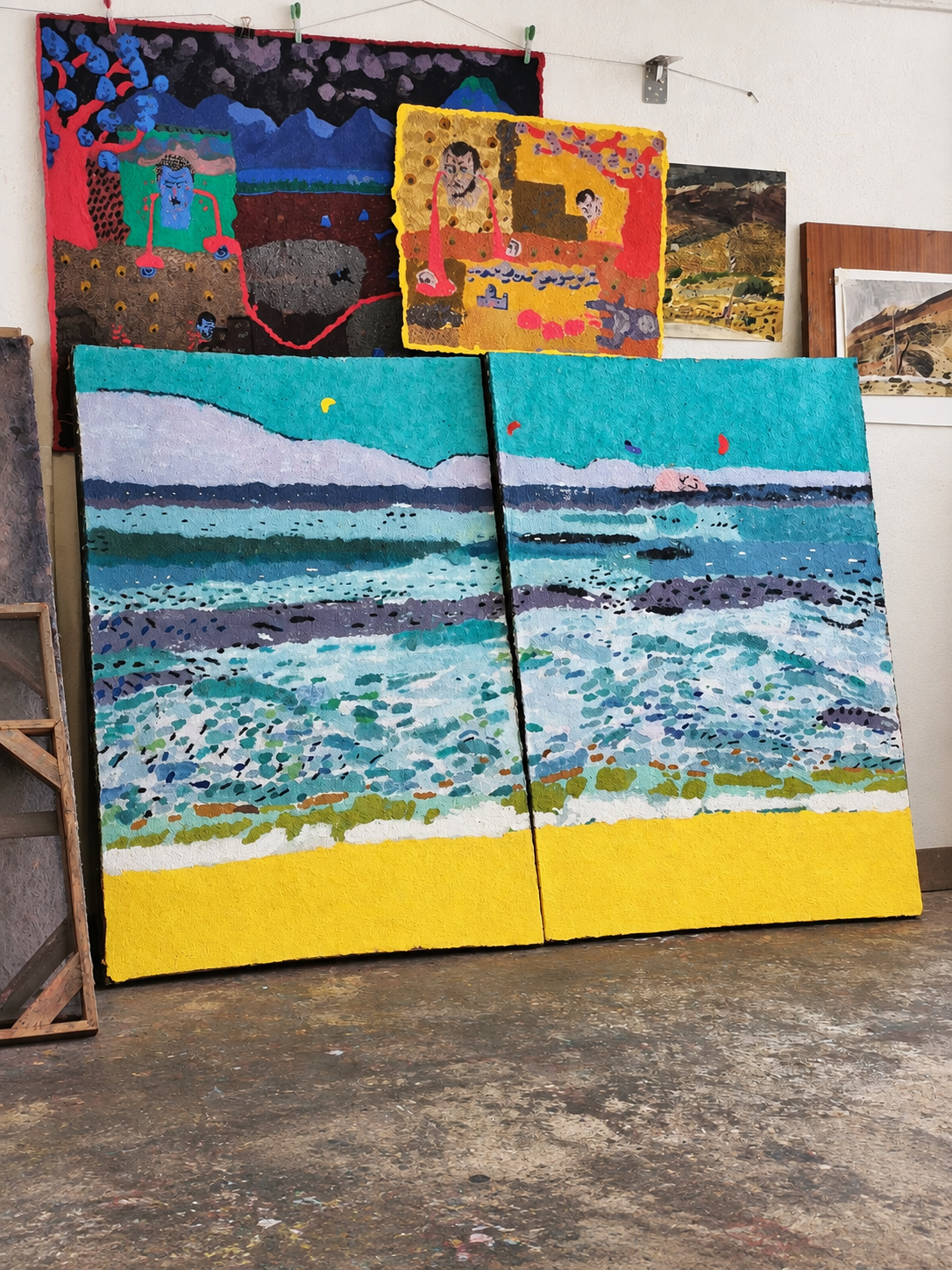
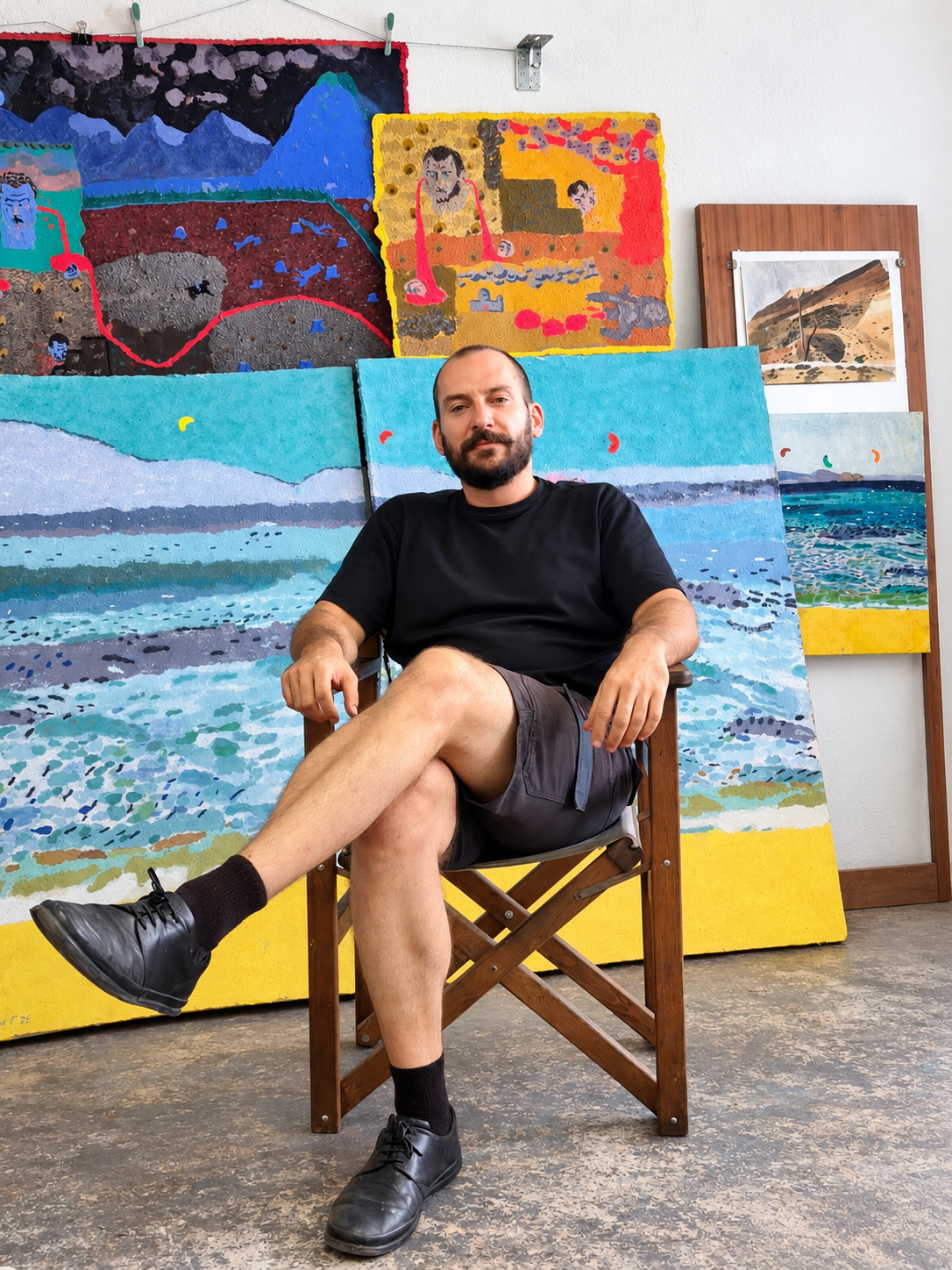
Giannis Efthimiou has a slight problem with certainties. Even when you ask him if he has found his painting idiom—which, looking at his work, one could easily assume he has—he avoids a simple yes. “It’s not something I actively seek; it emerges,” he says. The phrase is interesting precisely because Efthimiou is an artist whose work has acquired several highly recognizable characteristics in recent years—paper pulp; intensely textured surface; mountains and seas; houses, horses and riders—that recur from work to work.
But in his studio, you don’t get the impression that he has found a formula which he intends simply to repeat from here on out. After all, paper pulp, the material with which his painting is now most closely associated, does not easily lend itself to certainties. It bulges, breaking the flat surface, and it diverts the image from its probable initial path; worst-case scenario, it can also tear when it’s being detached, ruining weeks of work. Efthimiou does not seem to view this possibility as accidental to the process. It is integral to it.
PANOS KOUGIAS/TO BHMA INTL EDITION
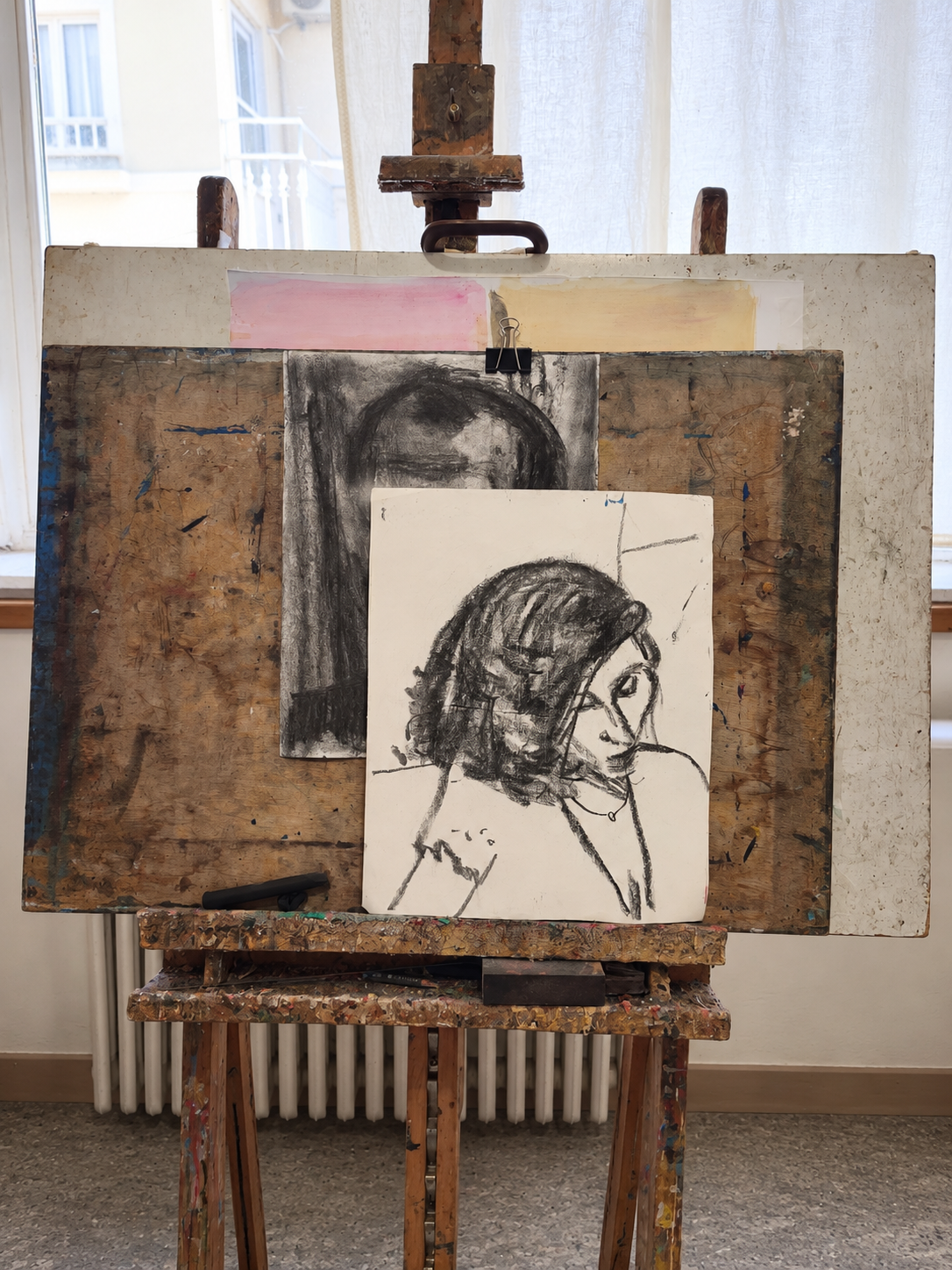
Which may imbue a story he tells me about his early years with a different weight. He grew up in Corinth, without—as he says—having any real idea what contemporary artists do. It was his aunt Efi who noticed his inclination and suggested the School of Fine Arts on Tinos. And so, when he was confronted with art for the very first time, at eighteen, he was standing before a block of marble, not an empty canvas. The task: to square it off. His hands bled and blistered, and if a corner broke off from a misplaced strike, there was no way to glue it back on. You had to start lowering the surface all over again. The distance from marble to paper pulp seems vast. In Efthimiou’s work, however, there is a strange continuity: the painting is still very much wrought by hand, and the material still has the capacity to resist.
Speaking about his trajectory to date, Efthimiou also returns to the people who stood by him, referring to some with an almost familial tenderness—as if they parented him in their own way, as he puts it. These pivotal figures include Kostas Karasavvidis, who is not just a framer to him, but an artist in his own right and a wonderful human being; Evi Konstantinidou from Evripides Art Gallery, with her long career on the gallery scene; as well as Tasos and Christina Mantzavinos, whom he thanks in particular for their help regarding his relationship with the Skoufa Gallery. The people to whom he feels he owes a debt of gratitude also include Paraskevi Zerva, curator of the Lafcadio Hearn exhibition in Thessaloniki, which provides the occasion for our meeting and discussion today.
Lately, another world has intruded into his familiar iconography: that of Lafcadio Hearn. The catalyst was a group exhibition at the Vafopouleio Cultural Center in Thessaloniki. Efthimiou started reading Hearn with a view to creating a single piece, but found himself returning to his stories over and over again, drawn to the mix of metaphysical, fairytale and macabre elements, and to that strange proximity of darkness and humor. And the one piece became several. Our conversation proceeds in much the same way, moving from a material to painting, from painting to life, and from there to the question of whether the many things that happen in a studio ever find a way out into the world.
Do you feel you have found your painting idiom, or are you still searching for it?
I don’t know if I’m searching for it. I think it emerges. And I am ready—or not—to see it. There are times when something may emerge, but I’m not yet ready to see it. With paper pulp, however, I feel I have found a field that allows me to say whatever I want, however I want. It won’t be judged as much against the history of painting, against the great masters, or my own teachers and art education. And that gives me the peace of mind I need to do anything. I don’t think it ends there, though. If you are to feel alive, it needs to be constantly subverted. And, naturally, an alphabet gradually emerges out of that. For instance, I might paint a wave using certain brushstrokes because of something I saw once, and then that evolves from work to work. That’s how an idiom is created. I want it to be my own language. That enables me to say what I want the way I want. And nature helps immensely with this. Observing it is an inexhaustible resource.
PANOS KOUGIAS/TO BHMA INTL EDITION
You started out in sculpture. What traces has that experience left in the way you paint today?
I started working in marble on Tinos, though I never actually went there with that in mind. I came from a provincial background, in Corinth, where I didn’t even know what contemporary artists did. My aunt, Efi, had seen that I had some talent and suggested that school.
So there I was, at the age of 18, standing in front of a huge block of marble. The first exercise was to square off the rock. The relationship you form with such a hard material—my hands bled and blistered—brings you into very direct, literal contact with manual labor And it teaches you not to get discouraged. If you hit the chisel wrong and a corner breaks off, you just have to lower the entire surface all over again. You can’t add material back on, like you would with clay. That, I think, is what has carried over most into my painting: the sheer physicality of the work, and the stamina it takes. Rather than any specific sculptural quality of the painted surface.
Paper pulp has become a signature material in your work. How did you first discover it?
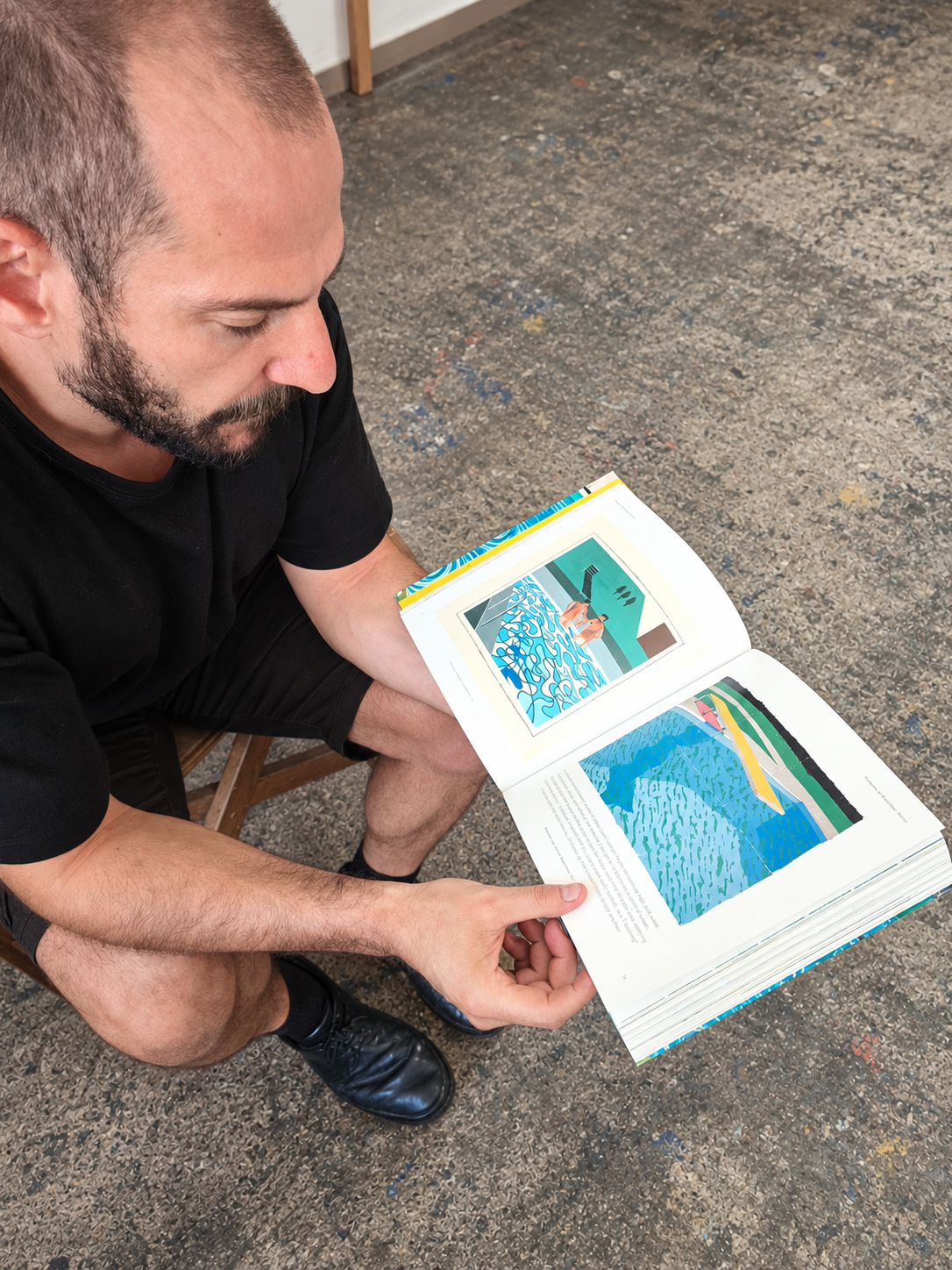
The initial spark came from some works by David Hockney, which made use of this technique. And they set me off on a quest. For about two years, I experimented constantly—with more or less moisture, with color and without, doing things in different ways.
PANOS KOUGIAS/TO BHMA INTL EDITION
For me, this put the matiere more center stage. That was the big gamble: I believed, and still do, that paper pulp can become a new painting medium in its own right. Not just a different way of doing something that already exists. No, I see it acquiring its own dynamic which shapes the drawing and the painting. My explorations began with the belief that a new kind of painting could emerge from it. Which is why different elements find their way into my works. In some places there is a pronounced matiere, in others the surface becomes highly textured, elsewhere there is an almost collage feel. I have played with it in many ways, and I feel the possibilities are endless.
How much do you wrest control of a piece before you start making it?
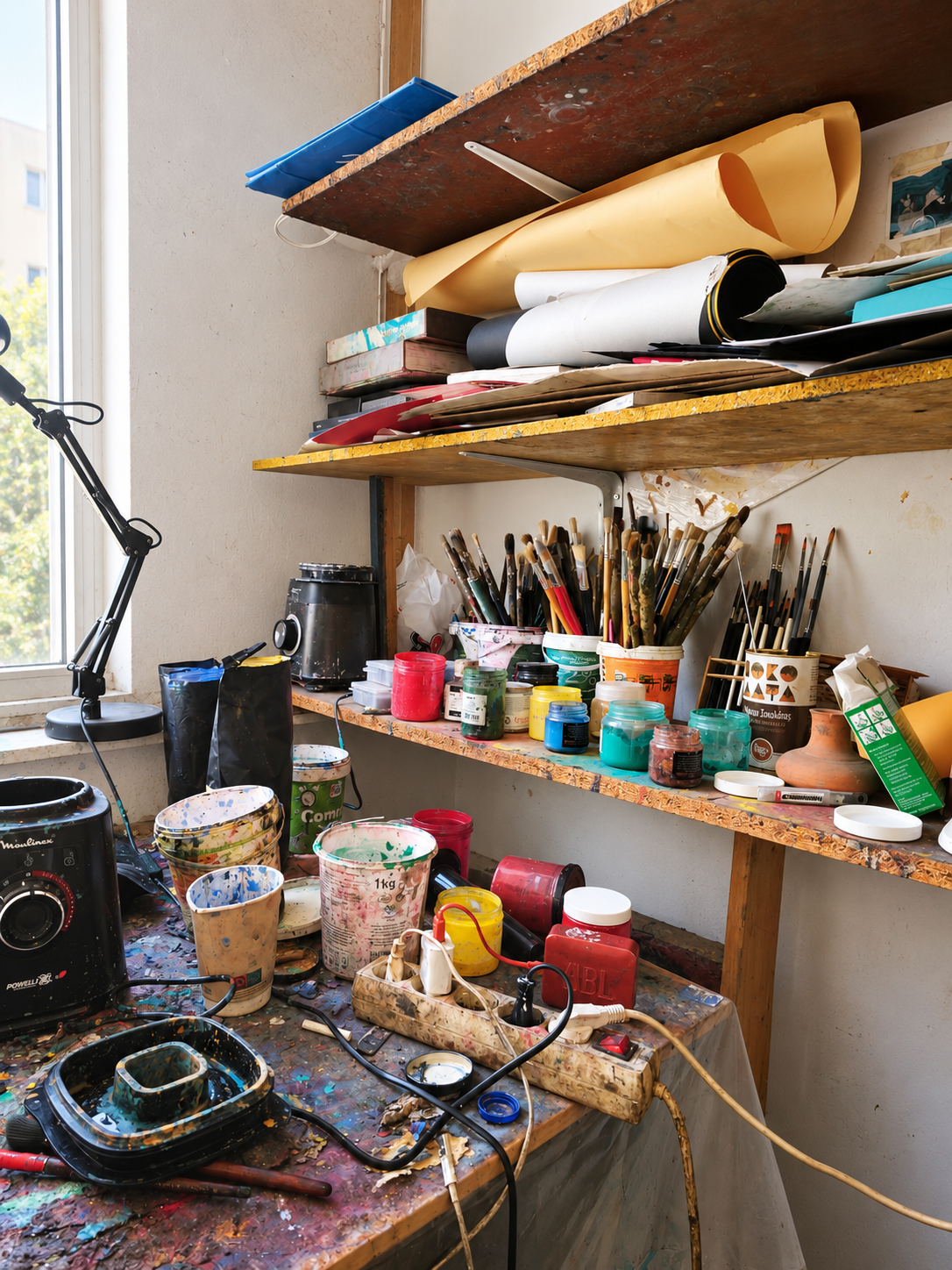
I start with something in mind, but I want to be in a state where I’m ready to subvert it. It never goes exactly as planned. When physical labor is involved—and especially when working with a material even I don’t fully understand yet—things can take many unexpected turns. You start out taking it somewhere, and it takes you somewhere else. There is also the detachment process, during which the entire work can be destroyed. I might have worked on something for a month, but when I peel the paper off, it tears and that’s the end of that. I don’t want to remove that risk, however— it creates tension, gets my adrenaline flowing. If I ever reached a point where I was simply producing something ready-made, why wouldn’t I just change jobs? What would be in that for me?
Is painting for you more a product or a process?
In the past, I cared hardly at all about the end result. It was the process that interested me. I could work on something for six months and, in the end, all that remained was the imprint of the process that had led there. But it was honing my instinct and teaching me how not to get discouraged.
Painting has become a lens through which I read many things in my life. Recently, I was on a trip with a friend and he asked me when I had last felt truly happy. What came to mind was a day I’d painted a landscape I really liked. I had such an adrenaline rush when I finished, I had to go outside and it felt like I was high on something. And that tells you something. It can also be problematic, because I have a tendency to filter everything through painting: my relationships, my daily routine, other activities.
PANOS KOUGIAS/TO BHMA INTL EDITION
Still, I try not to lose what got me here, which is the joy of creating. I don’t like the whole “tortured artist” thing at all. I’m interested in being well so that I can paint. I don’t want to forfeit my life to do it; I want to have my life so that I can do it.
Can success and the market affect that relationship?
I think about it and engage in constant self-criticism. You say to yourself: you do what you do, you sell it, you make money from it—but why are you doing it in the end? On the other hand, you have no choice but to operate within a system. Otherwise, I would have to go live in a cave and paint. That said, I didn’t try to manufacture an identity from the start, so people would say “That’s an Efthimiou.” I didn’t work toward ending up where I am today. I tried to paint well. Painting interests me. The rest just happened. And I was lucky because I crossed paths with people who appreciated the work and helped me immensely.
In the Lafcadio Hearn exhibition at the Vafopouleio, what was it that drew you most to Hearn’s world?
The intense metaphysical element. Reading his work generated immensely powerful images for me, but not just cerebrally—they touched me emotionally and activated my imagination.
I am generally drawn to this contradiction between tragedy and irony. Hearn had something slightly childlike about him, like a character from a fairy tale, and at the same time something very dark and profound. And those three elements—the childlike, the dark and the metaphysical—resonated deeply with something that was probably already inside me. I didn’t start out intending to make a series of works. I just wanted to create the piece for the show, but an entire body of work emerged in the end.
What exactly will we see at the Vafopouleio?
The piece is essentially a jigsaw puzzle of stories. I read three or four of Hearn’s books and, for some reason, certain stories stuck with me—ones where death plays a leading role, sometimes in a strange and darkly humorous way. I played with these in the rest of the works in the series, too.
One of the stories that touched me most was about a musician staying in a monastery; every night, a samurai would lead him to a palace to play music. He later discovers that he has actually been going to a cemetery and playing for the dead. It touched me so, because he was an artist: he was playing for something higher than this world, then returned to play for people.
PANOS KOUGIAS/TO BHMA INTL EDITION
What are you working on right now? Are you already thinking about your one-man show?
It’s still early days for a solo exhibition. I have some ideas, but I try not to dwell on it, because when you start thinking about an exhibition, it can impose rigidities and limitations on your work.
I don’t work on a single, specific theme. I might do the Hearn pieces, then go back to landscapes, or start something else. At the moment, there’s also a new body of work that started out as small pieces I made for a book, then began to develop in a puzzle-like way. I don’t like to keep things too shut off. It’s dangerous to learn to operate in just one way, and then be left incapable of working in any other. I want to be able to see the drawing as apart from myself, too. When I work from nature, nature subverts what I have in my head; when I work with my imagination, it subverts what I have taken from nature. It’s a constant back and forth between the two.
You have used the phrase “by us, for us.” Do you believe that contemporary art in Greece communicates with the public in a real way?
I’ll tell you something very simple. I have friends, young people, who, when I tell them I’m a painter and exhibit at the Skoufa Gallery, reply: “We’ve never gone in because we thought you had to pay an admission fee.” And we’re talking about people who aren’t completely removed from our reality here. I have accepted that painting isn’t a dominant art form today. I know what I do, and I’m okay with that. But I would really like to communicate more. Because we often feel it’s done “by us, for us.”
PANOS KOUGIAS/TO BHMA INTL EDITION
On the one hand, there is the gallery, you exhibit your work in that gallery, and, naturally, you want to sell so you can make a living. But this inevitably caters to a specific financial demographic. On the other hand, there is a segment of contemporary art that moves from exhibition to exhibition, in different spaces, but even that can ultimately end up being “by us, for us,” catering to an intellectual elite. I think the art can often fail to communicate in a real way in either case.
I would like there to be more space for young artists and a more concerted effort from the institutions. A space where young people can show their work and be given a chance. The system itself might reject you afterwards; but you must be given the opportunity to test your mettle first.
PANOS KOUGIAS/TO BHMA INTL EDITION