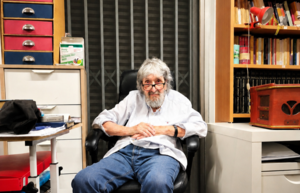
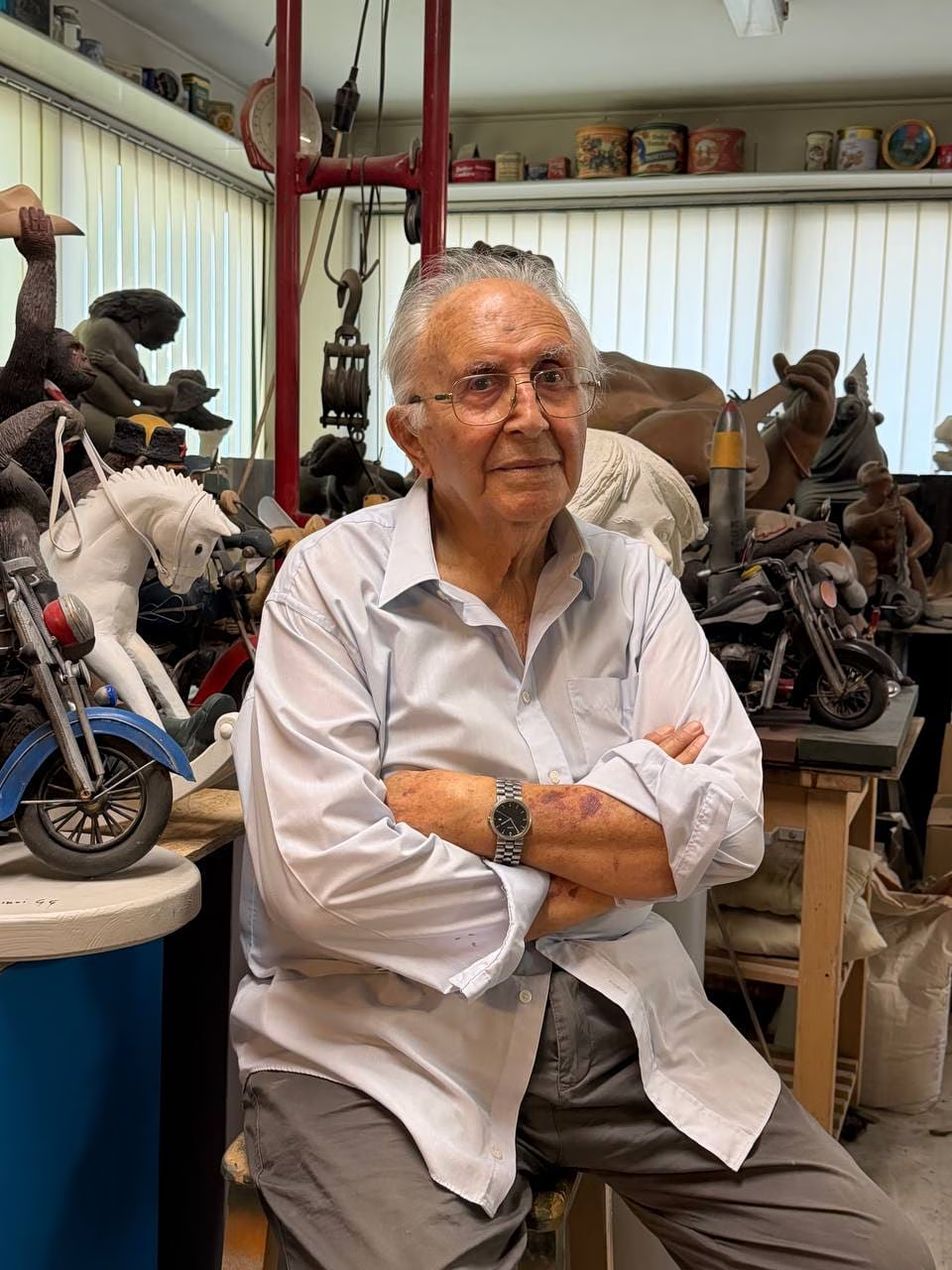
A few days ago, I visited Giorgos Georgiadis at his studio. We met to discuss a career spanning nearly seventy years in sculpture, but our conversation quickly opened up to embrace memories of his childhood, the people who shaped him, the events that left a mark on his work, and the quests and questions which, at ninety-two years of age, continue to preoccupy him with the same intensity as ever.
He welcomed me with a rare politeness and a generosity of spirit from a bygone era. Without reservations and dispensing with formalities, he spoke to me about those small, chance incidents that, as he puts it, can change an artist’s course.
Whether speaking of “The Epinikia,” which came into being during the years of the dictatorship, or “Mythology Backwards,” or the dystopian creatures of the recent “Reinstatement>72 Centuries A.C”, he is never simply sharing the history of a sculpture. He is telling the story of an era and the people who traversed it.
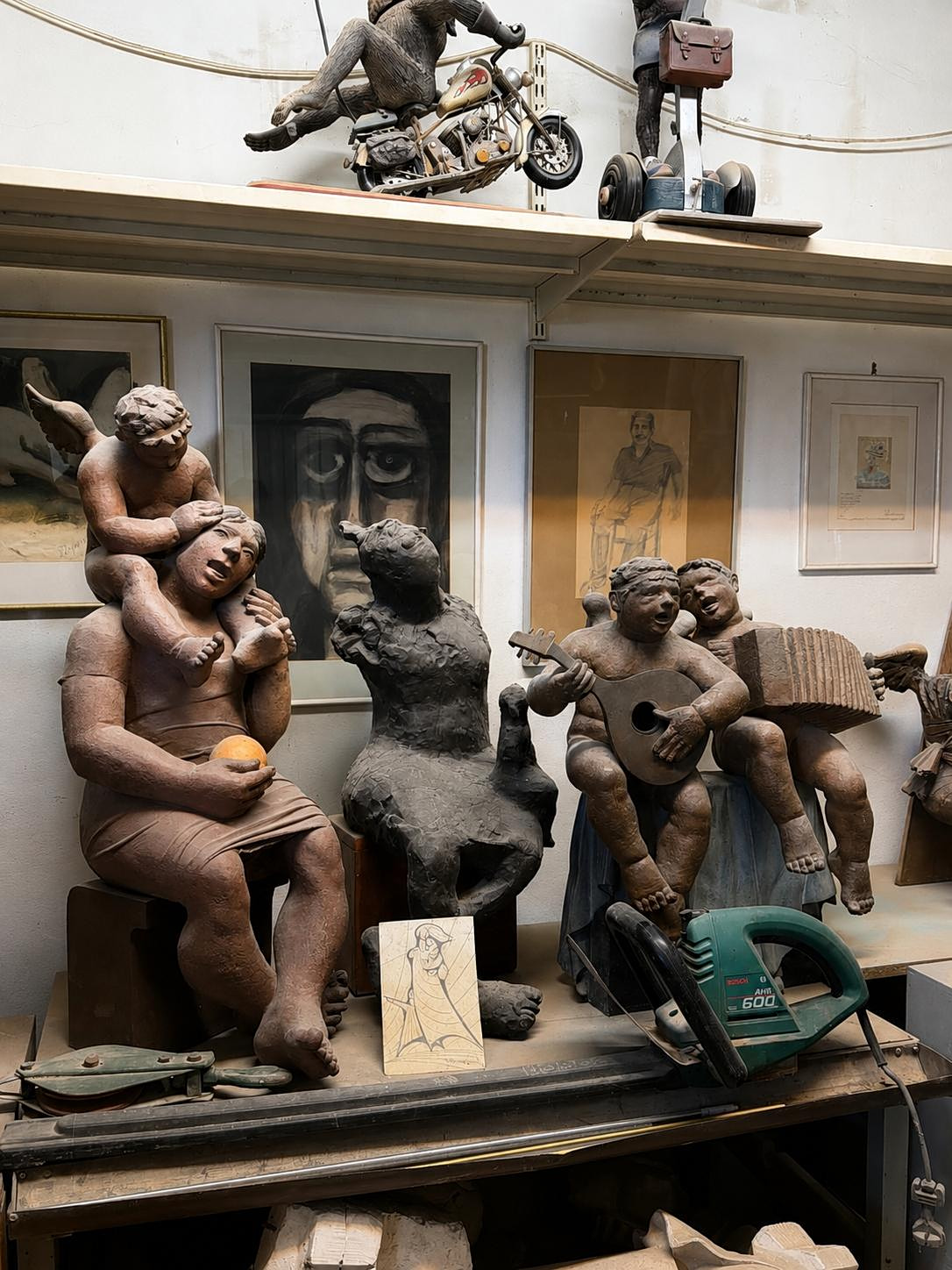
Throughout our conversation, his studio spreads out around us like a living archive of a life. Sculptures from different periods, test pieces, sketches, tools, and figures small and large coexist as milestones in a dialogue that has been ongoing for nearly seventy years. The discreet presence of his partner, the internationally renowned ceramist Maro Kerasioti, completes this “portrait” by adding a key piece: their creative coexistence. It quickly becomes clear from our conversation that she has been a constant presence in his life and a fellow traveller through the most decisive shifts in his work.
Giorgos Georgiadis is a creator who, after nearly seven decades of continuous artistic endeavor, continues to approach art with the curiosity of the child who would mold figures out of clay in the back of a shop in Marousi. And, perhaps, therein lies the secret of his journey. In the ability to remain a student of the world, even when the world has long since acknowledged him as a master.
PANOS KOUGIAS/TO BHMA INTL EDITION
Mr. Georgiadis, what was the defining moment when you first knew for sure that you wanted to sculpt?
When I was in Primary School, between the ages of six and twelve, my father ran a hardware and paint shop in Marousi. His younger brother—my uncle—had a plumbing supply store, and their father, my grandfather, kept a tinsmith’s workshop on Ermou Street, in the same town. Three shops, just two years after the Asia Minor Catastrophe and the family’s hasty and violent expulsion from Smyrna, where they’d lived.
So my father, who was an avid self-taught painter, sold all sorts of things in this shop, including paints and art supplies—brushes, canvases, palettes, and so forth. And he’d often gather with his customers whose primary interest was in painting, so they could exchange views and knowledge with each other about their shared interests. Those I can remember include Nikolaidis, who had graduated in painting from the Athens School of Fine Arts (ASFA); Laskaris the painter, Papalaskaris’ son; Kritharis, a tuberculosis specialist and self-taught painter; and Mrs. Lychnou, a formally trained painter and wife of an MP for the Ionian Islands. She was a highly progressive figure for her time, as she rode a bicycle and would smoke alongside my father. And so, quite often, when I happened to be present at their gatherings, I would listen to their discussions on the subject of art.
I should note that, because my father also played the violin, his interests extended to music as well. It was then that I first heard the names Lytras, Parthenis, Bouzianis, Leonardo da Vinci, Michelangelo, Rembrandt, Picasso, El Greco, Goya, Beethoven, Liszt, and Brahms—all jumbled together, with art as their common denominator.
“The Epinikia” is one of your most emblematic series, and a milestone in your career. What was the initial spark of inspiration behind this work, and how does the concept of “victory” converse with our present?
At that time, I had a mania for making all sorts of things with my hands, and since I never lacked tools, I would craft everything: from toy guns for my friends, to dolls for the girls in the neighborhood. I even got a hold of clay, asking for it from Marousi’s potters, which I used to create little animals and people. At my uncle’s shop, using his tools, I could construct small objects out of metal and sheet iron. I was never really drawn to my father’s paints. He wanted me to study architecture or dentistry, though I could never understand how he’d combine those two professions. As for me, on finishing high school, I chose to listen to my heart and attend the ASFA.
Any form of art—whether it be poetry, painting, sculpture, theater, even literature—expresses, in some way, the stimuli and influences its creators absorb from their political, economic, and social environment. Over the course of my work, for nearly seventy years now, I have engaged with and expressed myself through different materials, often working in one for a period of time before moving on to another. Coincidentally, for several years my focus was on a seated female torso, since my work was anthropocentric and figurative from the very beginning. The seated figure arose from a necessity: one of my first studios—I have moved through seven over the years, but this one was in Kallithea—had a low ceiling, which made it hard to work on standing figures. That condition would end up leaving its mark on my entire oeuvre.
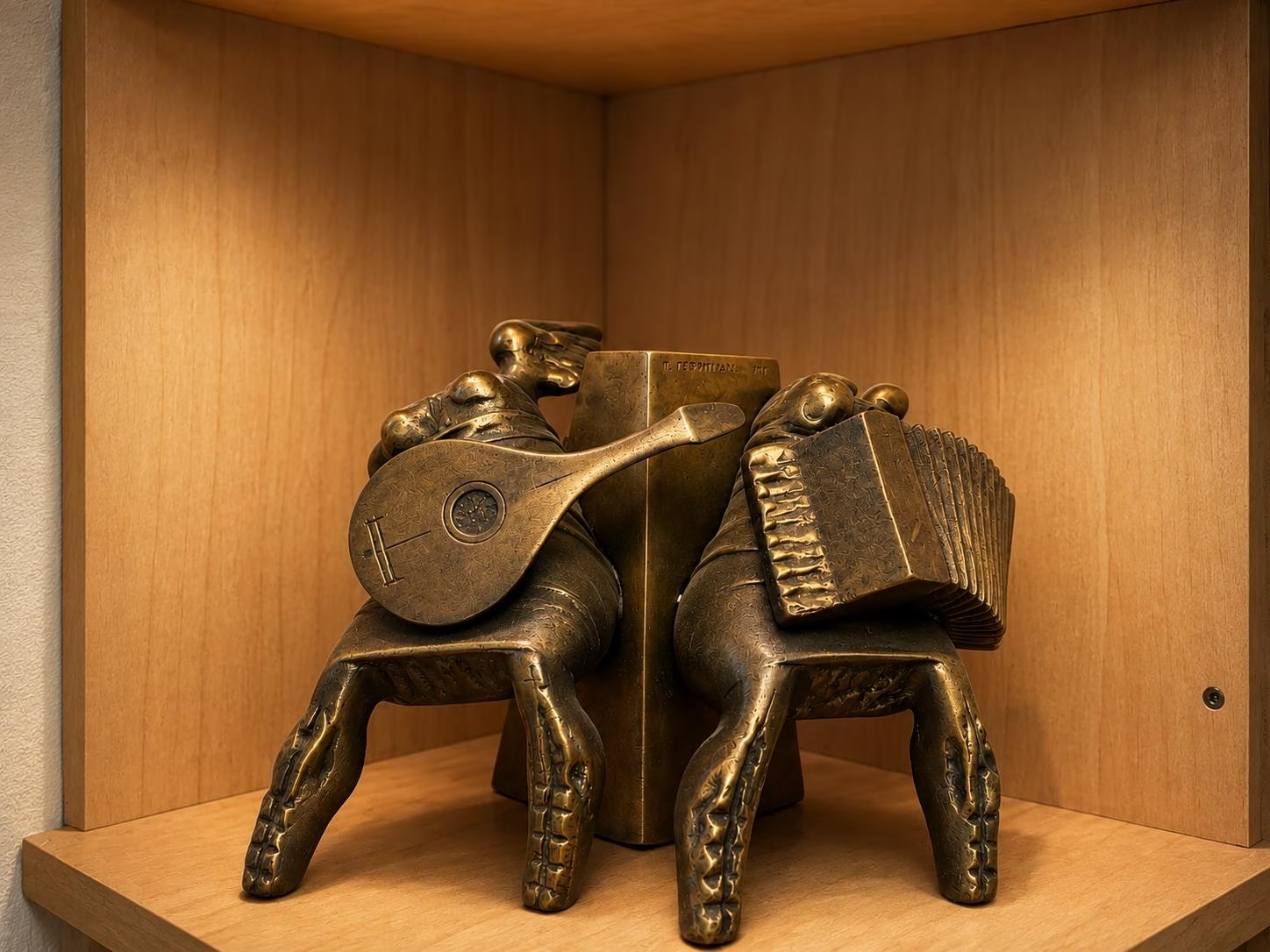
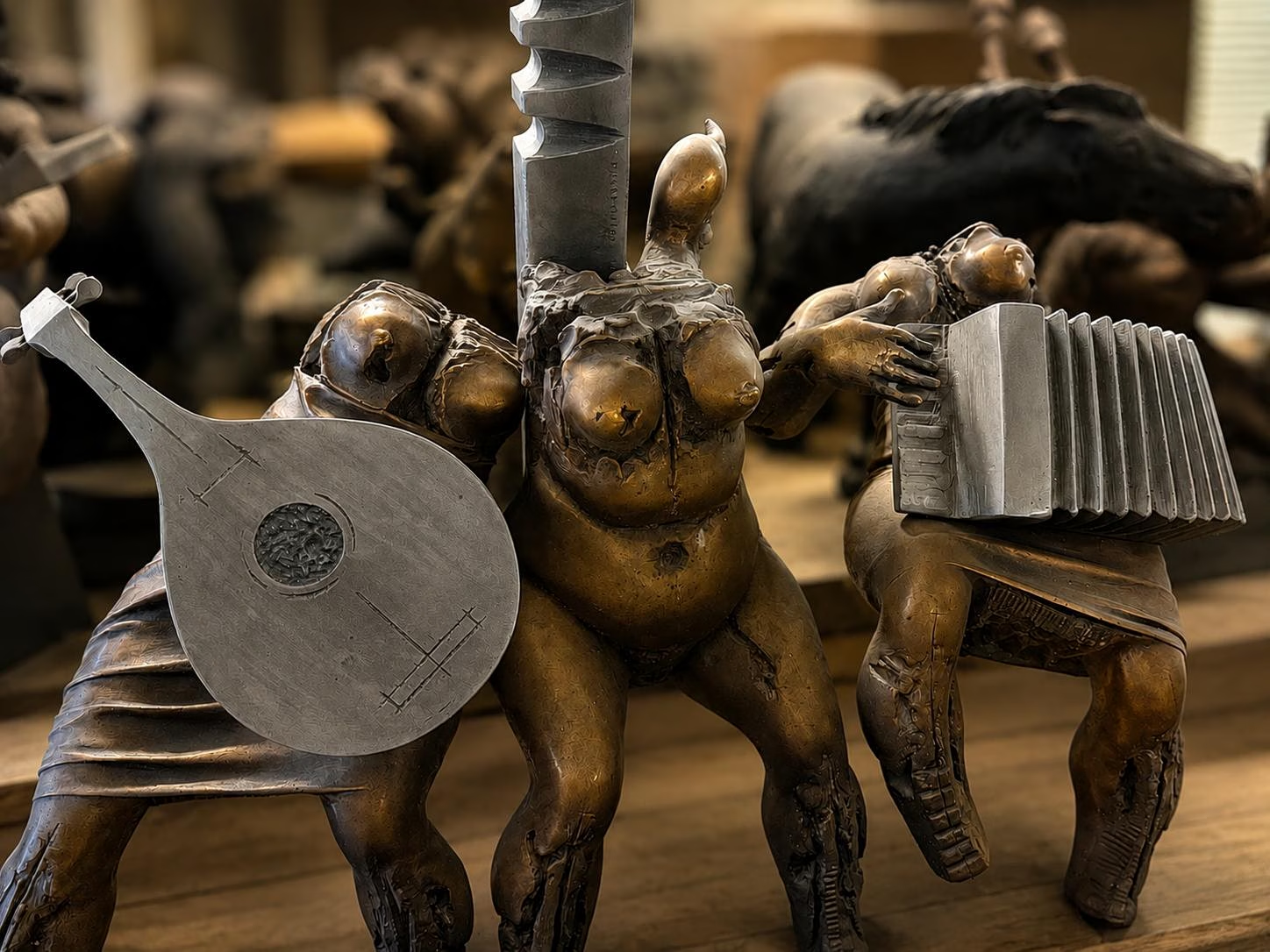
Trying to transmute stimuli and emotions, I would remove the human body’s primary expressive parts—the head, arms and legs—, and set out to compose in space solely through the movement of the torso. The torso was one of the subjects we had to study at ASFA. I chose the female body for the entire “Epinikia” series because, aside from its harmonious curves, it is so plastic in its movement; it also symbolizes motherhood and the perpetuation of humanity. The wings I added—often just one, as a solitary means of escape from some form of oppression—drew their symbolism from the fabrics in which the torsos are tightly bound. I produced this series of works during the abhorrent dictatorship the Colonels imposed on Greece. Many of my colleagues, and not just sculptors, expressed themselves in a kind of silent protest through similar themes during that period.
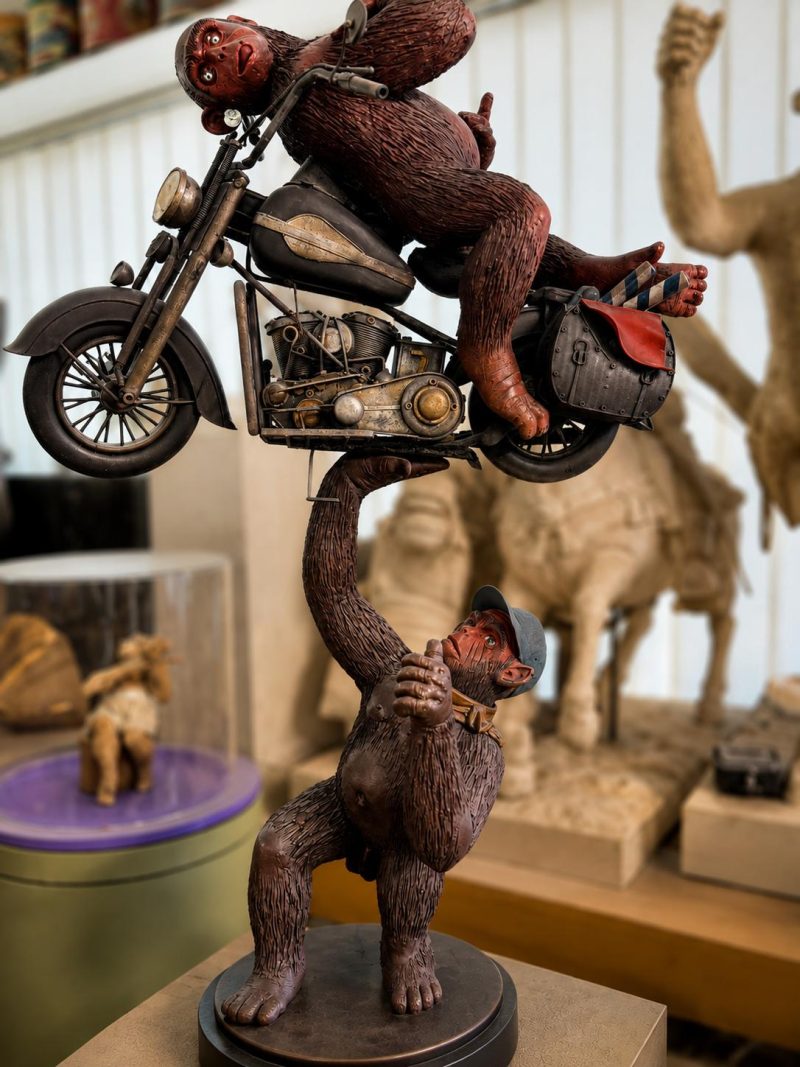
One of the many artful sculptures by Giorgos Georgiadis. PANOS KOUGIAS/TO BHMA INTL EDITION
As I mentioned earlier, the series’ general title was “The Epinikia,” meaning the victory celebrations that followed a victory, the triumphal chant, the paean. In many of these works, with its loose folds and pleats, the fabric signifies liberation, release, and serenity. All the works in this series, from the small ones to the larger-than-life-size, express stimuli from my surroundings, and pressures I would at times be put under by the prevailing conditions. Sometimes, a random event can lead you down new paths that end up molding and marking your professional goals. I would like to say at this point that my use of tight or loose fabric around a highly kinetic body or torso came about entirely by chance when, during a break from work, I covered a seated female torso in clay with a wet cloth to keep it drying out.
When I returned a while later and saw my work draped in that blessed fabric, it occurred to me that I could use the technique to express various situations that were concerning and troubling me. After all, in art—in sculpture, but also in dance and painting—many artists have chosen to express themselves using the folds in fabric. Of this specific sculpture, which I named “waiting” and cast in metal exactly as I found it, the well-known French art critic Louis Charmet wrote in the Paris-Journal of the time, in the context of my participation in the European Exhibition at the Musée Rodin: “Standing out among them all is the seated figure by the Greek sculptor Giorgos Georgiadis.”
I did not expect this, and it was a great honor and a reward for my efforts. Imagine that, when my teacher Giannis Pappas proposed that I take part in the show, in my haste, I used a wooden crate with knots and nails as a seat for the figure. Perhaps this also played some singular part in the work’s aesthetics. I cast the work in two copies. One is in the Greek Ministry of Culture, the other in the collection of a French collector.
In your recent exhibition “Reinstatement>72 Centuries A.C.”, you once again created something entirely new and entirely different from what we had seen from you thus far. At the same time, humor, sarcasm, and a pervasive irony coexist in these sculptures, alongside the tragic element. How difficult is it to achieve this delicate balance?
It’s true, humor and satire have not been absent from my artistic inquiries at times, primarily from the series I dubbed “Mythology Backwards”, and even in the series “Reinstatement >72 Centuries A.C.”, which is imbued with black humor, given what is going on all around us—wars with untold casualties, genocides, the bombarding of cities using weapons of mass destruction that are constantly evolving and being ‘improved’ to better destroy and wipe out peoples and civilizations.
It is there, perhaps, that the pessimistic element in my work becomes apparent. It is this series of works, “Homo Sapiens 20 Centuries AD”, in which I boldly tried to highlight all the many contradictions and inequalities that exist between people on this small planet we call Earth. The lack of food and water, shelter and healthcare, combined with our fearful anguish over something even worse on the way, over the exploitation and fate of entire peoples, contrasted with the prosperity, happiness, comfortable living, and conspicuous consumption and wealth in another corner of the same planet, compelled me to create this series.
I used real utility objects including a gold toilet bowl, a supermarket trolley, a luxurious “period style” chair with velvet upholstery—all framed and juxtaposed against Third World figures cast in bronze. In all the things I’ve mentioned as stimuli across the various decades and periods of my work, there is an obvious inclination toward a narrative mode of expression, in conjunction with what I call my figurative and anthropocentric disposition.
PANOS KOUGIAS/TO BHMA INTL EDITION
Your sculpture is inhabited by zoomorphic humanoids and creatures that seem to have sprung from a post-apocalyptic or surrealist world. What do these hybrid forms symbolize for you?
From time to time, ever since the period when I was still working on “The Epinikia,” I have tackled a subject that is not human-centric. Namely horses. The horse wasn’t a subject I had studied before. As a trial, I began sketching the animals at a stud farm in Marathon. I made countless sketches, experimenting with various techniques—pencils, charcoal, ink, and even monotypes, spreading printing ink on the surface of glass, which I would then print onto rice paper before continuing to draw on the print in India ink. This monotype technique was shown to me by the talented engraver Nota Siotropou in her studio in Rome; sadly, she left us too soon.
All this work sketching horses captivated me so much that at a certain point I decided to model a horse in clay. The plasticity of this animal’s movements is particularly distinctive, offering multiple fascinating variations. So one horse became two, then three, always with a different motion, until I had some thirty sculptures cast in bronze. It was at this point that it first occurred to me to mold them as a herd. The interesting thing was that I could layer this composition by assigning each horse a different position. I can say that this prolonged study of horses gifted me a unique professional experience.
From the traditional bronze, we have seen you passionately turn to double-fired cast stoneware in your recent exhibitions at the Sianti Gallery. How did this need to change material arise, and what new expressive possibilities did it offer you?
The use of cast stoneware ceramic came about out of necessity, and due to the encouragement of my partner Maro, who is a ceramist. Because casting works in my favorite material, bronze, had become financially unfeasible for me. I can say, however, that this change in medium gave me the opportunity, over a period of seven years, to mold and realize these works in a unique and different way—one every bit as time-consuming as bronze, but from a different perspective and using a technique that proved truly revelatory for me. The balance you mention, between humor and irony, is hard to achieve because the boundaries between the two, just like those between comedy and tragedy, are vague, unstable, and hard to discern.
Over the years, I have seen a good many artistic trends, styles, and movements emerge around me but leave me entirely unmoved, even though some were very interesting and bequeathed us high-caliber works. I remember the time when abstraction was the prevailing mood in art, with representation, narrative, and drawing all stripped out, leaving only color for painting and volume for sculpture. It made an impression on me then how many of my fellow artists, primarily painters, would go to sleep one night painting figuratively and wake up the next morning working abstractly. That was when I decided to express myself free from influences, exactly as I felt after two World Wars. So, I imagined that in the distant future, roughly seven thousand years from now, humans will have degraded into beasts, to the point where the great naturalist Darwin takes over—meaning they are now what he called ‘anthropoids’.
PANOS KOUGIAS/TO BHMA INTL EDITION
It’s just that, as I imagine and render them in the works in this series, they have retained certain preferences from their earlier life as Homo Sapiens. They prefer to wear clothes, to walk on two legs, for instance. Above all else, they have retained their worship of machines of all kinds, with the motorcycle symbolizing this peculiarity in their subsequent evolution.
In your works, we also frequently observe a strong connection with ancient Greek literature and myth, but viewed through an “inverted” or deconstructed prism. Does myth remain a fundamental lens through which you interpret reality?
For the works in the “Mythology Backwards” series, I turned to Greek mythology, whose myths are richly plotted and which has inspired many artists around the world at different times. Myths feature subjects that verge on the fantastical with dramatic, comic, and ironic elements that are as fascinating as they are timeless. Somewhat tentatively, I too entered this unique, magical world, intent on expressing the various stories and singular situations to be found in Greek mythology in my own way.
I named the series “Mythology Backwards”, because I tried to view the fiction being described in a completely topsy-turvy way. So I took the relationship between Zeus and the young Europa one step further, and perhaps in a slightly more unorthodox light; or I looked at Hercules’s weaknesses in relation to his strength; and even asked why Aphrodite shouldn’t be a sexy, Black African woman conversing with Hermaphroditus, the son she had with the god Hermes; or the sensitive and musically talented Arion of Lesbos, who out of hunger ended up eating the beloved dolphin that saved his life. Also, the beautiful muse of dance and music, Terpsichore, whom I imagined as a very corpulent and slow-moving female figure presenting herself as something she cannot be: a ballet dancer.
This entire series, cast in bronze—an expensive and time-consuming technique—also gave me the opportunity to use wax at a certain stage. It’s a malleable material, and one I grew particularly fond of, as it allowed me to mold some parts of these sculptures directly in the wax. They are unique works; further copies are an impossibility, due to my quirk of destroying their casts and molds. Many have criticized me for this decision.
In 1984, you represented Greece at the Venice Biennale, a crowning moment for any artist. What do you remember most vividly from that international experience, and how did it influence your subsequent perception of Greek art in relation to that of the rest of the world?
It was decided by the Minister of Culture at the time, Melina Mercouri, that, together with my late friend the great painter Christos Karas, we should represent Greece at the Venice Biennale in the spheres of painting and sculpture. The theme of that year’s exhibition was “Pittura-Pittura, Scultura-Scultura”. At this massive event, the various trends prevalent in art at the time were all on display in the national pavilions in the Giardini del Popolo, as the respective selection committees had nominated the most notable representatives of their country’s art scenes to participate. At the time, I was urged to participate by many worthy and respected colleagues, including Christos Kapralos, Vaso Katraki, George Zongolopoulos, and Spyros Vassiliou—who, along with Thanasis Apartis, I consider my mentors, alongside my teacher Yiannis Pappas.
Even though my study and work had reached a crossroads at that time, with the themes of “Homo Sapiens” and “The Epinikia,” I had reservations about participating. Ultimately, I took part with works from both series, which were linked by their technique, their material (bronze), and their symbolism: pessimism in the case of one half, optimism in the case of the other. Perhaps this contrast played its part, because the reviews for both Christos and myself were favorable. What has remained lodged in my memory from Venice, though, was a morning in the Biennale gardens, when, after a night of rain, a spider had woven a huge web between two tall trees. Spun with mastery and a flawless technique, the web showcased the raindrops shimmered on it like diamonds in the light, as the sun emerged from behind thick cloud.
For a long time, Christos and I stood admiring this magnificent work of art wrought by nature, which always has so much to teach us. It was an unexpected lesson in aesthetics. After Venice, our exhibition transferred intact and with great success to Berlin, to the Galerie am Kurfürstendamm.
Looking back at that time, do you believe that Greek sculpture held then—or holds now—its rightful place in the global artistic firmament?
The great French sculptor Auguste Rodin, in his writings and testament to us all, and especially to young people, wrote, as a kind of wish, that it would be a great blessing for humanity if nations were governed and their fates decided by artists. Then, lasting peace and justice among people would prevail on the planet, without wars and weapons of mass destruction. Following the unique experience of participating in the Venice and Alexandria Biennales, as well as at the Pan-European Exhibition in Budapest, with its flawless presentation of works, I saw that Greek sculptors, in their experiments with new trends and modern tools, all while using traditional materials, surpass many sculptors around the world in creativity and originality.
They are distinguished by a boldness of expression in their realization of a subject in space. If we set out to analyze the various art forms and trends that developed in different parts of the planet, we quickly realize that expression is influenced by—and goes hand in hand with—the conditions and stimuli that prevail in different settings and environments, as well as the different materials available in each place. In Greece, for both sculpture and architecture, the primary raw material available from antiquity to the present has always been marble. Additionally, there are ceramic materials with which many sculptors and experienced ceramists work. In Italy, color and bronze dominated the golden age of the great Renaissance. In certain other countries with forests and timber, wood carving prevailed. All of this is only natural.
PANOS KOUGIAS/TO BHMA INTL EDITION
How do you feel about the state of sculpture today?
Sculpture, as I have always understood it, as a monumental and timeless form of art wrought from materials that are almost imperishable over time—such as marble, bronze, and even ceramics—continues to evolve as an art form as new and more modern tools become available to most sculptors. In many cases, the ease with which all these materials can now be processed produces works with a decorative perspective, without this detracting from them, given the abstract disposition each artist brings to their work. Abstraction, and the current tendency to simplify form, have given many the opportunity to engage with the arts—through, primarily, sculpture and painting. All of them are set apart under the umbrella term “visual” artists.
The wise Yiannis Tsarouchis once said: “In Greece, you are whatever you declare yourself to be.” My intention with what I say and write from time to time is not to analyze every facet of my work from an aesthetic viewpoint, but purely to point out the motives and stimuli that, being prevalent in my milieu, provided me with the ideas I process and render tangible in my work. Often, when the artist himself attempts to analyze his work by speaking or writing about it, the significance, meaning, and broader resonances can often end up diminished.
If you had to leave a single piece of advice or testament to young Greek sculptors who are embarking on their own artistic journeys in today’s volatile global environment, what would it be?
I believe that young artists, and sculptors in particular, who have to deal with difficult materials, must dedicate a lot of time to their work. They must acquire knowledge little by little, and no matter how many stages they master, they should keep on striving to improve their technique still further, so they can grow as artists and leave their mark on this world.