 Μake us preferred on Google
 The phrase “May Day is not a day off, it’s a strike” is a concise and perfectly accurate way to capture what Labor Day truly represents.
But how and where did the tradition of the May Day strike actually begin?
Writing in the April 30, 2006 edition of To Vima, Fotini Tomái, who was at the time the head of the Diplomatic and Historical Archive Service of the Greek Ministry of Foreign Affairs, explained it as follows:
“The origins of May Day trace back to 19th-century America. Mobilizations, rallies, and short-lived strikes continued throughout the first half of the 1800s, with the goal of passing state and federal legislation establishing an eight-hour workday.”
Loopholes for Employers
As Tomái explains, although by 1868 six states and many cities had already passed eight-hour workday laws, the relevant legislation was riddled with loopholes that employers could exploit. Some even reduced workers’ daily wages proportionally when the hours were cut.
Industrialists took an even harsher approach during the economic downturn of 1873–1879. Working hours frequently stretched to twelve and fifteen, and in many industries workers were on the job even on holidays and Sundays, without a break throughout the year. An even more inhumane practice was forcing workers to put in 24 consecutive hours when switching from a day shift to a night shift.
The Knights of Labor
Of the various organizations that had emerged by that point, the most dynamic and numerous was the Knights of Labor, founded in 1886, which quickly swelled to 700,000 members — including many Black workers and women. The organization’s motto was “An injury to one is an injury to all.” It soon opened its ranks to salaried employees but barred stockbrokers, lawyers, doctors, gamblers, and saloon owners.
“A Second Independence Day”
At first slowly, but then after 1884 — under the influence of Marxists who had risen to leadership positions, among them the furniture maker George Edmonston — the Knights began calling for a “second Independence Day.” Up until then, workers had traditionally used the July 4th Independence Day anniversary to put forward their demands.
May 1st
Why Edmonston chose May 1st rather than the established July 4th remains unclear. Some connect the date to the practice of construction workers, who, having suffered unemployment due to harsh weather conditions throughout the winter, would gather on May Day, when the world celebrated the arrival of spring, and demand that their employers sign annual labor contracts.
It is also possible that Edmonston chose May 1st in memory of the great march in Chicago on May 1, 1867, in which 10,000 workers took to the streets demanding an eight-hour workday.
With the entry of anarchists from Boston, Philadelphia, and Chicago into the Federation of Labor Unions, the character of strike actions shifted. Even terrorism was adopted as a tool for social demands, and violent incidents did indeed occur, as did their armed suppression.
May Day 1886
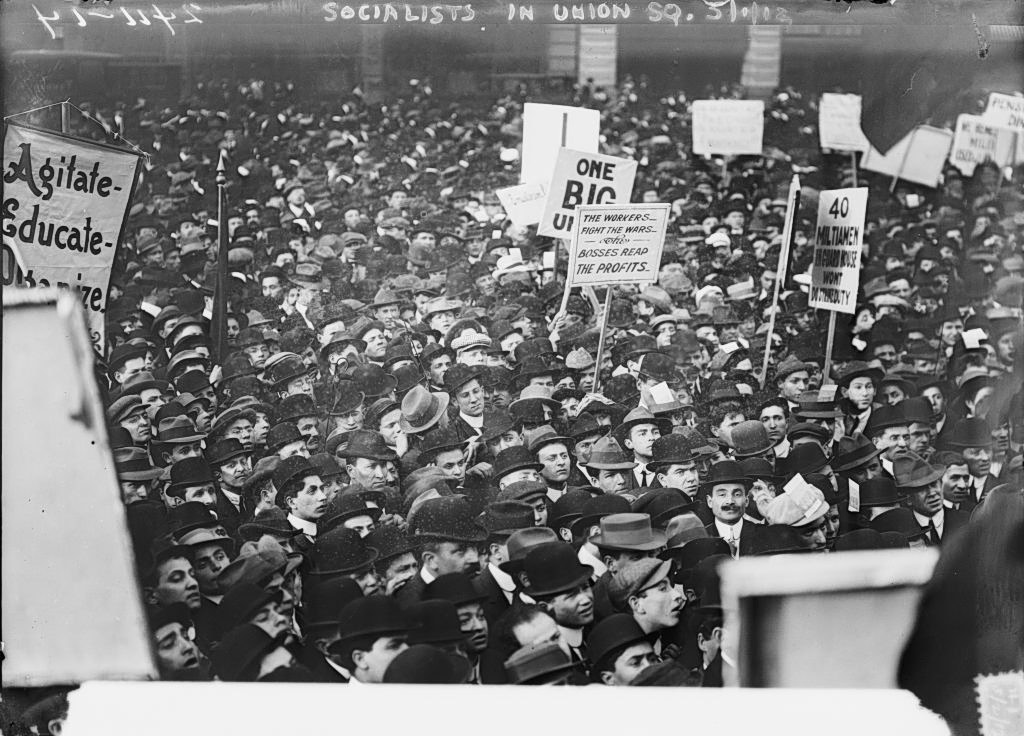
The crowning moment in the global history of the labor movement remains May Day 1886, when 400,000 workers mobilized across major American cities. In Chicago alone, 90,000 protesters, along with 10,000 Bohemians, Germans, and Poles marching separately, demonstrated in Union Square, calling for the establishment of the eight-hour workday.
The bloody events at Haymarket Square in Chicago two days later, and in Milwaukee the day after that, directed against strikebreakers, leaving many injured and one dead, made a strong impression on European labor movement leaders and socialist party figures.
In 1889, three years after the Congress of the Second International met in Paris, May Day was officially established across Europe as a day of international demonstrations in support of workers’ demands.