On September 21, 1933, the trial of those arrested over the burning of the Reichstag, the German parliament building, began in Leipzig. The building had gone up in flames on the night of February 27 that year.
Adolf Hitler had been in power since January 1933, when German President Paul von Hindenburg, under pressure from conservative German politicians, appointed him chancellor.
Hitler had made his antidemocratic intentions clear from the outset. Although he still maintained a semblance of constitutional propriety, it was evident that Germany was sinking ever deeper into Nazi authoritarianism and violence.
Eleftheron Vima reported on February 28, 1933:
Shortly before 9 p.m., a fire broke out in the Reichstag building and rapidly assumed such proportions that the flames were visible from every part of Berlin.
All available fire engines were immediately dispatched to the scene, and efforts to contain the blaze began at once. After an hour, the flames began to subside and thick clouds of smoke rose from the building. The fire was eventually brought under control.
All the evidence indicates arson. The fire first broke out in the chamber where the parliamentary committees met. […]

Targeting the Communists
On March 1, 1933, Eleftheron Vima published information from Berlin that revealed the Nazi government’s intentions:
The investigations into the fire at the Reichstag building clearly indicate that it was one of the largest Bolshevik attempts against public order.
A police search of the Communist headquarters in Berlin, known as the Karl Liebknecht House, and the documents discovered there demonstrate that detailed instructions existed for carrying out Communist terrorist acts following the Russian model. […]
During the unrest and clashes that would be provoked with the police, the wives and children of police officers were preferably to be placed in the front line.
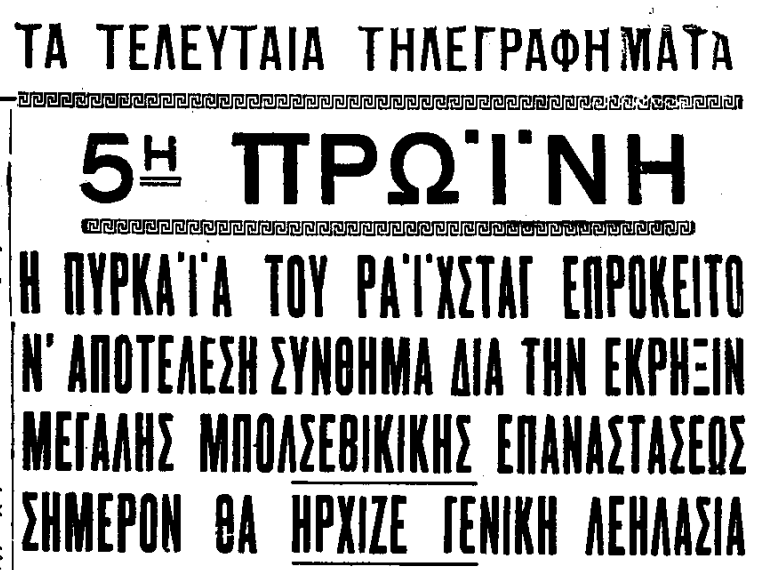
Eleftheron Vima, March 1, 1933, Historical Archive of To Vima and Ta Nea
The Political Context
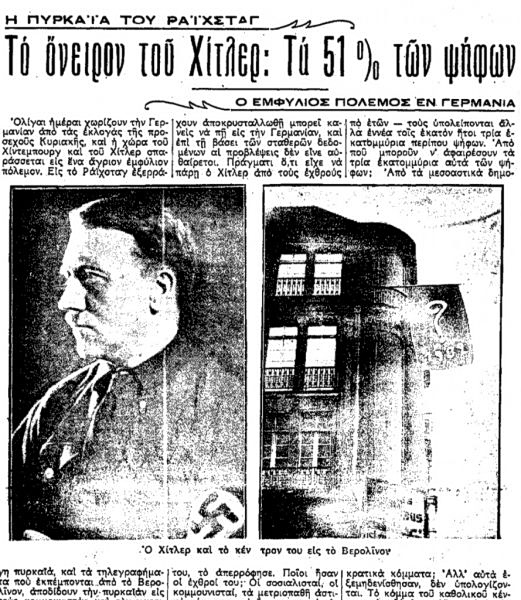
With Hitler in power, parliament had suspended its proceedings and elections had been called for March 5. The Nazi Party had already engaged in coordinated acts of violence and intimidation.
As Ta Nea reported on January 20, 1963:
On the evening of February 27 [1933] came the event that shook the entire world: the Reichstag fire. Even before any investigation had taken place, the radio announced: “The Communists set fire to the Reichstag.” That same night, 4,500 people were arrested, most of them Communist Party officials, along with many officials from other parties. Another 7,000 arrests followed the next day. The prisons could no longer hold them. It was then that Göring established the notorious concentration camps.
A Nazi False Flag?
Even at the time, many argued that the fire was a provocation staged by the Nazi government.
Athinaika Nea wrote on March 1, 1933:
Only a few days separate Germany from next Sunday’s elections, and the country of Hindenburg and Hitler is convulsed by a savage civil war.
A fire broke out in the Reichstag, and dispatches from Berlin attribute it to the Communists, describing it as the signal for a Communist attempt to seize power through revolution and as the signal for civil war.
The dispatches are clearly speaking Hitler’s language. Even if the fire were the work of a “Communist hand,” it could not be described as the signal for civil war, but as a consequence of the civil war, whose signal was something else: Hitler’s rise to power.
The intentions of the National Socialists were well known. Hitler, who until recently never tired of proclaiming his respect for the law in order to reach power more safely, has now achieved his objective. He has forgotten his transformation from a street demagogue into a law-abiding politician. While asking for the German people’s vote, he repeatedly warns that even if his coalition fails to secure a majority in the elections, he has no intention of surrendering power to his opponents.
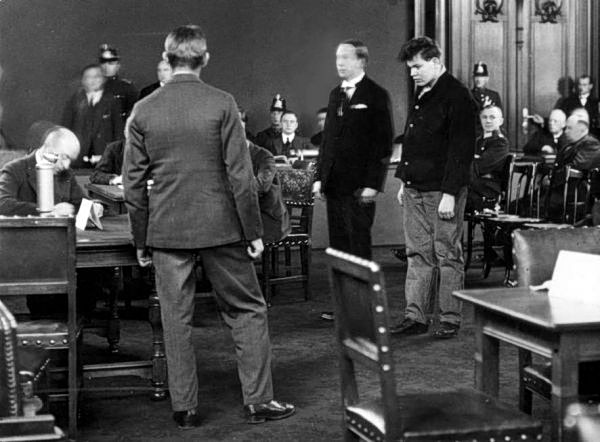
The defendant Marinus van der Lubbe. Source: dirkdeklein.net
The Scapegoat
A convincing provocation naturally requires the right scapegoats. Dutch communist Marinus van der Lubbe was arrested at the scene of the fire.
The trial began in Leipzig on September 21, 1933, and van der Lubbe was not the only defendant. Ernst Torgler, the parliamentary leader of the Communist Party of Germany, was charged with participating in the arson and with treason. Three Bulgarian communists, Vasil Tanev, Blagoy Popov and Georgi Dimitrov, who later became leader of the Communist International and of Bulgaria, were accused of instigating, preparing and organizing the operation.
The International “Trial” in London
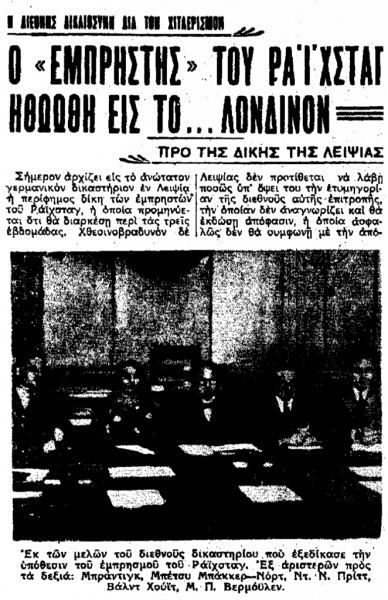
Suspicions of a Nazi provocation were so strong that an international commission of prominent legal experts was established to investigate what had actually happened.
Its members included “D. N. Pritt, a renowned London lawyer who chaired the commission’s sessions; the American Arthur Garfield Hays; the well-known Parisian lawyer Moro-Giafferi; Dr. Branting, son of the late Swedish prime minister; Dutch legal scholar Dr. Betsy Bakker-Nort; former Italian prime minister Francesco Nitti; Hans Huber, one of Switzerland’s most distinguished criminal lawyers, a member of the Permanent Court of Arbitration in The Hague and the author of the draft Swiss penal code; and two legal scholars from Belgium and the Netherlands, Dr. Vermeylen and Dr. Wald Huyt.”
The Work of an “Agent Provocateur”
According to Athinaika Nea on September 21, 1933, the commission was formed because:
Suspicion had arisen internationally that the February crime was nothing more than the work of an “agent provocateur,” intended to assist Hitlerism in its persecution of the Communists, and that the Leipzig trial would be nothing more than a staged production designed to conceal the true arsonists of the German Reichstag.
The international commission in London issued its decision on the day the Leipzig trial began.
The decision begins with a severe indictment of those who initiated and organized the Leipzig trial, before reaching the following conclusions:
- Van der Lubbe cannot be regarded as a communist, but as a counterintelligence agent serving the enemies of the Communist Party.
- Torgler, Popov, Dimitrov and Tanev are completely innocent.
- Van der Lubbe acted with accomplices, and the fire was started through an underground passage connecting the Reichstag with the residence of its president.
- There is credible evidence supporting the view that the guilty parties were among the leading figures of the National Socialist movement.
Finally, the international commission declares that it is prepared to reconvene during or after the conclusion of the Leipzig trial.
The Main Defendant
French lawyer Moro-Giafferi, a member of the commission, discussed the defendant and the possibility that he had acted entirely on his own:
I am convinced that the travels, experiences, and romantic and sexual adventures of the deviant van der Lubbe brought him into contact with several people of the same low caliber who abounded within Hitler’s party. Assuming that the Hitlerites needed someone excitable and pathologically ambitious, someone determined to attract attention to himself by any means, they could not have found anyone more suitable than van der Lubbe.
Shortly before returning to Germany, on February 13, 1933, as he was leaving the house where he lived in Leiden, the Netherlands, he stated that he had been entrusted with an important mission. Significantly, he said he would not need a passport for that journey.
Van der Lubbe was ultimately found guilty under pressure from the Nazi regime and executed.
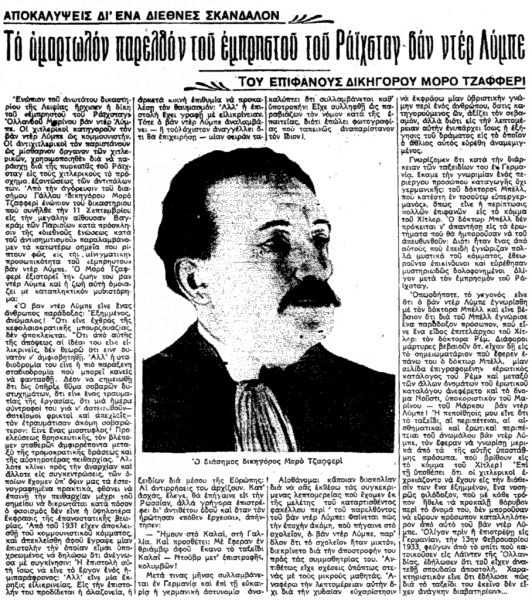
Athinaika Nea 23.9.1933 Historical Archive “To BHMA” & “Ta Nea”
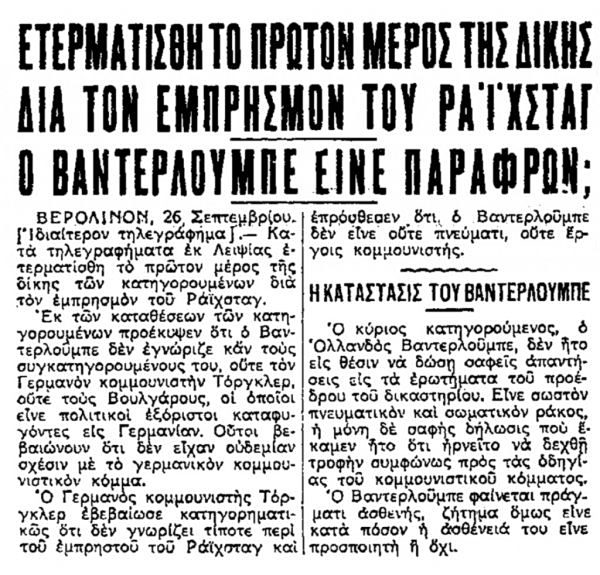
Athinaika Nea 26.9.1933 Historical Archive “To BHMA” & “Ta Nea”
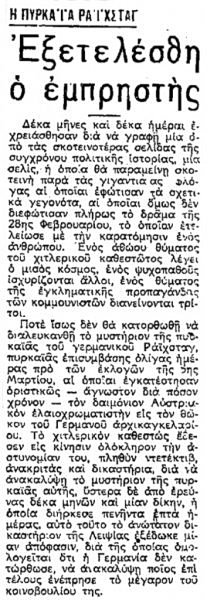
Athinaika Nea 11.1.1934
The Verdict
Athinaika Nea described the verdict as:
One of the darkest pages in modern political history, a page that will remain dark despite the enormous flames that illuminated the events surrounding it, but failed to shed full light on the drama of February 28, which ended with the beheading of a man. Half the world calls him an innocent victim of the Hitler regime; others claim he was mentally disturbed; still others maintain that he was a victim of criminal Communist propaganda.
The mystery of the German Reichstag fire may never be solved. It occurred only days before the March 5 elections, which definitively installed, for an unknown length of time, the diabolical Austrian house painter in the seat of the German chancellor.
To this day, no clear answers have been provided. Most historical evidence nevertheless confirms that van der Lubbe did set fire to the Reichstag, although there is no evidence whatsoever to substantiate the Nazi allegations of an organized Communist attack.
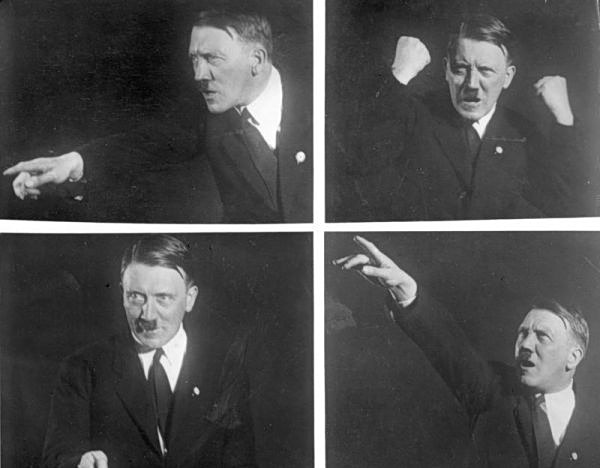
The very next day, invoking the Communist threat, Adolf Hitler sought and secured the suspension of key provisions of the German Constitution and, as noted above, imprisoned thousands of people.
Germany and humanity had taken their first steps toward catastrophe.