 Μake us preferred on Google
Europe has rediscovered the price of its own security, and it is paying. In 2025, defense spending across the European Union reached €418 billion, a 20% increase in a single year. The European Defence Agency (EDA) expects it to climb to €454 billion in 2026. Whether Europe is willing to spend on its defense is no longer in question.
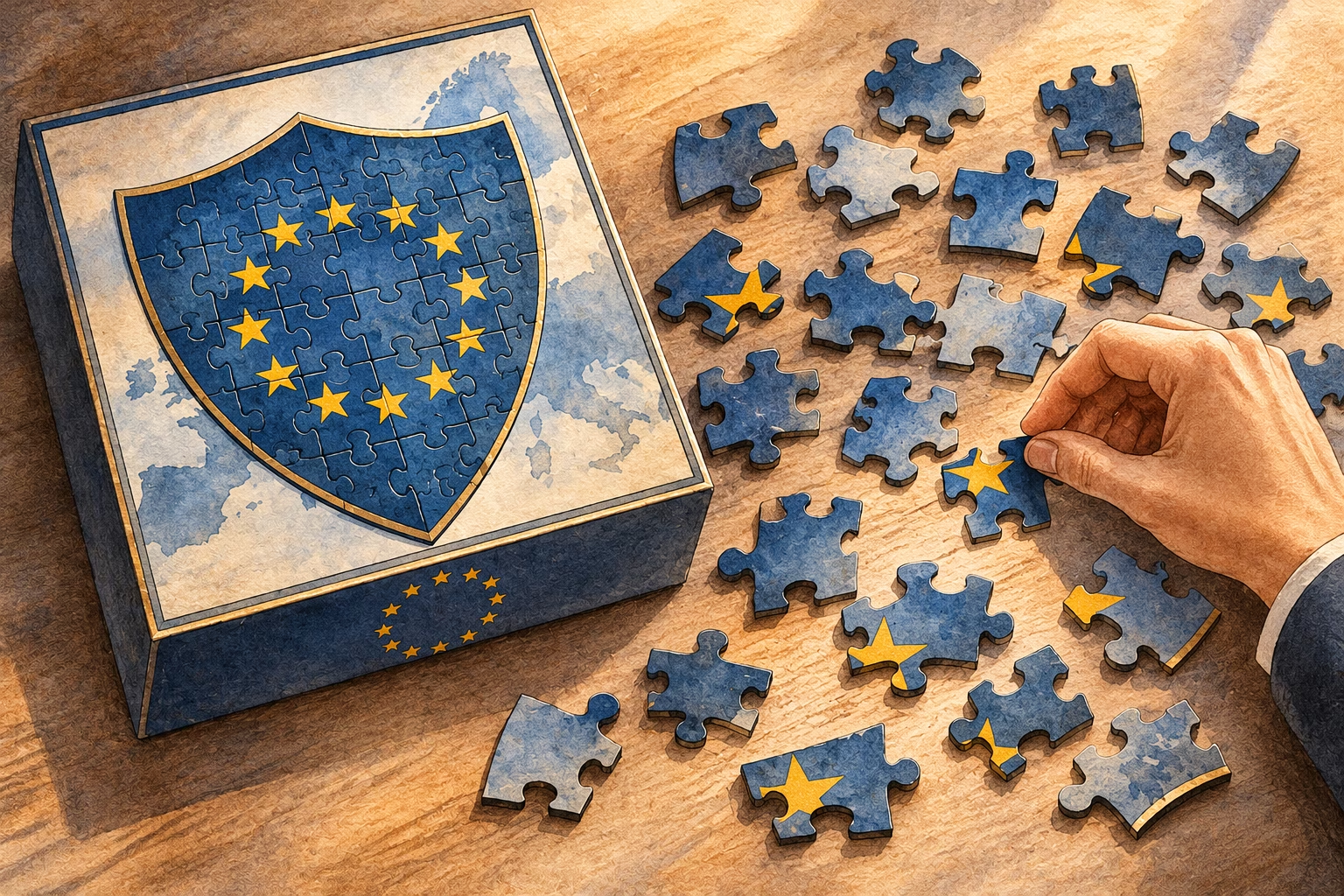
The harder question is what that money buys. Today, much of it is still spent nationally: each capital plans, buys and maintains its own systems. Twenty-seven armies, twenty-seven shopping lists.
The Cost of Fragmented Defense
Of the €115 billion that member states spent on defense equipment in 2025, only 24% went to collaborative procurement, according to the EDA’s Defence Data 2025-2026. This falls short of the EDA’s 35% collective benchmark and the more ambitious 40% target for 2030 set out in the European Defence Industrial Strategy. Roughly three-quarters of equipment spending still takes place nationally.
Fragmentation carries three costs. First, it raises prices: smaller national orders limit economies of scale and make it harder for European manufacturers to invest in production capacity. Second, it complicates military cooperation. Different systems require separate training, maintenance, spare parts and supply chains, making it harder for European forces to operate together. Third, it creates strategic dependencies.
When governments need capabilities quickly that European industry cannot yet supply at scale, they turn to external suppliers. According to SIPRI’s 2026 assessment of international arms transfers, the United States accounted for 58% of major arms imports by European NATO members between 2021 and 2025. Buying from allies is not inherently undesirable, but such dependence raises questions about Europe’s freedom of action in a crisis.
Why Europe still buys in pieces?
National procurement decisions are not irrational. Governments have legitimate reasons to protect domestic defense industries and jobs, retain control over decisions involving national security, and respond quickly to specific military requirements. The priorities of a Baltic state may differ considerably from those of a Mediterranean country. A common procurement model cannot simply erase these differences.
The legal framework also reflects the importance of national security. Article 346 of the Treaty on the Functioning of the European Union allows member states to take measures they consider necessary to protect essential security interests connected with the production of or trade in arms, ammunition and war material. However, it is not a blanket exemption from EU rules. The Court of Justice has consistently treated such derogations as exceptional, requiring member states to justify their use. The risk is that a provision designed to protect genuine security interests becomes a convenient justification for national preference.
Nor is joint procurement automatically more efficient. Multinational programs can generate delays, cost overruns and complicated decision-making when participating states have different requirements and industrial priorities. Cooperation without clear governance can reproduce fragmentation at a higher level. The lesson is not that Europe should always buy together, but that joint programs need agreed requirements, realistic timelines and fewer national variations.
Strategic autonomy cannot be bought with money alone
Strategic autonomy does not mean that Europe must produce everything itself or distance itself from its allies. It means having credible options, reducing critical dependencies and retaining the capacity to act when circumstances demand it. That requires more than increased budgets. It requires political agreement on common priorities and a willingness to make commitments beyond immediate national interests.
The EU’s Security Action for Europe (SAFE) regulation, adopted in May 2025, provides up to €150 billion in loans to support defense investment, with joint procurement at its core. Its implementation will be an important test. Greece, for example, received an allocation of €787.7 million and its first payment of €118.2 million in July 2026, according to the European Commission.
SAFE should not be judged simply by how much money is disbursed. The more important questions are whether critical capability gaps have been closed, whether genuinely joint programs have emerged, whether interoperability has improved and whether reliance on external suppliers has decreased.
Power Begins Where Fragmentation Ends
Defense will remain a national responsibility, and not every purchase needs to be made jointly. Cooperation, however, can no longer be a wish repeated in European communiqués. It must become the rule, with national solutions as exceptions that have to be justified. Three steps would make that real.
First, European funding instruments should create clear incentives for joint procurement by two or more member states, while allowing justified exceptions where operational urgency or specific national requirements make them necessary.
Second, progress should be assessed publicly every year through measurable capability indicators, including joint programs launched, capability gaps addressed, interoperability gains and critical dependencies reduced.
Third, member states invoking Article 346 should provide specific, evidence-based justifications, subject to scrutiny under EU law. Protecting essential security interests is legitimate; using national security as a blanket justification for protectionism is not. [Commission v Italy, Case C-337/05.]
Europe has shown that it can find the money for its security. The next step is harder, and deeply political: to show that it can spend it together. Whether 27 national efforts become one credible European force depends on it. A continent that buys its security in pieces will, in the end, defend itself in pieces.
Pinelopi Gkampeta is an ODETH Executive Board Member, PhD(c) in EU External Relations Law, School of Law, NKUA